


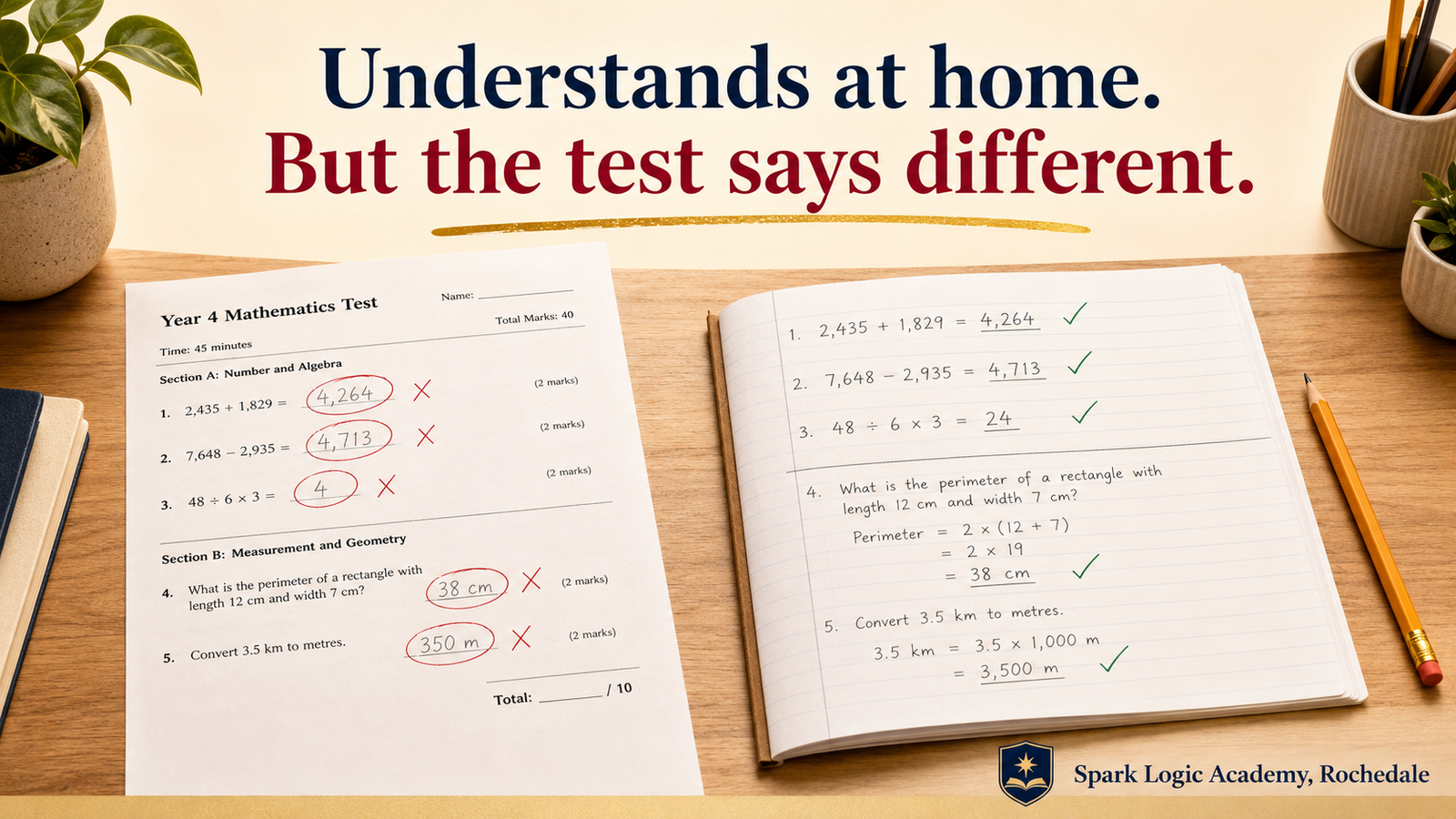
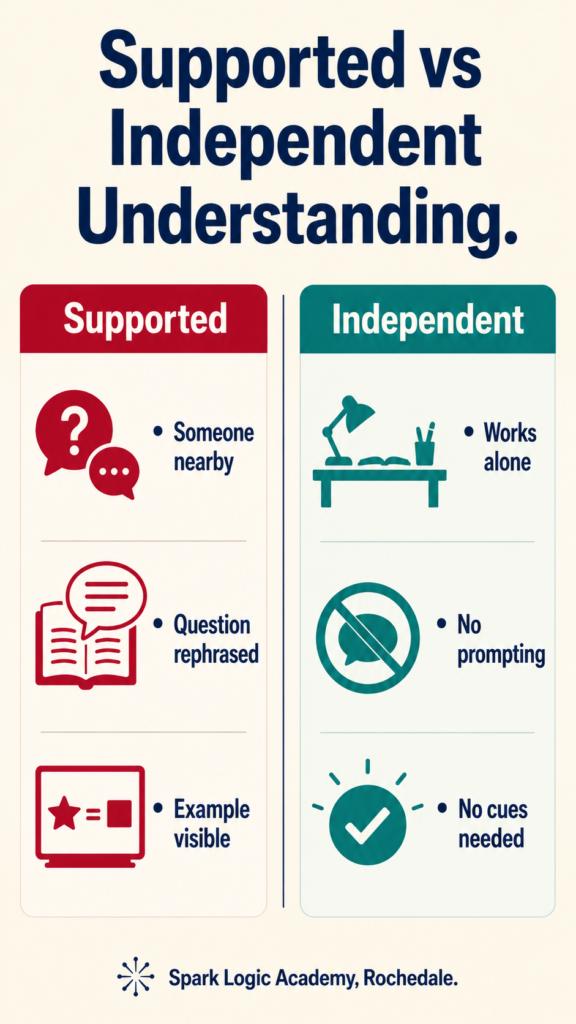
A few patterns that suggest a child may be working with supported understanding:
If a child consistently asks for questions to be explained differently before they can attempt them, they may be relying on the rephrasing as a cue to trigger their response. On a test, that rephrasing is not available.
Checking a worked example before starting is a form of cued retrieval. The example provides a model that the child follows. Without it, they may not be able to generate the approach independently.
If a child works well while a parent or tutor is present but struggles the moment that person leaves, the presence itself is functioning as a support. This is a clear signal that the understanding is not fully independent.
Explaining a concept uses memory and language. Applying it to an unfamiliar variation requires genuine understanding and flexible retrieval. If a child can recite the steps but not adapt them, the understanding may be surface rather than deep.
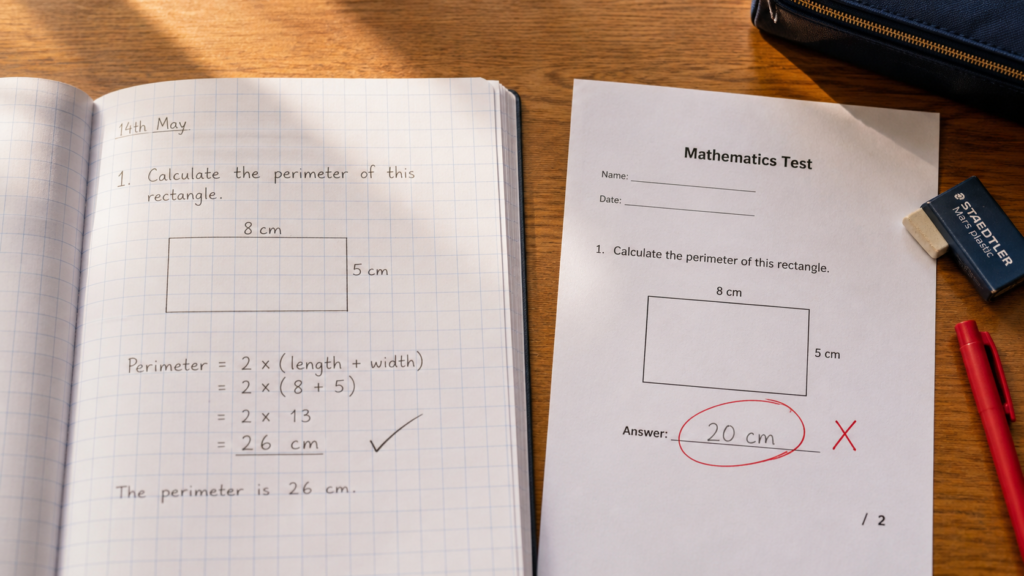
The most revealing thing a parent can do at home is remove the supports one by one and observe what changes. What happens if you leave the room while they work? What happens if they cannot look at the example before starting? What happens if you do not rephrase the question? The results of those tests will tell you more than any homework result about where independent understanding actually sits.
Reviewing notes or re-reading worked examples does not build retrieval. Retrieval is built by closing the book and trying to recall or solve without any cues. Spacing that practice out over days rather than concentrating it the night before a test builds much stronger and more durable independent recall.
The most important question is not what your child can do with help, but what they can do without any help at all. That level may be different from what home practice suggests. Finding it precisely is the starting point for genuine progress.
When parents describe this pattern at Spark Logic Academy, the free 30-minute one-on-one trial assessment is designed to identify where independent understanding actually sits.
The session does not offer prompts or rephrasing. It does not allow the child to check examples. It starts from where the child can work completely without support and identifies whether that level is where it should be for their age and stage. In many cases, the gap between what home practice suggests and what the session finds is the exact explanation for the test result the parent could not understand.
This is different from the kind of information that homework results provide. Homework measures supported performance. The trial finds independent performance. That distinction matters because building on the wrong level, even with effort and time, does not close the right gap.
You can also read related guides at Spark Logic Academy: why a child understands in a session but forgets at home, what to do when the teacher says your child is fine but something feels off, and whether homework resistance is normal or a warning sign.
30 minutes. One-on-one. Find where independent understanding actually sits. Every new student. Ages 3 to 12. Small groups. Qualified teachers. Rochedale, Brisbane.
WhatsApp: 0494 719 869
Tel: 0417 226 366 | info@sparklogicacademy.com.au
11 Lorisch Way, Rochedale QLD 4123
My child got full marks on the homework but failed the test. How is that possible?
Homework is typically done in an environment where support is available, reference materials are nearby, and the child can take their time. Tests remove all of those conditions. If a child’s understanding has only ever been built with those supports present, the test will reveal the gap. The homework result reflects supported performance. The test result reflects independent performance. Both are accurate, but they are measuring different things.
Is this the same as test anxiety?
Sometimes, but not always. Test anxiety is a genuine response to the pressure of being assessed and can affect performance even when independent understanding is solid. The pattern described in this guide is different: the child does not have the independent understanding in the first place, so the test pressure is not the cause of the gap, it is simply the moment the gap becomes visible. A one-on-one trial session in a low-pressure setting is a useful way to distinguish between the two.
How long does it take to build independent understanding?
It depends on how large the gap is and how far back the foundation needs to go. In some cases, a few weeks of targeted work at the right level produces clear results. In others, particularly where the gap has been present for a long time and spans multiple concepts, the process takes longer. The most important first step is identifying where independent understanding actually sits, so that the work starts in the right place rather than at the assumed level.
What if my child works independently at home and still performs poorly on tests?
If a child is genuinely working without any support at home and still underperforming on tests, the issue is likely to be in the foundation itself rather than in the type of practice. There may be a gap in a foundational concept that is making later content harder to retain. A one-on-one assessment is the most efficient way to identify where that gap sits and what it involves.








Your information will never be shared with any third party