

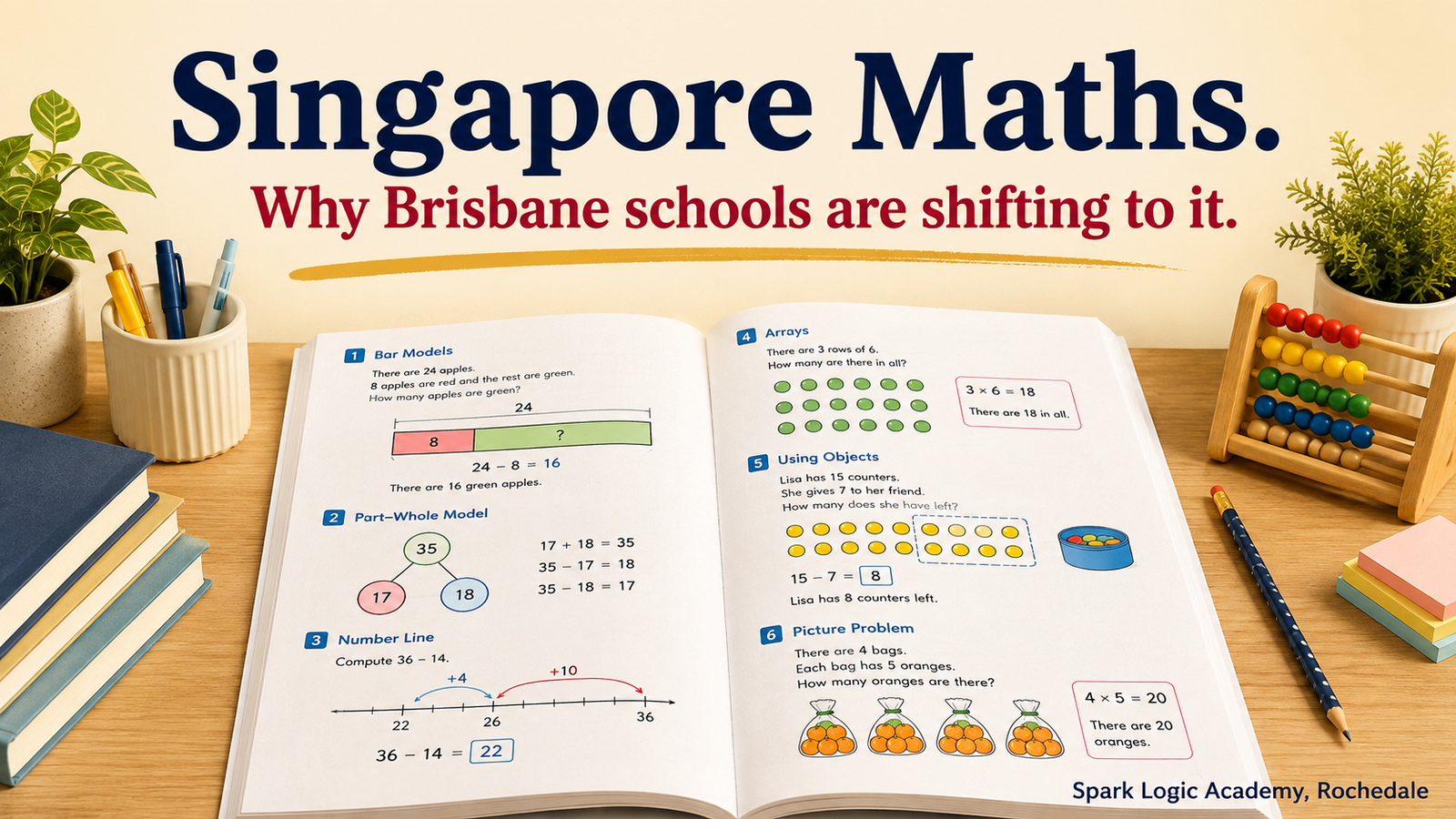
Your child sits down to do their maths homework and pulls out a method you do not recognise. Bar models. Number bonds. Arrays made from dots. It looks nothing like the column method or the times tables drills you remember from school.
This is Singapore Maths. And the reason it looks different is not because schools have decided to make things more complicated. It is because it is built on a fundamentally different principle about how mathematical understanding actually develops.
Brisbane schools are increasingly adopting Singapore Maths approaches, and parents deserve to understand what it is and why the shift is happening.
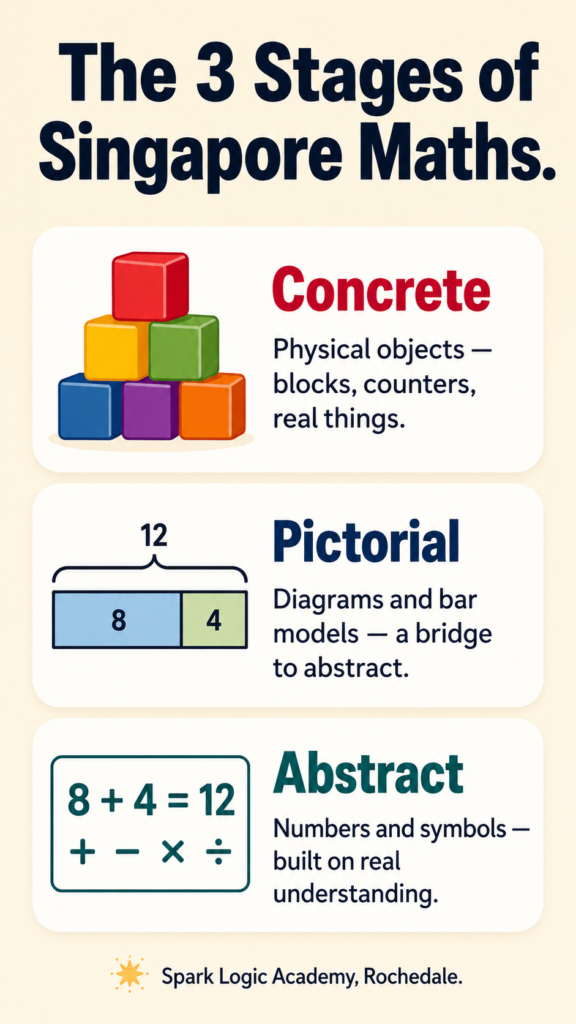
Singapore Maths is a teaching approach developed in Singapore in the 1980s that consistently produces some of the highest maths achievement results in the world. The approach is built on a three-stage model called Concrete-Pictorial-Abstract, or CPA.
Before a student sees any numbers, they work with physical objects. Blocks, counters, fraction tiles, real things they can hold and move. A student learning to add is not shown the equation 3 + 4 = 7 first. They are given three blocks and four blocks and asked to combine them and count. The understanding is built through direct physical experience before any symbolic representation is introduced.
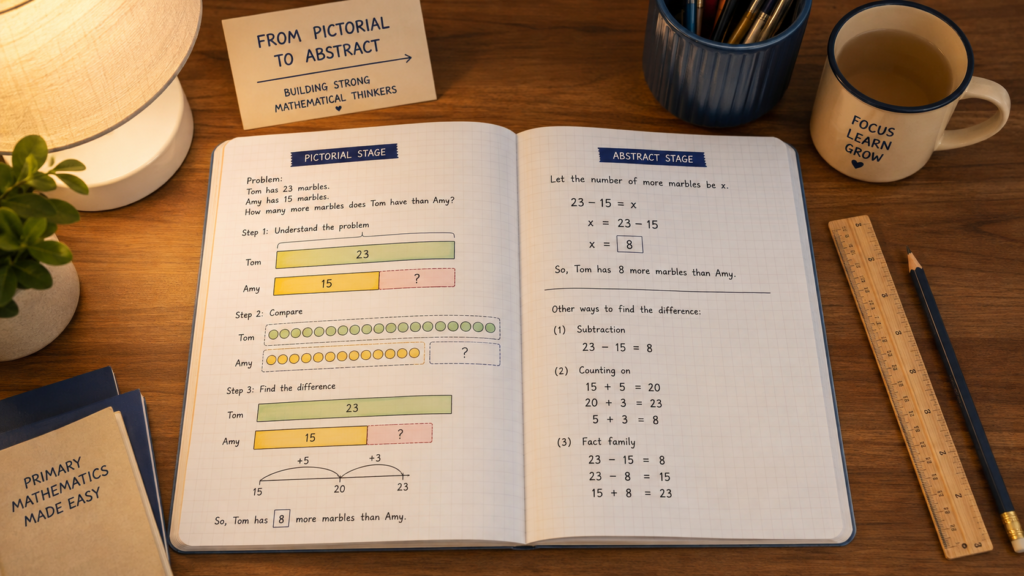
Once the student has a solid physical understanding, the objects are replaced with diagrams and pictures. Bar models, number lines, arrays. The student is now working with a representation of the concrete experience rather than the thing itself. This is the bridge between physical understanding and abstract thinking.
Only once the pictorial stage is solid does the student move to abstract numbers and symbols. The equation 3 + 4 = 7 now has meaning because the student has physically built that understanding through the two earlier stages. The symbol is now a shorthand for something they genuinely understand, not a rule they have memorised.
The critical feature of the CPA approach is that no stage is skipped and no stage advances until the previous one is genuinely solid. Mastery before movement is the core discipline of Singapore Maths.
Australian maths education has traditionally placed significant emphasis on procedural fluency — learning the steps of a method and applying them reliably. This produces students who can complete familiar question types efficiently. It produces students who struggle when the question appears in an unfamiliar format.
NAPLAN maths assessments, and increasingly the Queensland curriculum, include questions designed to test conceptual understanding rather than procedural recall. A student who has memorised the long division algorithm can complete a standard long division question. That same student may not be able to apply the underlying concept to a word problem where the question is not presented in the familiar format.
Singapore Maths builds conceptual understanding from the beginning. A student who understands why multiplication works as repeated addition, or why fractions require a common denominator, can transfer that understanding to a problem they have never seen before. A student who has only memorised the procedure cannot.
The shift Brisbane schools are making is a response to this gap. The research on Singapore Maths and related mastery-based approaches consistently shows stronger long-term outcomes, particularly for students who go on to secondary maths where conceptual understanding becomes essential.
If your child is coming home with maths that looks unfamiliar, the most important thing to understand is that the unfamiliarity is intentional. The method your child is learning is designed to build genuine mathematical understanding, not just the ability to complete familiar question types.
If your child is struggling with Singapore Maths, the most important question is not whether they have practised enough. It is whether the current stage of learning is solid. A child who is shaky on the pictorial stage cannot benefit from moving to abstract numbers, regardless of how much they practise at the abstract level. The gap is earlier.
At Spark Logic Academy in Rochedale, the CPA approach underpins how we teach every maths student from ages 3 to 12. Every student begins with an assessment that identifies their actual independent working level, not just their year-level placement. This tells us which stage — concrete, pictorial, or abstract — needs attention before anything else.
We work in small groups of up to 8 students with qualified teachers. The small group size allows the teacher to observe how each student is actually working through a problem, not just whether the final answer is correct. This is essential for identifying where the CPA stage has not been consolidated.
For parents who want to understand more about how their child is learning, the free 30-minute one-on-one trial at Spark Logic Academy is an assessment session, not a sales pitch. It shows the parent exactly where their child is working independently and what the next step looks like.
For related reading: why your child can work hard every night without results improving, why a child understands at home but not in a test, and why a child can do maths with help but not alone.
30 minutes. One-on-one. Find your child’s actual working level and what they need next. Every new student. Ages 3 to 12. Small groups. Qualified teachers. Rochedale, Brisbane.
WhatsApp: 0494 719 869
Tel: 0417 226 366 | info@sparklogicacademy.com.au
11 Lorisch Way, Rochedale QLD 4123
Is Singapore Maths harder than traditional maths?
Singapore Maths is not harder, but it is different in a way that can feel challenging at first for students who are used to memorising steps. Because it requires genuine understanding at each stage before moving forward, a student who has been skipping understanding and relying on memory may find the early concrete and pictorial stages slower than expected. In the medium term, students who have built understanding through the CPA stages tend to find harder maths more manageable, because they have the conceptual tools to approach unfamiliar problems.My child’s school does not use Singapore Maths. Will tutoring that uses it confuse them?
Not in our experience. The CPA approach builds the underlying understanding that any maths method relies on. A student who develops a solid conceptual understanding of, say, fractions through CPA will be better able to apply any procedural method their school uses, because they understand what the procedure is doing. We align with what the school is teaching at the surface level while building the deeper understanding underneath it.At what age should my child start learning with Singapore Maths principles?
From the beginning of formal maths learning, which in the Queensland curriculum starts in Prep. The concrete stage is particularly important in early learning because young students naturally think in physical terms before they can reliably work with abstract symbols. A student in Prep or Year 1 who builds solid concrete understanding of number sense and basic operations is building the foundation that all later maths depends on. We work with students from age 3 upward at Spark Logic Academy.How quickly will I see results?
This depends on where the gap is. A student who is missing a specific stage of CPA understanding for a topic they are currently studying at school can often show improvement within a few weeks once the gap is identified and addressed. A student who has multiple foundation gaps across different topics will need longer. The free trial assessment is designed to give parents a clear picture of where their child is and what the realistic timeline looks like before committing to ongoing sessions.








Your information will never be shared with any third party