

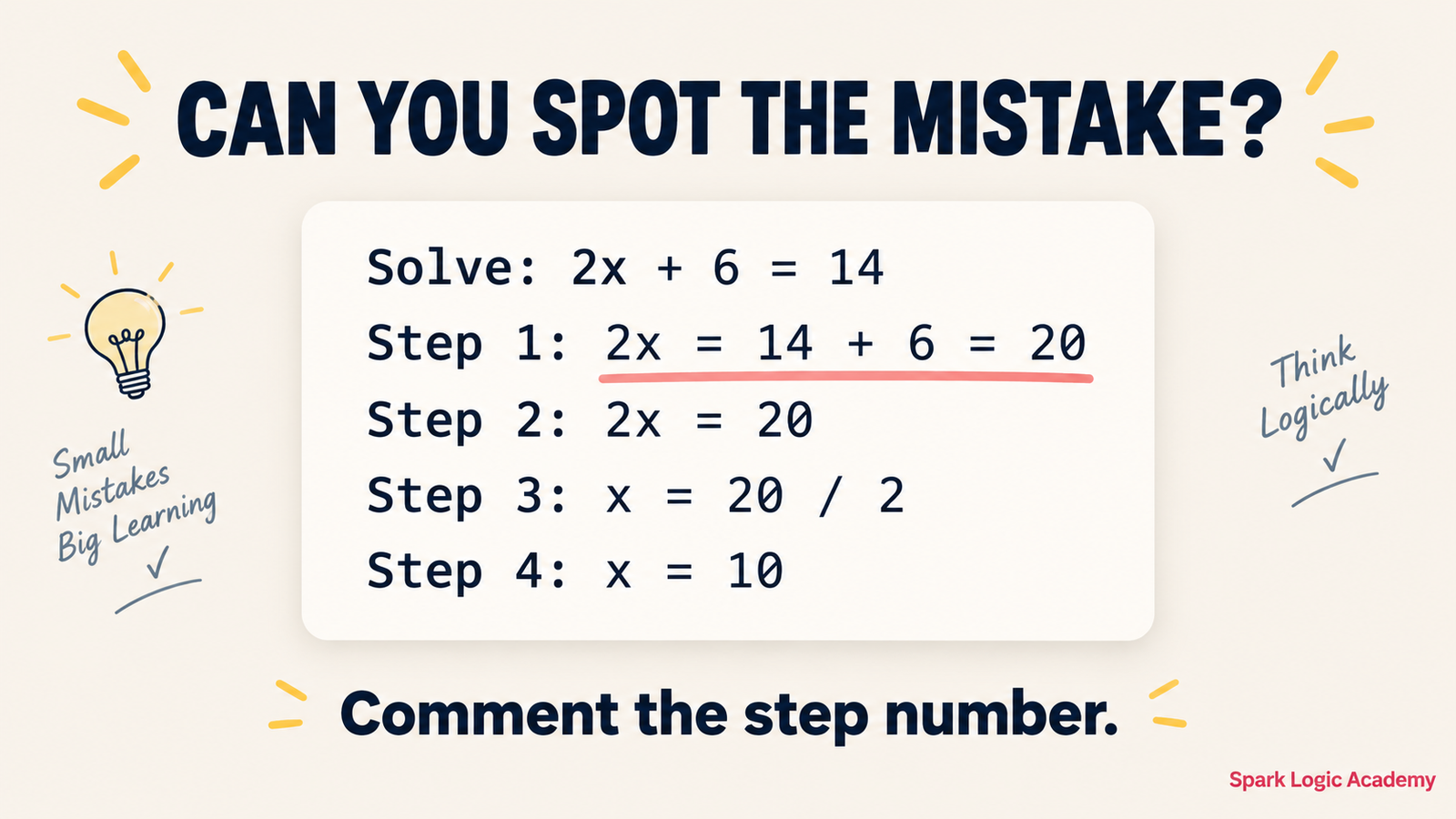
Look at this worked solution. One of the four steps contains a mistake. Can you find it before reading on?
Solve: 2x + 6 = 14
Step 1: 2x = 14 + 6 = 20
Step 2: 2x = 20
Step 3: x = 20 ÷ 2
Step 4: x = 10
Comment the step number you think is wrong. Then keep reading.
The error is in Step 1
When moving a term across the equals sign, the operation reverses. Moving +6 from the left side to the right means it becomes -6.
The correct working:
- 2x = 14 – 6 = 8
- x = 8 ÷ 2
- x = 4
The answer is x = 4, not 10. The student added 6 instead of subtracting it — a sign error.
Why this error is so common
Sign errors are a common algebra mistake for students who are still building confidence with inverse operations. It does not happen because students are careless. It happens because many students learn to “move a term to the other side” as a physical action — without understanding why the sign changes.
The underlying reason: what you are really doing is subtracting 6 from both sides of the equation to keep it balanced. On the left, 6 – 6 cancels to zero. On the right, 14 – 6 = 8.
A student who understands this is much less likely to make the sign error. A student who has only memorised “move it to the other side” may repeat the mistake under pressure without understanding why.
What this tells you about a student’s understanding
If a student looks at that worked solution and immediately catches the error in Step 1, it is a strong indicator that they understand the balance principle behind algebra, not just the procedural steps. That understanding transfers across different types of equations.
If a student looks at it and it all seems correct — or they can identify something feels off but cannot say why — it is a signal that procedural knowledge is running ahead of conceptual understanding. That gap rarely fixes itself. It tends to widen as the curriculum advances.
When is algebra introduced in Queensland schools?
Algebraic thinking develops progressively through primary school, building on number relationships, patterns and inverse operations before students tackle more formal equation work.
A student who understands why 8 + 4 = 12 means 12 – 4 = 8 already has the foundation for understanding why moving a term across an equals sign reverses its sign. The connection is direct. Most students are never explicitly shown it.
How Spark Logic Academy approaches this
At Spark Logic Academy in Rochedale, the free 30-minute trial diagnostic starts with exactly this kind of reasoning check — not testing what a student has memorised, but whether they can explain what they are doing and why.
A student who catches the sign error and explains it clearly shows strong conceptual groundwork. A student who gets the correct answer by instinct but cannot explain why has a gap worth addressing before formal algebra becomes a recurring stressor.
Our programs include Maths and Logic, English Writing and Reading, Phonics, Pre-Prep Bridging, STEM, and Coding & Technology for ages 3 to 12, with small-group classes of up to 8 students.
Book a Free 30-Minute Trial
Find out exactly where your child’s understanding is and what they need next. One-on-one. Every new student.
WhatsApp: +61 494 719 869
Phone: 0417 226 366
Related reading
- Can You Solve This Maths Puzzle? Most Adults Get It Wrong
- The One Conversation to Have With Your Child After a Bad Test Result
Spark Logic Academy | 11 Lorisch Way, Rochedale QLD 4123 | sparklogicacademy.com.au