

Try to solve this before reading further.
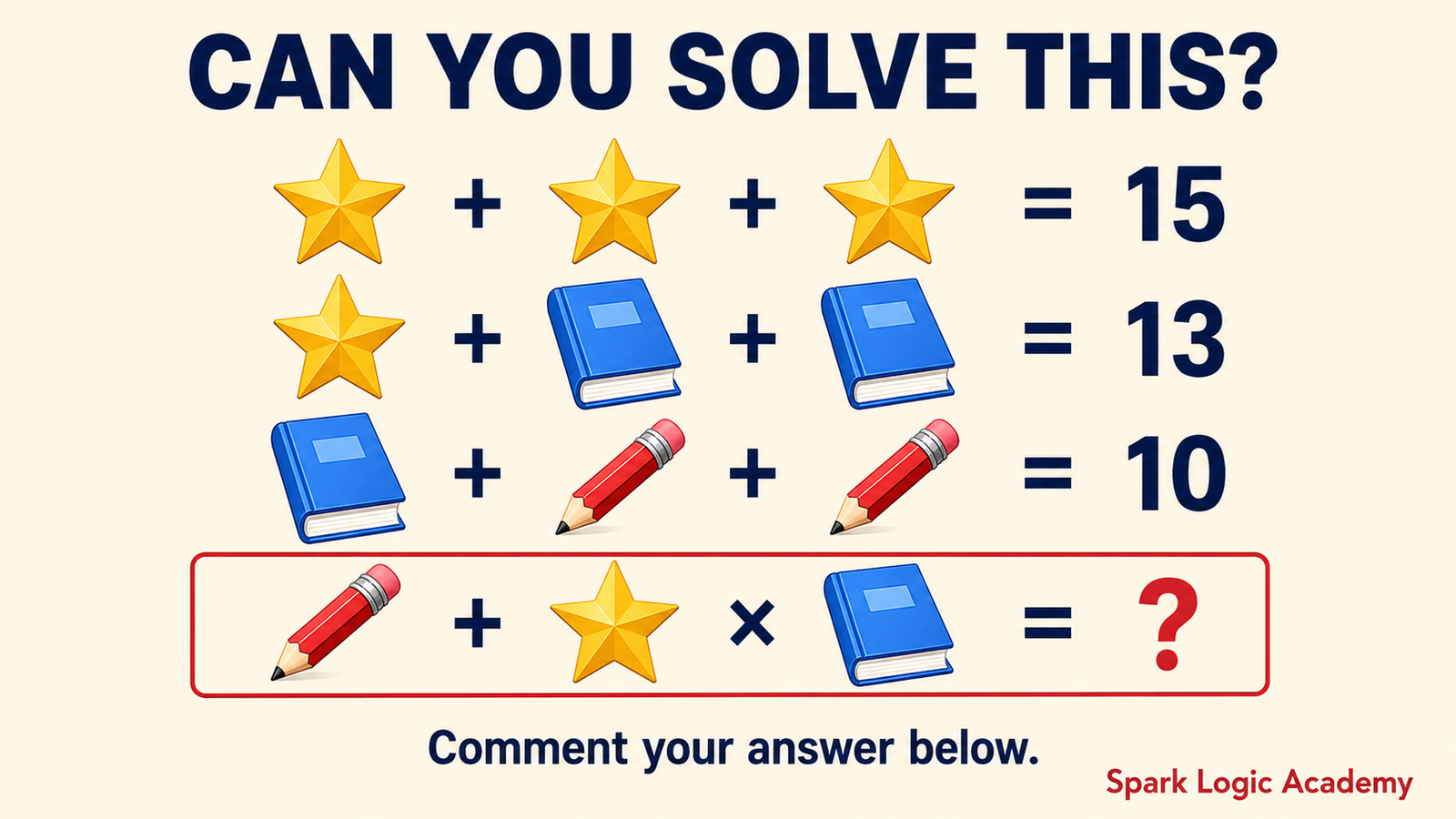
★ + ★ + ★ = 15
★ + 📚 + 📚 = 13
📚 + ✏️ + ✏️ = 10
✏️ + ★ × 📚 = ?
Comment your answer. Then keep reading.
The most common answer is 32. And it makes complete sense if you work through the puzzle left to right:
That reasoning is logical. It is also incorrect.
The final line is ✏️ + ★ × 📚, which means 3 + 5 × 4.
Order of operations — sometimes called BODMAS (Brackets, Orders, Division, Multiplication, Addition, Subtraction) — states that multiplication is always performed before addition, unless brackets indicate otherwise.
So the correct working is:
The answer is 23, not 32.
This type of puzzle goes viral regularly because both answers feel defensible. The person who answers 32 is not guessing — they are applying consistent logic, just not the right convention. That is what makes it such a useful teaching moment.
Students who have only memorised steps (“multiply before add”) without understanding why that rule exists will get this right today but struggle when the same concept appears embedded in a longer problem. Students who genuinely understand order of operations — who can explain it, not just recite it — will apply it reliably across different contexts.
Order of operations is typically introduced in Year 5 (ages 10-11) under the Australian Curriculum. However, the underlying concept — that some operations take priority over others — is built through Years 3 and 4 through work on multiplication, grouping, and number relationships.
A child who has a solid foundation in multiplication and understands why it represents repeated addition will find order of operations intuitive when it is formally introduced. A child who has learned multiplication as a set of facts to recall without understanding will often struggle at this stage — not because the concept is hard, but because the foundation is missing.
At Spark Logic Academy in Rochedale, our free 30-minute trial assessment starts with exactly this kind of reasoning — not testing what a student has memorised, but how they think through a problem they have not seen before.
Puzzles like this are useful diagnostic tools. A student who works through this correctly, explains each step, and catches their own impulse to go left-to-right shows strong conceptual understanding. A student who gets 32 confidently without questioning it shows a gap worth addressing — and addressing it at Year 4 is far easier than catching it at Year 7.
Our qualified teachers work with small groups of up to 8 students across Maths, English, Phonics, Science, Logic, STEM and Coding, and Early Learning for ages 3 to 12. Every session builds understanding, not just answers.
Book a Free 30-Minute Trial
Find out exactly where your child is and what they need next. One-on-one. Every new student.
WhatsApp: +61 494 719 869
Phone: 0417 226 366
Email: info@sparklogicacademy.com.auBook Online
Spark Logic Academy | 11 Lorisch Way, Rochedale QLD 4123 | sparklogicacademy.com.au








Your information will never be shared with any third party