


Ten minutes of setup can change how the whole evening goes.
If your household has homework battles most evenings, the frustration is real — for you and for your child. But the source of the battle is almost never the homework itself.
The transition is the problem
Homework resistance peaks in the first two minutes of sitting down. The battle is about the shift in focus — moving from unstructured, enjoyable activity (screen time, play) into focused, demand-heavy work.
Once a child is at the desk and engaged, the resistance typically drops. The fight is at the door, not inside the room.
This means the solution is not more discipline or more consequences. It is a better transition. And a transition is something you can design.
The 4-step routine
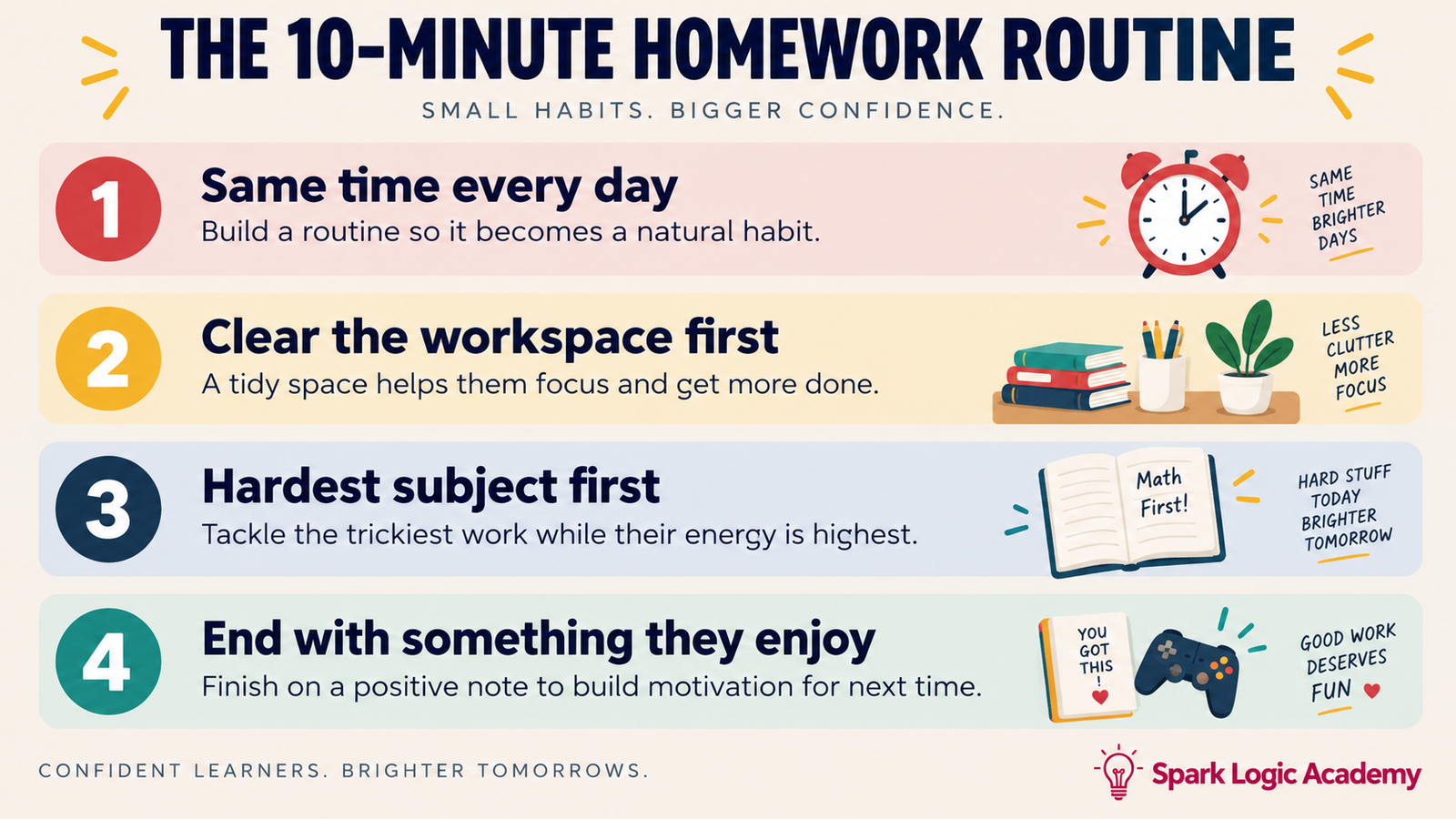
Same time every day
Predictability removes negotiation. When homework happens at the same time daily, the habit anchors to the routine — not to a parent’s reminder. The child stops arguing because the time is simply what it is.
Clear the workspace first
Physical clutter creates cognitive clutter. Give the child 60 seconds to clear and organise the desk before opening any books. It is a small action that signals the mode shift.
Hardest subject first, not last
Focus and willpower are highest at the beginning of a session, not the end. Saving the hard subject for last means tackling it when energy is at its lowest. Reversing the order consistently produces better work and less frustration.
End with five minutes of something they enjoy
How a session ends often shapes how a child feels about starting the next one. A study session that closes on a difficult task or on frustration builds a negative association with the next session. Five minutes of something enjoyable — reading a book they like, a quick puzzle, a creative activity — resets that association.
Why the last step matters most
The ending of an experience is disproportionately influential on how we remember it — and how we approach the next one. A session that ends on misery becomes something to dread. A session that ends on something enjoyable becomes something that is, at minimum, tolerable.
Parents often skip this step because it feels indulgent. It is not. It is the mechanism that makes tomorrow easier.
Try this for one week
The battles do not disappear immediately. The routine takes a few days to anchor. But within a week, most families notice the transition resistance drops significantly. By two weeks, the homework hour often stops being an event and becomes simply part of the day.
If the battles continue after two weeks despite a consistent routine, the issue may not be the environment — it may be that the child is finding the work genuinely difficult. In that case, the routine is still valuable, but support with the content itself becomes the next step.
When to consider additional support
A child who consistently resists homework, takes far longer than expected, or becomes distressed when working independently is often showing signs of a conceptual gap — not a behaviour problem. They are not resistant to work. They are resistant to struggling through something they do not understand without support.
At Spark Logic Academy in Rochedale, a free trial can help us understand how a student approaches the work and what may need more support.
Our programs include Maths and Logic, English Writing and Reading, Phonics, Pre-Prep Bridging, and Coding & Technology for ages 3 to 12, with small-group classes of up to 8 students.
Book a Free 30-Minute Trial
Book a free trial for the relevant program to see how your child approaches learning and where they may need support.
WhatsApp: +61 494 719 869
Phone: 0417 226 366
Related reading
- The One Conversation to Have With Your Child After a Bad Test Result
- Can You Spot the Mistake? The Algebra Error Most Year 6 Students Make
Spark Logic Academy | 11 Lorisch Way, Rochedale QLD 4123 | sparklogicacademy.com.au