



Your child is at that desk every night. Not distracted, not avoiding the work. Genuinely trying. And between one term and the next, between one test and the one that follows, the results do not move.
This is one of the most exhausting patterns parents describe, because there is nothing obvious to fix. The child is already doing the thing everyone says they should be doing. They are putting in the effort. And it is not working.
The reason is almost never motivation. When sustained hard work does not produce results, something else is wrong. Understanding what that something else is changes what needs to happen next.
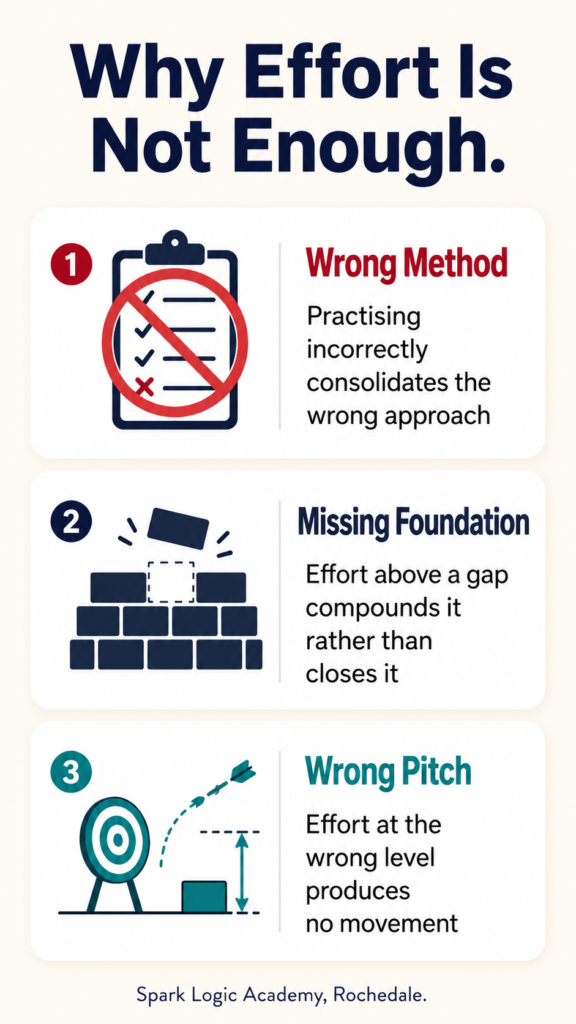
Effort is a necessary ingredient in learning. It is not a sufficient one. A child can work hard for an hour every night and make no progress at all if the effort is going in the wrong direction. There are three main reasons this happens.
When a child practises something incorrectly, they consolidate the incorrect approach. The more hours they put in, the more deeply the wrong method is embedded. This is why a child can study a maths topic for two weeks and produce the same incorrect result on a test that they produced before they started. They have not been practising the correct method. They have been practising their existing one, which does not work.
Identifying that the method is wrong requires someone to observe how the child is actually approaching the problem, not just whether the final answer is right or wrong. A child who gets the right answer occasionally by accident, or who can complete familiar question formats but breaks down on unfamiliar ones, is often using a flawed method that happens to produce correct outputs on a narrow range of question types.
Every skill in primary school maths and English is built on earlier skills. If a foundational skill was not fully consolidated at the stage where it was introduced, every layer of learning built on top of it is structurally unstable. The child may appear to be working at year-level content, but the underlying structure does not support it.
A child working hard on year five fractions who did not properly consolidate year three multiplication will hit a ceiling regardless of effort. The ceiling is not their capacity. It is the gap. Effort above the gap compounds it rather than closing it.

Learning happens at the edge of what a child can currently do independently. If the work is set significantly above that edge, the child cannot process what they are practising. They may produce answers, copy steps, or complete the surface of a task, but genuine learning is not occurring. Effort at the wrong pitch is not productive effort, regardless of how much of it there is.
This is also true when the work is set too low. A child completing tasks well below their actual level is not building anything. Hours of effort at a level that requires no challenge produces no academic growth.
When results do not improve despite effort, the instinctive response is often to suggest the child needs to work even harder. More hours. More practice. More repetition. In the three scenarios described above, this advice makes things worse, not better.
More practice of the wrong method embeds it more deeply. More effort above a foundation gap widens the gap by adding more unstable learning on top of it. More time spent at the wrong pitch is more time not spent where learning can actually happen.
There is also an emotional cost. A child who tries harder and sees no result begins to form conclusions about their own ability. They are not drawing a distinction between the effort and the direction of the effort. They are concluding that they are simply not capable of improvement. This is the point where motivation genuinely does become a secondary problem, caused by the original problem going unaddressed for too long.
If a child can produce as much in ten minutes as they can in an hour, the extra fifty minutes are not producing learning. This is a reliable sign that the effort is not landing productively. The child is going through the motions of working without encountering the kind of challenge that produces genuine consolidation.
A child who studies for a test, correctly identifies the material they need to cover, puts in genuine preparation time, and then produces the same mark as last time has a method or foundation problem, not a motivation problem. If studying was the issue, studying would help. When it does not, something else is causing the ceiling.
A child with a genuine method problem cannot identify which step they made an error on, or why. They know the answer is wrong. They do not know what they did that produced it. This is different from a child who made a careless error and can point to the moment of the mistake. An inability to trace the error back to its source is a reliable indicator that the underlying approach has not been understood.
When parents at Spark Logic Academy describe a child who is putting in effort without seeing results, the free 30-minute one-on-one trial is designed to find where the effort is going wrong.
The trial does not measure how much a child has studied. It assesses what the child can actually do independently, without support, and examines how they are approaching the problems they attempt. This reveals whether the method being used is correct, whether there is a foundation gap underneath the current level of work, and whether the pitch of the current work is appropriate for the child’s actual independent level.
In many cases, a child who has been working hard without results needs a relatively targeted intervention rather than more of the same work. Finding the specific cause of the gap changes what instruction looks like, and changes the ratio between effort and outcome significantly.
For related guides at Spark Logic Academy: why a child can do it with help but not alone, why a child understands at home but the test results say something different, and what it means when homework takes only five minutes every night.
30 minutes. One-on-one. Find where the effort is going and why the results are not following. Every new student. Ages 3 to 12. Small groups. Qualified teachers. Rochedale, Brisbane.
WhatsApp: 0494 719 869
Tel: 0417 226 366 | info@sparklogicacademy.com.au
11 Lorisch Way, Rochedale QLD 4123
How do I know if the problem is method, foundation, or pitch?
The clearest way to distinguish between them is to observe how the child approaches a problem, not just whether they get the right answer. A method problem shows up as a consistent incorrect process even when the child tries carefully. A foundation gap shows up as a child who can manage current-year content on familiar formats but breaks down when the question requires underlying knowledge from an earlier stage. A pitch problem shows up as a child who cannot begin or sustain independent work on the material regardless of how carefully they try. An assessment that includes observation of the working process, not just the outputs, is the most reliable way to identify which is present.My child has had extra tutoring but the results have not changed. What is going wrong?
This is a common situation and it usually means the tutoring has been targeting the same level and method as the school, rather than identifying and addressing the underlying cause of the gap. If the tutoring consists of additional practice at the same year-level content the child is already working on, and that content is sitting above a foundation gap, the tutoring will produce the same result as the school work. The first step is to identify whether the child has a method problem, a foundation gap, or a pitch problem. Tutoring that addresses the correct cause tends to produce visible movement within a few weeks.Is it possible my child genuinely has a learning difficulty and not just a method or foundation problem?
Yes, it is possible. A learning difficulty can produce exactly this pattern: sustained effort without commensurate results, a ceiling that does not respond to more work, and a gap between how hard the child is trying and what they are producing. A formal assessment by a psychologist or learning specialist is the appropriate route to investigate this. However, it is also common for children who have been identified as having learning difficulties to have had a method or foundation gap contributing to the pattern, either alongside the difficulty or as a separate factor. Both can be present at the same time, and addressing the one that is addressable is still worthwhile.My child is starting to give up. How do I talk to them about this without making it worse?
The most helpful framing is to separate the effort from the direction of the effort. The child is not wrong to have tried hard. The work they have put in is real and matters. What is going to change is not the amount of effort, but the target of it. Finding the right level and method is not a criticism of what they have done so far. It is the next step. Children who understand that their effort was not wasted, but that it needs to be aimed more precisely, tend to re-engage more readily than children who are told they simply need to try harder again.








Your information will never be shared with any third party