


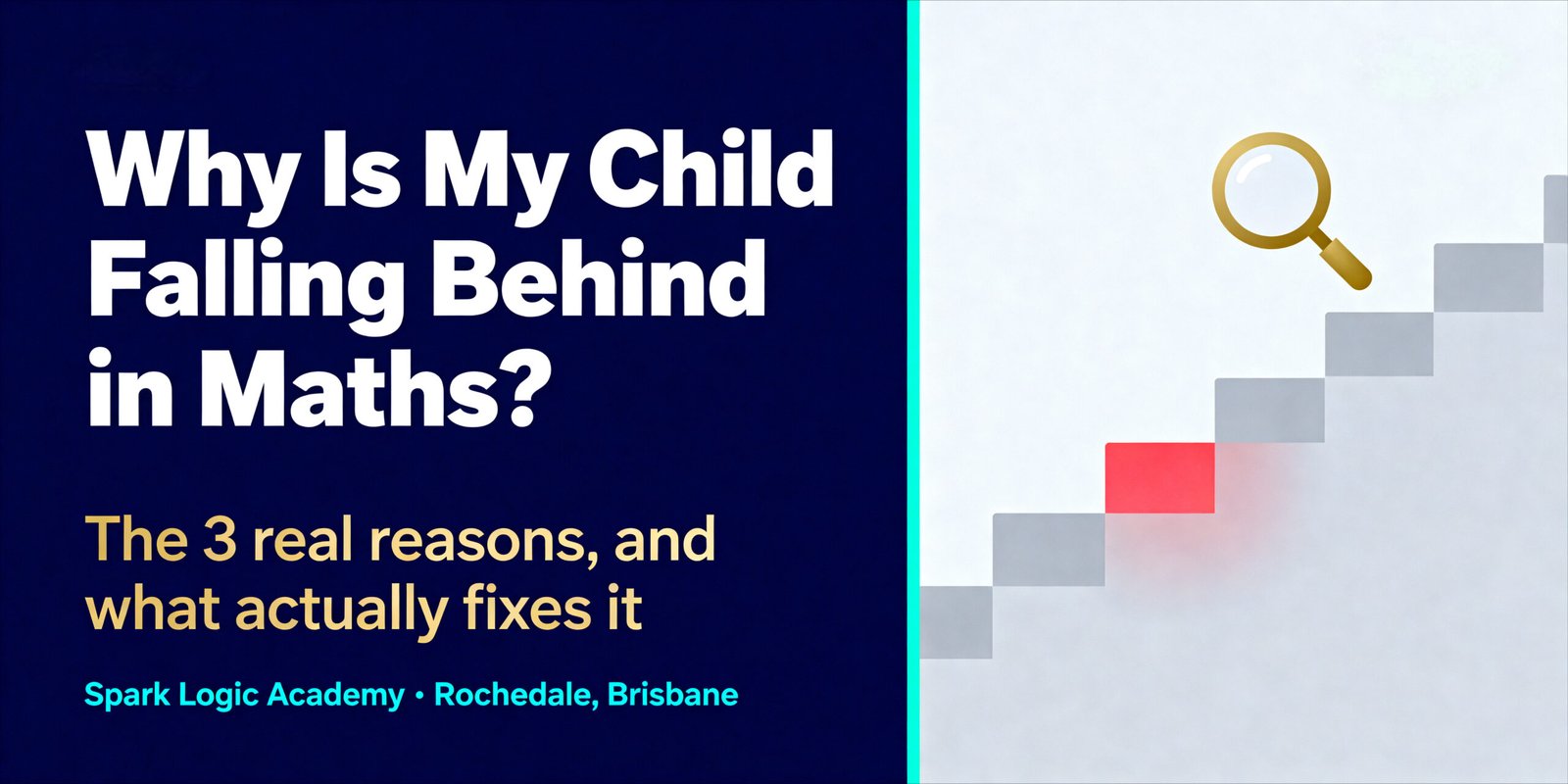
When a child starts struggling in maths, the first thing most parents reach for is an explanation: they are not focusing, they are not trying hard enough, or they are simply not a maths person. These explanations feel intuitive, but in almost every case they are wrong. And when a parent acts on the wrong explanation, the real problem keeps growing.
The truth is that children fall behind in maths for very specific, identifiable reasons. Not vague ones. Not character flaws. Specific gaps in knowledge or confidence that developed at a particular point and were never addressed. Once you understand what those reasons actually are, the path forward becomes much clearer.
At Spark Logic Academy in Rochedale, we work with children aged 3 to 12 in small groups of up to 8 students. We see the same three patterns again and again. Here is what they are and why they matter.
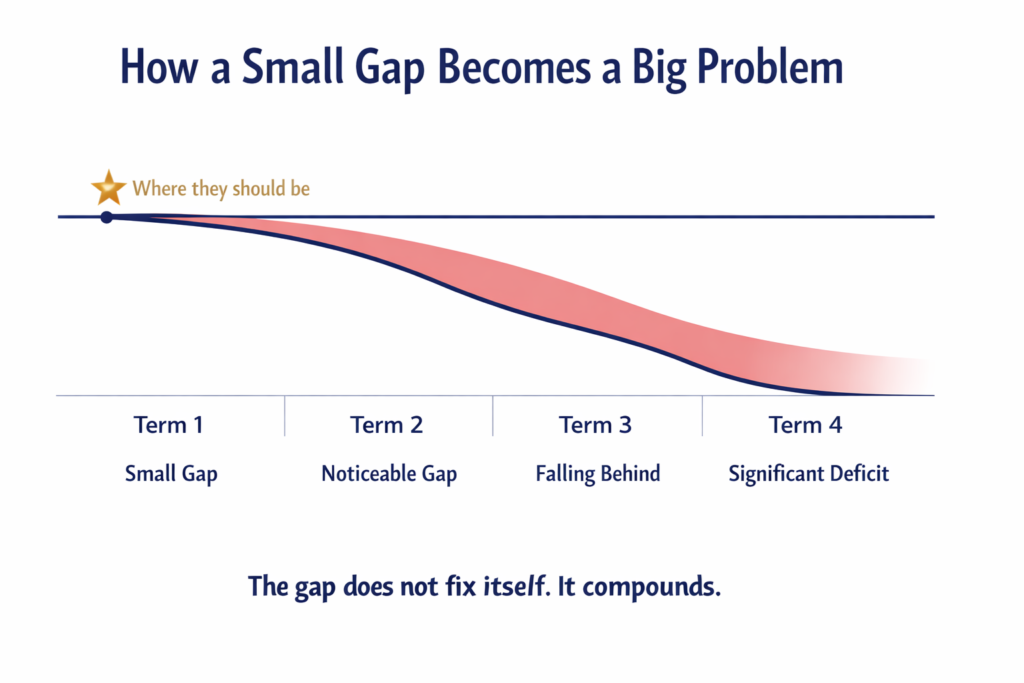
A teacher with 25 or more students cannot pause the curriculum for one child who has not grasped a concept. The lesson moves on. The child nods along, copies what is on the board, and does their best to keep up. But the gap is there. And because maths builds on itself, that gap does not stay contained. It spreads into the next topic, and the next, until the child is sitting in a lesson that assumes knowledge they never properly developed.
This is one of the most common and most overlooked causes. Maths is cumulative in a way that few other subjects are. If a child did not fully grasp place value, fractions, or basic multiplication at the time they were taught, every concept built on top of those will feel shaky. By the time the gap becomes visible, the child may be in Year 4 or Year 5 with a gap that started in Year 2. More work on Year 5 content will not fix a Year 2 problem.
This is often the most difficult to reverse, and it almost always develops from one of the first two reasons. Once a child concludes that they are not good at maths, they start to disengage. They stop putting their hand up. They rush through homework to get it over with. They avoid thinking carefully about problems because getting it wrong has started to feel personal. Less engagement means more gaps. More gaps reinforce the belief. The spiral tightens with each passing term.
“More homework on top of confusion does not fix the confusion. It makes it worse. The only thing that works is finding where the understanding broke down and rebuilding from that exact point.”
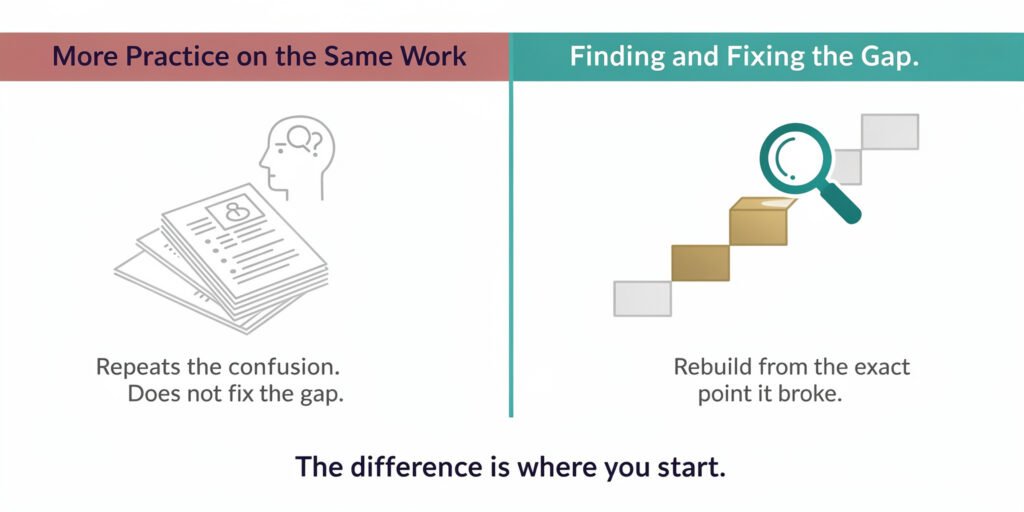
When parents see a child struggling, the instinct is to do more: more worksheets, more practice problems, more time at the kitchen table. And extra practice is not without value. But if the practice is built on top of a gap in foundational understanding, it reinforces incorrect methods or deepens frustration rather than building genuine skill.
A child who does not understand what a fraction actually represents cannot become fluent at fractions by doing more fraction problems. What they need is someone to go back to the point where the understanding broke, explain it clearly, and give them enough small-group attention to work through it properly.
This is the difference between practice and diagnosis. One repeats the work. The other finds where the work went wrong in the first place.
Before we start, we identify the exact point where understanding broke down. Not the grade level, not the general topic. The specific concept. From there, we rebuild in small groups of up to 8 students so your child gets the individual attention that a classroom of 25 cannot provide. Programs run across Maths, Logic, Phonics, English Writing and Reading, Pre-Prep Bridging, STEM and Coding for children aged 3 to 12.
The honest answer is: earlier than most parents think. The three patterns above do not announce themselves loudly. They develop quietly over one or two terms before the grades start to reflect them. By the time a report card shows a problem, the gap has usually been growing for a while.
Parents who bring their child in early, before the confidence spiral has fully taken hold, almost always see faster results. The gap is smaller, the child has not yet written themselves off as bad at maths, and the rebuild takes weeks rather than months.
If you have noticed any of the signs described above, a free trial assessment is the fastest way to find out exactly where things stand and what support would make the biggest difference.
This is more common than most parents realise. We start from where the understanding actually broke down, regardless of year level. It takes longer than catching a recent gap, but the results are solid because we are fixing the actual cause rather than patching over it.
In most cases, yes. Disliking maths is almost always a response to feeling confused and unsuccessful at it. As understanding improves and small wins start to build up, the attitude usually shifts as well. Confidence follows competence.
Most families notice a shift in attitude within the first 3 to 4 sessions. Academic results typically follow within 4 to 8 weeks depending on the size of the gap and the year level.
No. Our programs also cover Logic, Phonics, English Writing and Reading, Pre-Prep Bridging, STEM and Coding. All programs run in small groups of up to 8 students for children aged 3 to 12.
30 minutes, no obligation. We will find exactly where the gap is and tell you what support would help most.Book Your Free Trial
WhatsApp: +61 494 719 869
Tel: 0417 226 366
info@sparklogicacademy.com.au
11 Lorisch Way, Rochedale QLD 4123








Your information will never be shared with any third party