


When a child pushes back against reading, the instinct for most parents is to try harder: find more interesting books, set aside dedicated reading time, offer small rewards. These are reasonable responses. But if they are not working, it is usually because they are addressing the surface of the problem rather than the cause underneath it.
A child who genuinely hates reading is not a child who lacks curiosity or imagination. In almost every case, they are a child for whom reading has become difficult in a very specific way. And the good news is that specific difficulties have specific solutions.
At Spark Logic Academy in Rochedale, we work with children aged 3 to 12 through Phonics and English Writing and Reading programs in small groups of up to 8 students. We see the same three patterns come up again and again. Here is what they actually are.
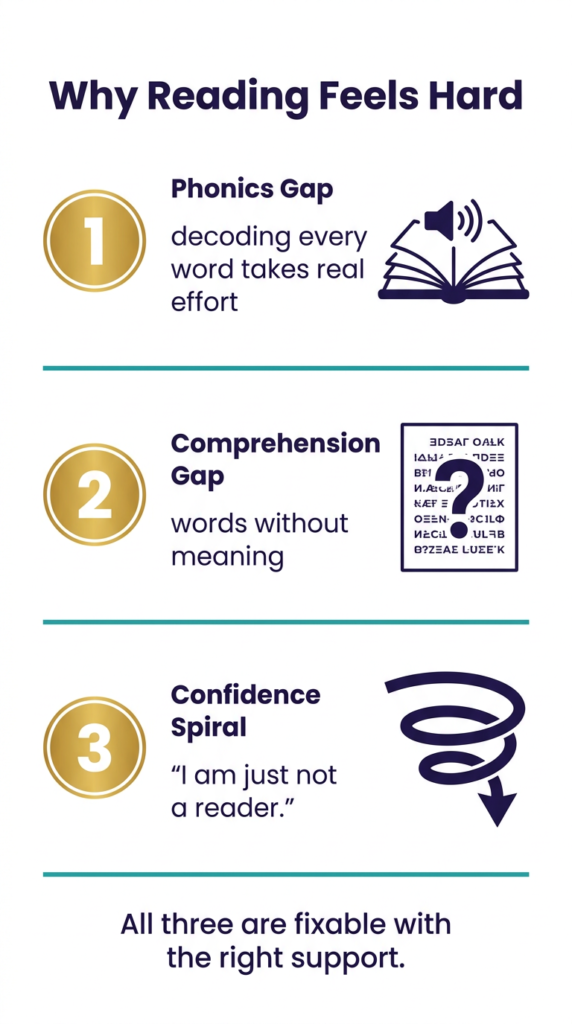
Phonics is the system that connects written letters and letter combinations to the sounds they represent. It is the foundation every reader builds on. When a child has not fully developed this system, reading requires genuine mental effort for every single word. Fluent readers decode automatically, almost without noticing. A child with a phonics gap has to consciously work out each word, which is slow, tiring, and frustrating. When reading feels like hard work from the first line, the natural response is to avoid it.
Some children develop enough decoding skill to read words aloud accurately, but the meaning does not come through. They finish a page and cannot tell you what happened. They can reproduce the words without understanding the story. This is more common than most parents expect, and it is particularly demoralising because the child appears to be reading but gains nothing from it. Reading that produces no meaning produces no pleasure, and the motivation to continue disappears very quickly.
After enough sessions where reading felt difficult, slow, or unrewarding, a child begins to form a conclusion about themselves: they are not a reader. This belief then shapes everything that follows. They disengage faster. They resist sitting down with a book. They feel embarrassed reading aloud. The original skill gap may have been small, but the identity that formed around it can be harder to shift than the gap itself. And without addressing the belief, even improving the skill does not always get the child reading willingly.
“A child who hates reading is usually a child who finds reading hard. Fix the hard part, and the hate almost always follows it out the door.”
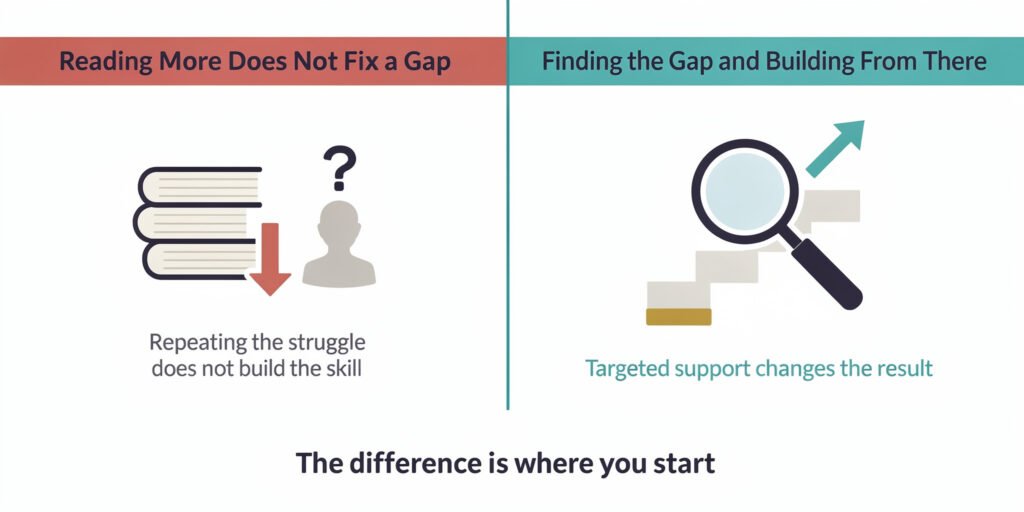
The advice parents hear most often is to read more with their child at home. More reading time. More bedtime stories. More trips to the library. And reading together does have real value for vocabulary, listening, and love of stories. But it does not fix a phonics gap or a comprehension gap.
A child who cannot decode fluently does not become a fluent decoder by doing more struggling. What they need is targeted instruction in phonics, built up step by step from where their understanding currently sits. A child who reads without comprehension needs explicit support in visualising, summarising, and connecting what they read to what they already know.
These are teachable skills. They just require the right approach, enough individual attention, and enough patience to work through the specific gap rather than around it.
We start with a free trial assessment to identify exactly which gap is driving the problem. From there, our Phonics and English Writing and Reading programs address the skill from the ground up in small groups of up to 8 students. Children aged 3 to 12. Every child gets individual attention in an environment where asking questions is normal and getting things wrong is part of the process.
Reading difficulties are easiest to address before the confidence spiral has had time to take hold. A child in Year 1 or Year 2 with a phonics gap can often close it within one or two terms with consistent, targeted support. A child in Year 4 or Year 5 who has been reading poorly for years and has formed a strong belief that they simply cannot do it will need more time, not because the skill gap is harder to fix, but because the belief has to shift alongside the skill.
If you have noticed your child avoiding books, reading slowly and reluctantly, or frequently saying they hate reading, that is the signal to act. The earlier the support begins, the easier the process.
Our free 30-minute trial assessment identifies exactly where the gap sits and gives you a clear picture of what support would look like before you commit to anything.
This usually points to a comprehension gap rather than a phonics problem. Being able to decode words and being able to understand a text are two separate skills. If the meaning is not coming through, reading produces no reward, which quickly leads to avoidance. A good assessment will tell you which gap is actually the issue.
It is never too late, though it does take longer when a reading gap has been in place for several years. We work with children up to age 12. The skill can always be rebuilt with the right support. The attitude often follows once the child starts experiencing genuine success with reading for the first time.
A quick way to check at home: ask your child to read a short passage aloud, then ask them two or three simple questions about what they just read. If they read the words reasonably well but cannot answer the questions, comprehension is the likely issue. If they struggle to read the words themselves, phonics is the more likely starting point. Our free trial assessment identifies this properly.
No. Our programs cover Maths, Logic, Phonics, English Writing and Reading, Pre-Prep Bridging, STEM and Coding, all in small groups of up to 8 students for children aged 3 to 12. Many families find that supporting both literacy and maths together makes a significant difference to overall confidence at school.
30 minutes, no obligation. We will identify exactly where the gap is and show you what support would look like.
11 Lorisch Way, Rochedale QLD 4123








Your information will never be shared with any third party