


When a child struggles with writing, the most common response from adults is to ask them to try harder, practise more, or sit with the task until something appears. Sometimes that works. More often, it does not. And when it does not, it is usually because the child is not being lazy or difficult. They are missing something specific that no amount of effort alone can substitute for.
Writing is one of the most complex skills children are asked to develop at primary school. It requires them to hold ideas in mind, organise those ideas into a structure, translate them into sentences, manage spelling and grammar simultaneously, and produce a finished piece that communicates clearly. Most adults would find that overwhelming if they had never been explicitly taught how to do it. Children are no different.
At Spark Logic Academy in Rochedale, we support children aged 3 to 12 through English Writing and Reading programs in small groups of up to 8 students. We see the same three patterns come up repeatedly when a child struggles with writing. Here is what they are.
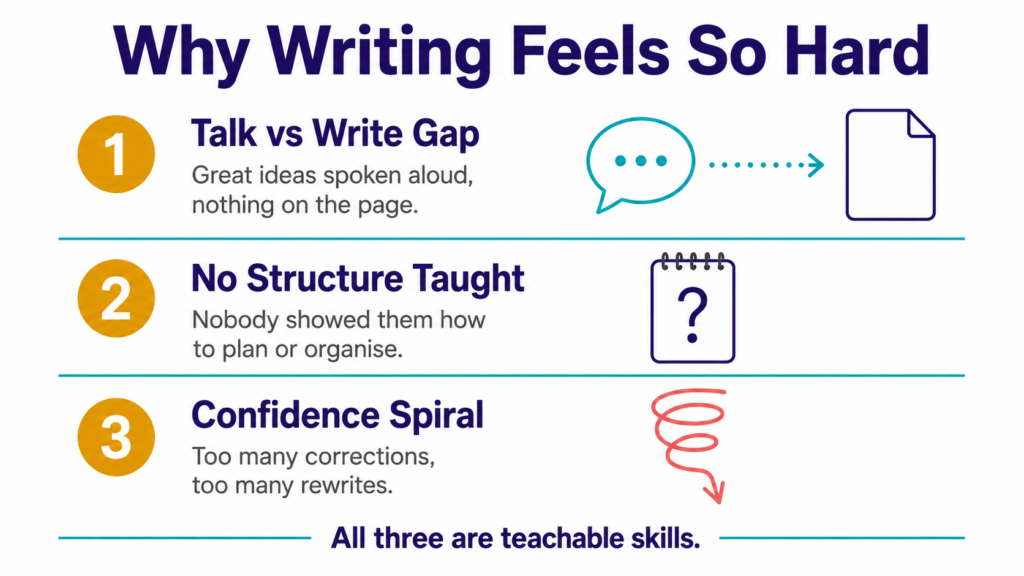
This is the most common pattern we see, and the one that surprises parents the most. A child can sit at the dinner table and tell you a vivid, detailed story. They can describe characters, build tension, and land a punchline. Then you sit them down with a pen and paper, and nothing comes out. Not because the ideas have disappeared. Because speaking and writing are genuinely different skills, and the skill of transferring spoken ideas into written form has not been explicitly built. These children are not struggling with creativity. They are struggling with the bridge between thought and page.
Most classroom writing instruction focuses on what to write. The topic, the theme, the prompt. Far less time is spent on how to write: how to gather your thoughts before you begin, how to organise ideas into a sequence, how to build a paragraph with a clear point, how to revise a draft without losing everything you meant to say. These are learnable processes. But they do not develop automatically just because a child is asked to write repeatedly. Without explicit instruction in writing structure, a blank page is genuinely overwhelming, and avoidance is the natural response.
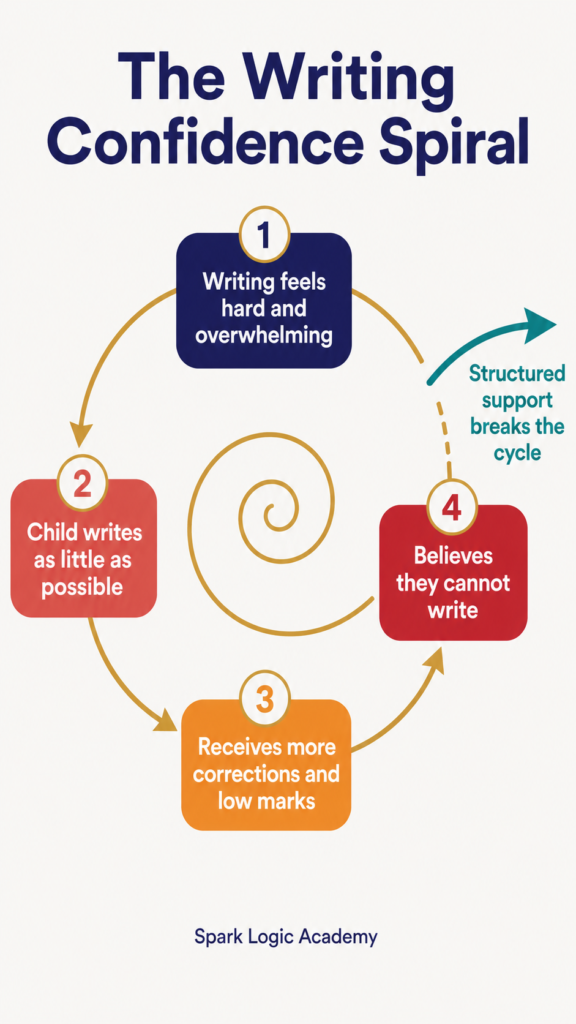
Writing is one of the few school tasks where the child’s effort is visible and permanently marked. Corrections in red pen, low marks on assignments, and comparisons with peers who seem to write easily can accumulate into a very specific belief: I am not a writer. Once that belief takes hold, it changes how the child approaches every writing task. They write less because they expect it to be wrong. They write less carefully because getting it over with feels better than trying and failing. The shorter, flatter, more avoidant the writing becomes, the more evidence builds for the belief that they cannot do it.
“A child who stares at a blank page is not a child without ideas. They are a child who has not yet been given the tools to get those ideas out.”
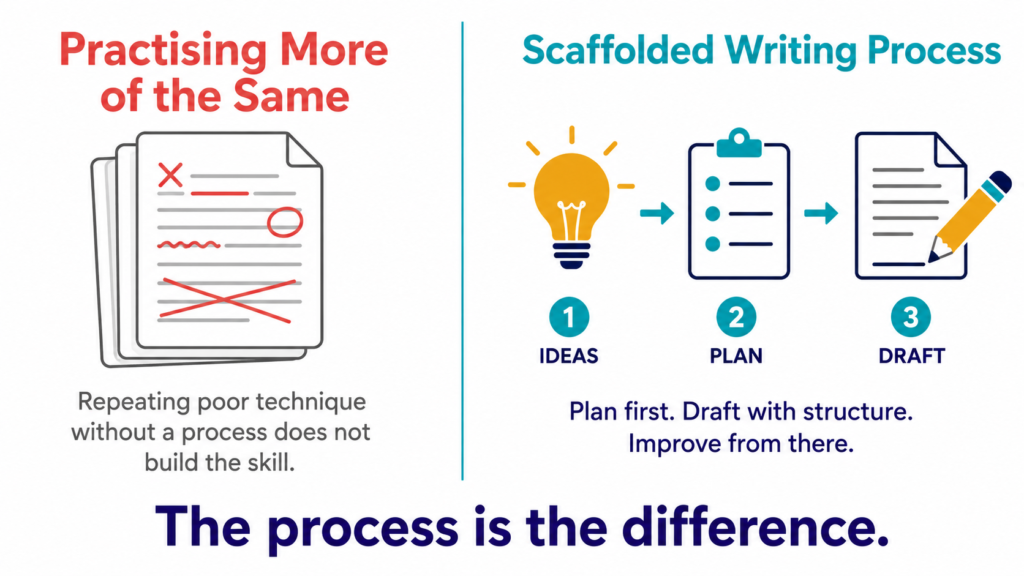
It seems logical: if a child is not writing well, they should write more. And there is truth in that, but only if the practice is structured and targeted. A child who has not been taught how to plan will produce the same unstructured, difficult-to-read pieces no matter how many times they practise. A child who writes under the weight of the confidence spiral will produce work that reflects anxiety, not ability.
What actually helps is specific, structured instruction in the writing process: how to brainstorm, how to plan, how to draft, and how to revisit. Alongside that, the child needs a setting where taking risks with language feels safe rather than punishable. Small group environments, where the feedback is constructive and the focus is on progress rather than perfection, tend to shift both the skill and the attitude faster than one-on-one drilling ever does.
We start with a free trial assessment to identify exactly where the writing gap sits. Our English Writing and Reading program works on the whole process: building vocabulary, structuring sentences and paragraphs, planning before writing, and drafting with confidence. All in small groups of up to 8 students so every child has room to ask questions and make mistakes without an audience of 25 watching. For children aged 3 to 12 in Rochedale, Brisbane.
Effective writing support does not look like more correction. It looks like more scaffolding. A good writing program gives children a process to follow before they touch the page, not just a topic and a timer. It builds vocabulary actively rather than assuming children will absorb words through reading alone. It teaches sentence variety so writing develops a rhythm rather than staying flat and repetitive. And it builds the habit of re-reading and improving, which most children have never been shown how to do.
Over time, children who receive this kind of structured support do not just write better. They write more willingly. The task stops feeling like an ordeal and starts feeling like something they can actually do. That shift in attitude is often the most visible change parents notice first, well before the written work itself improves measurably.
Yes, and it is one of the most fixable kinds. The gap between verbal and written expression is a specific skill gap, not a creativity or intelligence issue. Once a child is taught how to transfer their spoken ideas onto the page, and given a simple planning process to follow, written output tends to improve quite quickly.
Short, flat writing usually comes from one of two places: limited vocabulary and sentence variety, or the confidence spiral where the child writes as little as possible to reduce exposure to correction. Sometimes both. An assessment helps identify which is driving it so the support can be targeted correctly.
Most families notice a shift in willingness and confidence within the first 4 to 6 sessions. Written output tends to improve measurably within 6 to 10 weeks, depending on the size of the gap and whether confidence is a significant factor as well.
No. Our programs cover Maths, Logic, Phonics, English Writing and Reading, Pre-Prep Bridging, STEM and Coding, all in small groups of up to 8 students for children aged 3 to 12. Many families find that supporting literacy and maths together makes a significant difference to overall school confidence.
30 minutes, no obligation. We will identify exactly where the writing gap is and show you what support would look like.
Book Your Free Trial
WhatsApp: +61 494 719 869
Tel: 0417 226 366
info@sparklogicacademy.com.au
11 Lorisch Way, Rochedale QLD 4123








Your information will never be shared with any third party