


Most parents have never been told how long homework should actually take. Schools hand out the homework sheet and send it home, but the expected time is rarely written on it. So parents sit next to their child for an hour, then two, wondering whether this is normal or whether something is wrong.
There is a widely used guideline in Australian primary education. It is simple, practical, and most parents have never heard it. Once you know it, evenings get a lot easier.
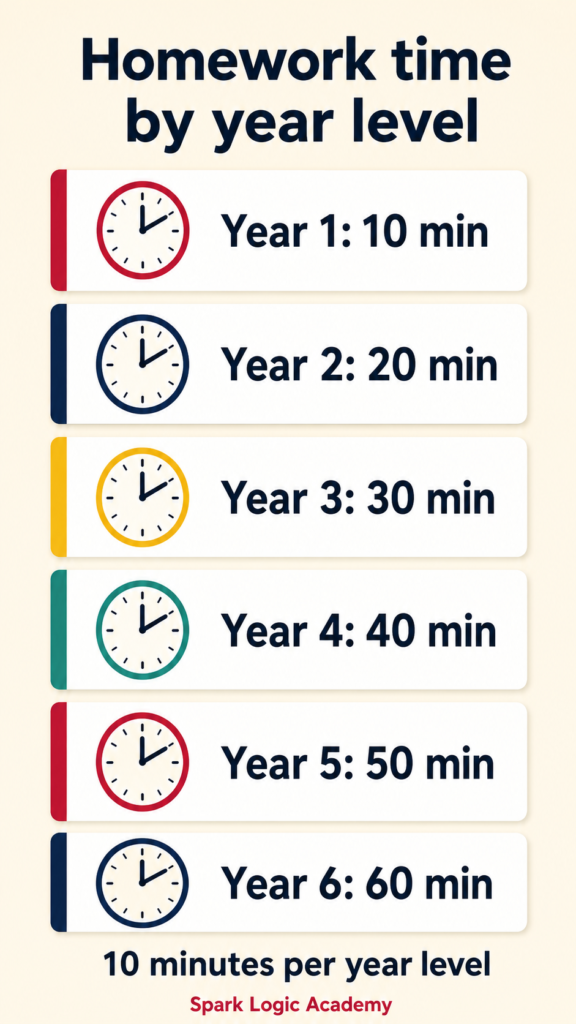
The guideline used by most Australian primary schools is 10 minutes of homework per year level, per night. That gives you:
These are rough guidelines, not rigid rules. Some nights will be shorter. Some subjects take more concentration than others. But if your child is regularly sitting at the table for two or three times these amounts, that pattern matters.
When homework consistently runs over time, there are usually a few reasons. It is worth knowing which one applies to your child before deciding what to do about it.
This is the easiest fix. A screen in the background, a sibling nearby, or starting homework too late in the afternoon all add significant time. Tired, hungry, or overstimulated children work slowly regardless of their ability. A quiet space, a snack first, and starting before 5pm makes a noticeable difference for most children.
This is the one parents often miss. When a child sits at a maths sheet for 45 minutes but the rest of the class does it in 15, it is not always about concentration. It is sometimes because they are doing the working-out twice: once to remember the method, and once to apply it. The method has not stuck. The gap is in the classroom, not at the table, and no amount of patient sitting-beside-them at home fixes it.
Children who are anxious about a subject will stall, distract, complain, need to get water, need to sharpen the pencil. The task is not too hard, but the anxiety around it is. This tends to appear with one subject in particular, often maths or writing.
At the start of term, especially the first week back, children are running on empty by the time they get home. Their working memory is reduced, their concentration is lower, and tasks that would normally take 20 minutes take 40. If this settles after the first week, it was just the transition. If it does not, something else is driving it.
There is a difference between a child who is slow because they are tired, and a child who is slow because they are missing something. The second pattern tends to be consistent, tends to be worst in one or two subjects, and tends to resist the usual fixes.
If you have tried the environment improvements, the time-boxing, and the early nights, and the homework is still taking twice as long as it should, the most useful next step is to find out what the gap actually is. Not to guess, not to add more practice at home, but to have someone who knows the curriculum sit with your child and identify the specific point where the understanding breaks down.
That is what our free trial assessment does at Spark Logic Academy. It is 30 minutes, it is free, and it tells you exactly where your child is sitting relative to where they should be for their year level. For most parents, it is the first time they have had a clear answer to what is actually going on. You can also read more in our article on why children resist homework and what that resistance usually means.
30 minutes. Find out exactly what is making homework take so long. Free for every new student. Small groups. Qualified teachers. Ages 3 to 12. Rochedale, Brisbane. Term 3 places available now.
WhatsApp: 0494 719 869
Tel: 0417 226 366 | info@sparklogicacademy.com.au
11 Lorisch Way, Rochedale QLD 4123
How long should homework take for a Year 3 student?
Around 30 minutes is the general guideline for Year 3, based on the 10-minutes-per-year-level rule used widely in Australian primary schools. If it is regularly taking 60 to 90 minutes, it is worth looking at whether the environment is distracting, whether the child is fatigued, or whether there is a gap in understanding of the current content.My child takes 2 hours on homework every night. Is that normal?
For primary school, no. Two hours is well above the expected range for most year levels. There are a few possible reasons: the environment is not set up well, the child is doing homework too late when they are already tired, or there is a knowledge gap making the work harder than it should be. The most useful step is to time-box homework at the correct amount for the year level, note what did not get done, and flag it with the teacher.Should I do homework with my child or let them do it alone?
For most primary school students, a nearby but not hovering presence works best. Be available to answer questions, but do not sit next to them directing every line. Independence at homework time is a skill that builds with practice. If they cannot do any of it without you sitting there, that is worth mentioning to the teacher.What if my child just refuses to do homework at all?
Refusal is usually one of two things: genuine fatigue (in which case the timing is the problem, not the child) or avoidance of something that feels hard or scary. A child who says “I hate homework” and then sits down and does it in ten minutes is tired. A child who says “I hate homework” and then stalls, cries, or cannot start even after a rest is probably avoidant. Avoidance this consistent is usually linked to a subject they are not confident in.At what point should I get a tutor for homework help?
When the homework is consistently taking more than twice the expected time for the year level, and you have already tried adjusting the environment and timing, it is worth getting an outside assessment. The goal is not to get someone to sit with them while they do it. It is to find out what the gap is and close it, so the homework stops being a battle in the first place.








Your information will never be shared with any third party