

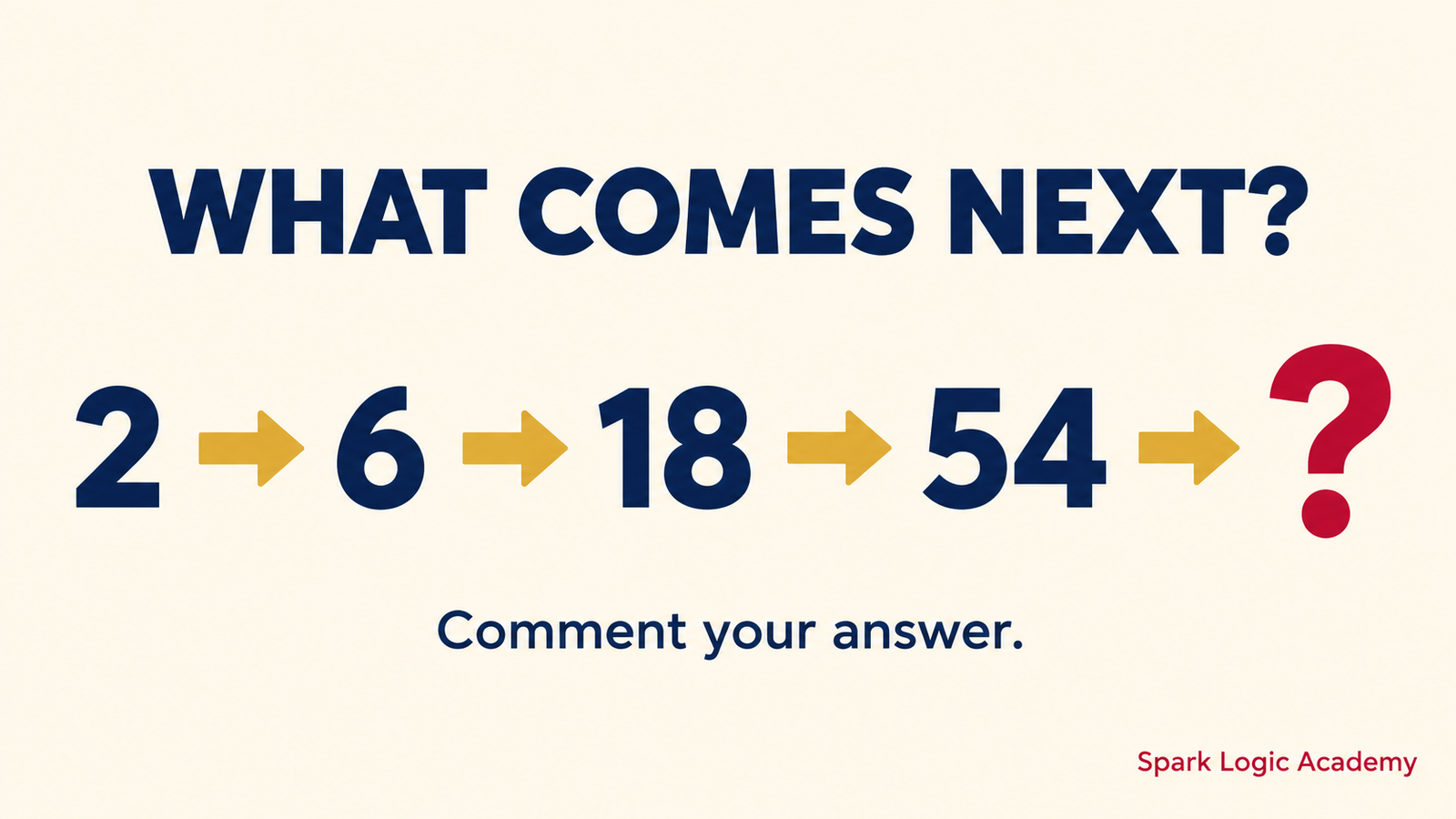
Try to answer this before reading further.
2, 6, 18, 54, ___
Comment your answer. Then keep reading.
What most people notice first
One common first instinct is to look at the gaps between the numbers:
- 6 – 2 = 4
- 18 – 6 = 12
- 54 – 18 = 36
The gaps themselves form a pattern: 4, 12, 36. Each gap is three times the previous gap. This is a valid observation — and it actually leads to the right answer (36 × 3 = 108, so the next gap would be 108, and 54 + 108 = 162).
But it is the long route.
The direct rule
Look at the numbers themselves instead of the gaps:
- 2 × 3 = 6
- 6 × 3 = 18
- 18 × 3 = 54
- 54 × 3 = 162
Each number is three times the one before it. The rule is multiplicative, not additive. The answer is 162.
This type of pattern, where each term is multiplied by a fixed number, is called a geometric sequence.
Why the route matters
Both methods arrive at 162. But the student who looks at the gaps is thinking additively. The student who looks at the ratio between terms is thinking multiplicatively.
This distinction is significant. Multiplicative thinking is the foundation for:
- Percentages and fractions
- Algebra (variables that multiply rather than add)
- Exponential growth (compounding interest, population growth)
- Ratios and proportional reasoning
Students who rely only on additive thinking can find proportional and algebraic reasoning harder as the curriculum becomes more advanced. The gap is not about intelligence. It is about which mathematical lens has been developed.
What this puzzle reveals about a student
Showing a student this sequence and asking them to explain their method can be a useful reasoning check. A student who says “I just kept adding more each time” is using valid reasoning but additive framing. A student who says “each number is times three” has multiplicative thinking already operating.
Crucially: a student who can only see the additive pattern may not notice the multiplicative one even when told to look for it. That is the gap worth addressing — not the answer itself, but the lens.
How Spark Logic Academy approaches this
At Spark Logic Academy in Rochedale, a free Maths trial can include this kind of pattern reasoning to understand how a student approaches a problem.
A student who immediately identifies the multiplicative rule and explains it clearly is ready for the next layer. A student who only sees the additive gaps has a foundation worth building — and building it in Year 4 or Year 5 is far easier than trying to catch up in Year 7.
Our programs include Maths and Logic, English Writing and Reading, Phonics, Pre-Prep Bridging, and Coding & Technology for ages 3 to 12, with small-group classes of up to 8 students.
Book a Free 30-Minute Trial
For Maths enquiries, book a free 30-minute trial to see how your child approaches problems and where they may need support.
WhatsApp: +61 494 719 869
Phone: 0417 226 366
Related reading
- Can You Solve This Maths Puzzle? Most Adults Get It Wrong
- Can You Spot the Mistake? The Algebra Error Most Year 6 Students Make
Spark Logic Academy | 11 Lorisch Way, Rochedale QLD 4123 | sparklogicacademy.com.au