

Pattern Detective: Logic Puzzles for Kids Aged 4–6

  • Home
  • Pattern Detective: Logic Puzzles for Kids Aged 4–6
Shape Image One
Pattern Detective: Logic Puzzles for Kids Aged 4–6

Spotting what comes next is one of the first big thinking skills children build. Patterns teach them to notice, predict and check, which is the same habit they will use later in maths, reading and problem solving.

This quiz has eight short puzzles for children aged about 4 to 6. Read each puzzle aloud, let your child point or tap, and enjoy the explanation together.

Play Pattern Detective

Pattern Detective

Best played together. Read each puzzle aloud, and let your child choose the answer. No sign-up needed, and nothing is saved or sent anywhere.

Parent answer key (spoilers)
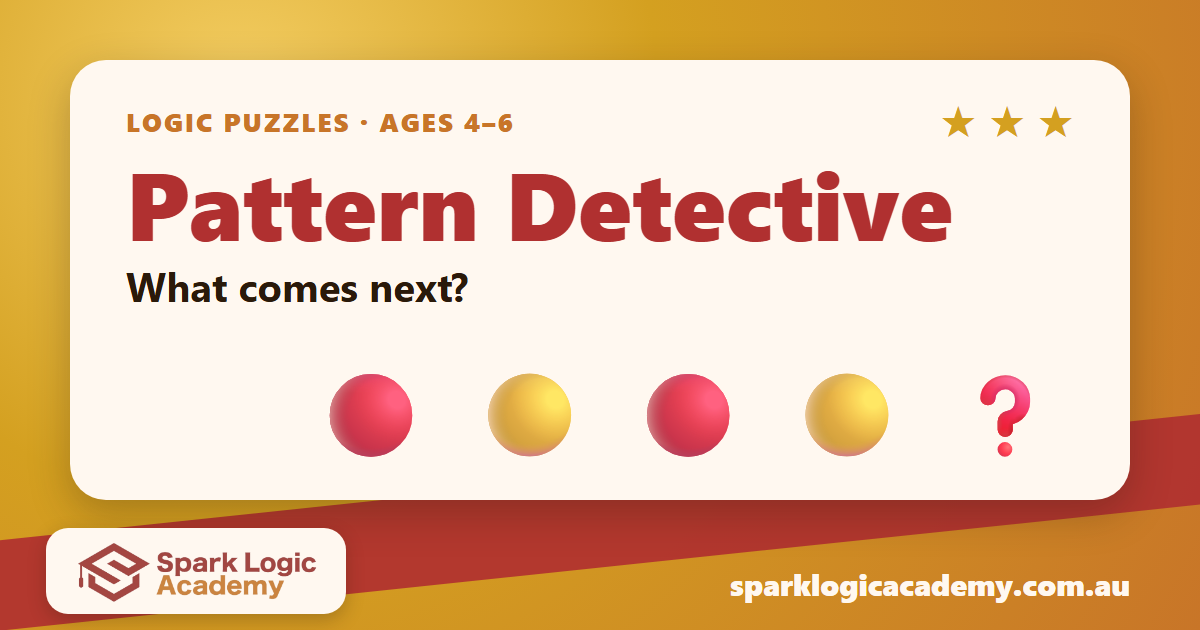
  1. What comes next? Answer: 🟡 Yellow. The pattern goes red, yellow, red, yellow. We have just had red, so yellow comes next.
  2. What comes next? Answer: 🌙 Moon. Two stars and then a moon, over and over. We have just had two stars, so the moon comes next.
  3. What comes next? Answer: 🐶 Dog. The pattern is cat, dog, dog. We have just had a cat, so a dog comes next.
  4. What comes next? Answer: 🍇 Grapes. Three things repeat: apple, banana, grapes. After apple and banana, the grapes come next.
  5. Which one does not belong? Answer: 🥕 Carrot. Apple, banana and grapes are all fruit. A carrot is a vegetable, so it is the odd one out.
  6. Which one does not belong? Answer: 🐘 Elephant. A car, a bus and a taxi are vehicles that drive on roads. An elephant is an animal, so it is the odd one out.
  7. What number comes next? Answer: 5. We are counting up by one each time. After 4 comes 5.
  8. What number comes next? Answer: 8. We are counting by twos, adding 2 each time. 6 and 2 more makes 8.

Why patterns matter

A pattern is something that repeats in a way we can predict. When children work out what comes next, they are practising logical thinking: look carefully, find the rule, test it. These are the same steps behind counting in twos, learning times tables and spotting spelling patterns.

How to use this quiz with your child

  • Read the puzzle aloud and say the pattern slowly: "red, blue, red, blue ...".
  • Ask "What is repeating?" before your child chooses. Finding the repeating part is the real skill.
  • If your child is unsure, cover the question mark and say the pattern again together.
  • Keep it short and playful. Two or three puzzles on a busy day is plenty.

Make your own patterns at home

Line up socks, blocks, spoons or dried pasta in a repeating pattern, leave a gap, and ask your child to fill it. Then swap roles and let them make a pattern that tricks you. Creating a pattern is harder than continuing one, and children love catching a grown-up out.

Building logical thinking in the early years

Spark Logic is our small-group program for ages 3 to 5, built around playful thinking activities like these. For more on how logical thinking helps children learn maths, see 7 powerful ways logical thinking helps children learn maths.

Not sure where to start?

Book a 30-minute, one-on-one, face-to-face trial assessment and our teacher will help recommend the most suitable program or class for your child.

Book a Trial Assessment Ask a Question

Leave a Reply

Your email address will not be published. Required fields are marked *