

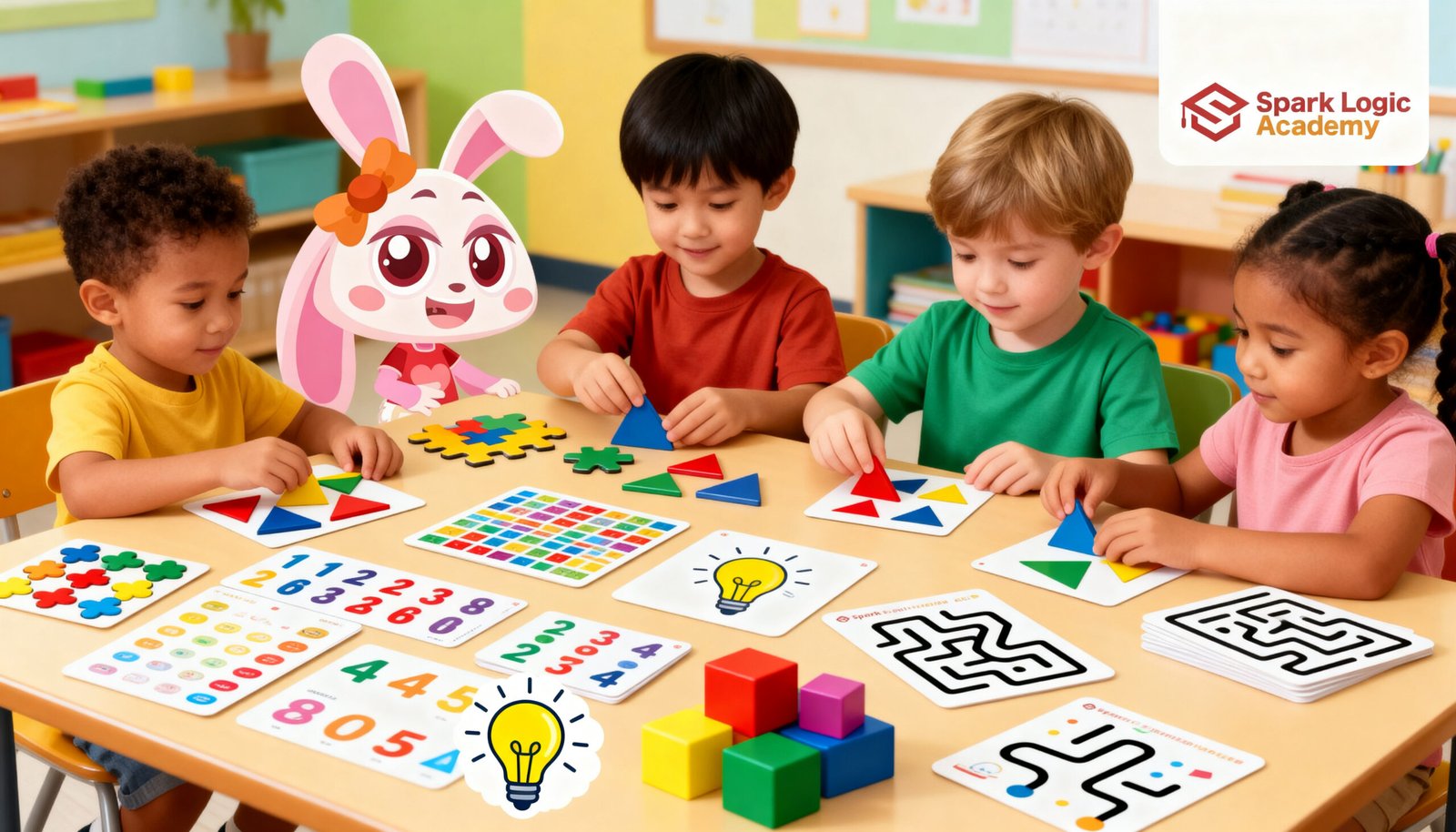
Logical thinking for children is one of the most important early learning foundations. Before a child can confidently solve maths problems, they need to notice patterns, compare objects, understand shapes, follow steps and explain what they see.
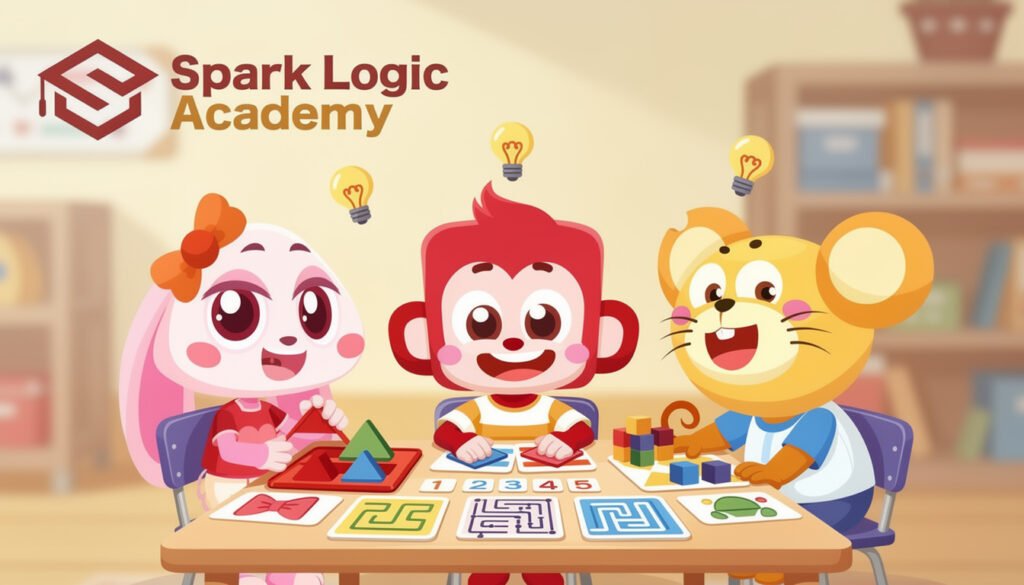
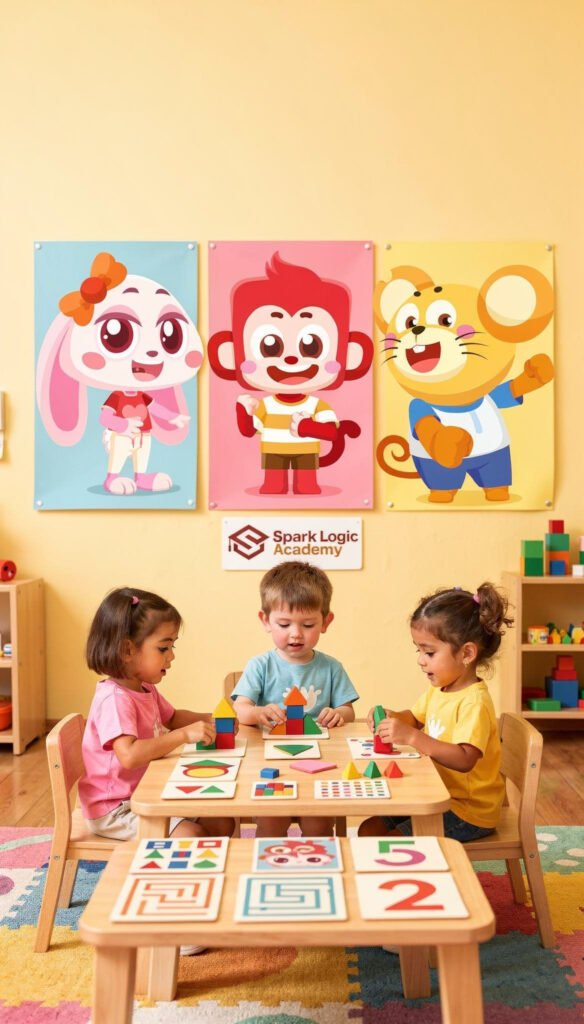
For young children, logic does not need to feel like a formal lesson. It can happen through puzzles, matching games, mazes, shapes, sorting activities, visual problems and simple reasoning tasks. At Spark Logic Academy in Rochedale, our Spark Logic L1 and Spark Logic L2 programs help children aged 3–5 build early thinking skills in a playful and structured way.
Logical thinking means a child can look at information, notice relationships and make simple decisions based on what they see. For young children, this might include sorting colours, matching shapes, completing a pattern, finding the next step in a sequence or solving a simple puzzle.
These activities may look simple, but they help children develop the early reasoning skills they later use in maths, reading, science and everyday problem-solving.
For broader child development context, parents can also read the Raising Children Network guide to logical-mathematical play, which explains how everyday play can support early thinking and problem-solving skills.
Patterns are one of the earliest bridges between play and maths. When children notice repeated colours, shapes, sounds or actions, they begin to understand order and prediction.
For example, a child might complete a red-blue-red-blue pattern or notice that a shape sequence repeats. This supports later skills such as counting, number patterns, skip counting and problem-solving.
Spatial thinking helps children understand where objects are, how shapes fit together and how things move in space. This is useful for puzzles, drawing, handwriting, geometry, maps and visual problem-solving.
Activities such as matching shapes, rotating pieces, solving mazes and building with blocks can help children strengthen spatial awareness in a natural way.
Logical thinking encourages children to try, test and adjust. Instead of giving up when something is difficult, children learn to ask questions such as:
This kind of thinking is important because maths is not only about getting answers. It is also about understanding how to approach a problem.
Before children work with more formal maths, they benefit from early experiences with comparison, grouping, order and visual reasoning. These are the foundations behind number sense and mathematical thinking.
A child who can sort objects, compare sizes, follow a sequence and recognise patterns is already developing important skills for maths learning.
This is why early logic programs can be helpful before or alongside maths enrichment. For children aged 3–5, Spark Logic L1 and Spark Logic L2 can support the transition toward stronger maths foundations.
Many children lose confidence when learning feels too hard or too fast. Logic activities can help because they are visual, playful and easier to approach than formal worksheets.
When children solve a puzzle or complete a pattern, they feel a sense of achievement. Over time, this helps them become more willing to try new learning tasks.
Logical thinking also supports school readiness. In a classroom, children need to listen, follow instructions, compare information, make choices and explain their thinking.
Activities that involve sorting, matching, sequencing and problem-solving can help children practise these skills before they enter more formal school routines.
For children preparing for Prep or primary school, parents may also explore our Pre-Prep Bridging Course.
Every child learns differently. Some children are ready for early maths. Others need more practice with reasoning, focus, patterns and visual thinking first.
Spark Logic gives young learners a friendly starting point. It helps children build confidence through age-appropriate activities before moving into more advanced maths, English or STEM learning.
At Spark Logic Academy, we currently use two starting levels:
If you are not sure which level is right, the best next step is to book a trial class or ask our team.
If your child is aged 3–5 and you want to build stronger early thinking skills, Spark Logic may be a good place to start.
You can view our learning programs, book a Trial Assessment, or contact our team with questions.
Not sure where to start?
Book a Trial Assessment Ask a Question








Your information will never be shared with any third party