



The homework book is open on the table. The pencil is there. Your child is sitting in the right place at roughly the right time. Forty-five minutes later, you come back to check and find two sentences written, a small collection of eraser shavings, and a child who looks surprised that you are asking about progress.
This is one of the most common things parents describe, and it is almost never a sign that a child is being difficult or lazy. There are usually a few specific things driving the pattern, and knowing what they are makes it considerably easier to respond.
Sitting in the right place is not the same as working. Children can appear to be doing homework while actually doing very little, and they are not usually doing this consciously. Avoidance of a task that feels overwhelming, unclear, or unrewarding often looks like stalling, fiddling, or slow movement through the motions of working without actually producing anything.
It is also worth noting that homework resistance tends to increase when the work itself feels genuinely difficult. Children who struggle with a concept at school will often sit in front of homework on the same topic and find that they simply cannot proceed, even when the time and space are appropriate.

More than one of these may apply at the same time.
When homework feels unmanageable or unclear, the most common response is not to try and fail. It is to avoid starting at all. Children who are unsure how to do a task will often sit at the desk and look busy, shuffling papers, sharpening pencils, arranging their materials, or staring at the page, rather than ask for help or admit they do not know where to begin.
This is particularly likely when the task involves a concept the child has not fully understood at school, or when the instructions are ambiguous. The act of beginning feels too risky when the child is not confident they are doing it correctly.
Starting a task is its own skill. Many children have no established sequence for how to begin homework: which subject to open first, where to look for instructions, how to identify what needs to be done before starting. Without a clear routine, each homework session involves a low-level version of the same decisions, and those unresolved decisions eat into productive time.
A consistent starting routine removes this barrier. When a child always begins homework the same way, the beginning of the session requires less mental energy and the transition into work happens more smoothly.
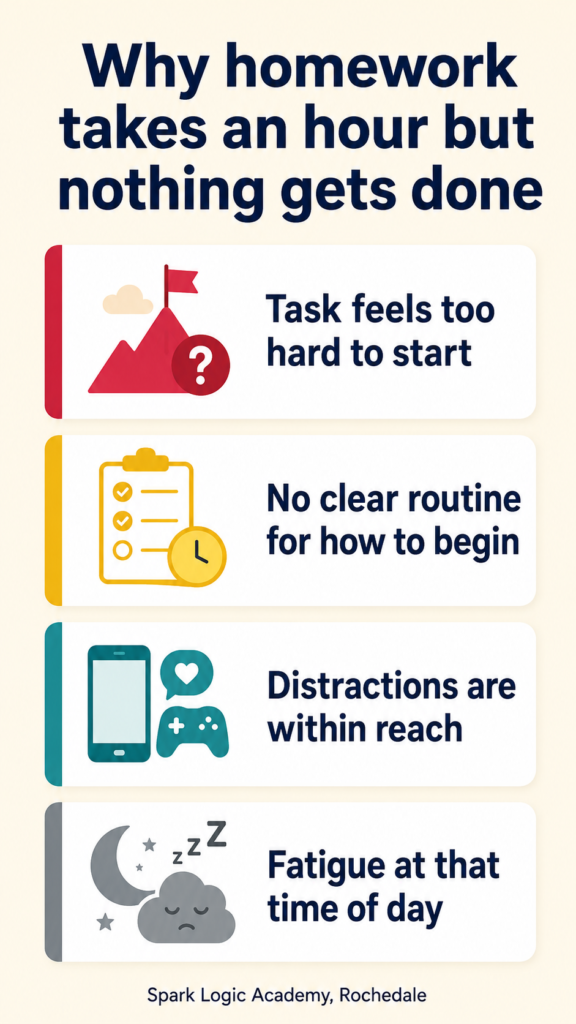
A phone nearby, a sibling talking in the next room, a television that can be heard, background music with words, or even a pencil case full of interesting objects can all compete for a child’s attention during homework. Unlike adults who have had years of practice redirecting their focus, children tend to follow whatever is most immediately interesting.
The most reliable way to address distraction during homework is to remove the distractions before the session starts, rather than asking the child to resist them throughout. Asking a child to sit next to a phone and not look at it for forty-five minutes is asking for something most adults also find difficult.
Many children come home from school already tired. A full day of concentrating, managing social situations, and learning new content draws on the same cognitive resources required for homework. Sitting down to do schoolwork immediately after school, or at a time when a child is consistently exhausted, may produce the appearance of doing homework without any of the actual cognitive engagement required.
Homework completed by a fatigued child often takes three times as long to finish and is retained far less than the same work done when the child has had time to rest and eat.
It is normal for homework sessions to be uneven, and occasional avoidance does not indicate a problem that requires outside support. The pattern tends to be worth investigating further when it is consistent across most homework sessions, when it is causing significant family conflict, or when the child appears genuinely stuck rather than just slow.
When a child consistently cannot make progress on homework independently, particularly in a specific subject, it is often useful to identify whether there are gaps in foundational knowledge making the current work harder to access. A child who does not fully understand a maths concept will not be able to do their maths homework no matter how good the conditions are. The work itself may be the barrier rather than habits or routine.
At Spark Logic Academy in Rochedale, our free 30-minute trial assessment identifies where a child’s understanding is actually sitting across their core subjects. You can also read more in our guides on why children need daily homework reminders, why children forget things they have just learned, and why children give up when work feels too hard.
30 minutes. Find out where your child’s understanding actually sits. Free for every new student. Small groups. Qualified teachers. Ages 3 to 12. Rochedale, Brisbane. Term 3 places available now.
WhatsApp: 0494 719 869
Tel: 0417 226 366 | info@sparklogicacademy.com.au
11 Lorisch Way, Rochedale QLD 4123

Is it normal for homework to take much longer than it should?
Very common, particularly in primary school. Homework avoidance, slow transitions into work, and distraction are all typical features of how children manage tasks they find difficult or unrewarding. The pattern tends to improve when the causes are addressed directly, particularly by removing distractions, building a starting routine, and checking whether the work itself is accessible.How long should homework take for primary school students?
Guidance varies, but a general benchmark for primary school is ten minutes per year of schooling. So a Year 4 student would typically spend around forty minutes on homework. If homework consistently takes significantly longer than this, it is often worth checking whether the child understands the content, whether the environment has too many distractions, or whether fatigue is affecting their ability to concentrate.My child says they do not know how to do the homework. Is this an avoidance tactic?
Sometimes, but not always. Children who genuinely cannot access the work will often say they do not know how to do it, and dismissing this as avoidance without checking can leave a real knowledge gap unaddressed. It is worth sitting with the child briefly to identify whether they can describe what the task is asking and whether they have any starting point for it. If they genuinely cannot, the work may be above their current level of understanding and is worth flagging to the teacher or investigating further.What is the best environment for children to do homework?
The most consistently effective homework environments are quiet, low-distraction spaces with all distracting devices removed or turned off before the session begins. A consistent location also helps, because familiar environments carry fewer novelty distractions. The kitchen table works well for many families because an adult is nearby to answer questions without being actively engaged in the homework.Should I sit with my child while they do homework?
Being nearby and available to answer questions is different from sitting next to the child and monitoring their progress throughout. Many children work more independently when a parent is accessible but not watching, because the expectation to demonstrate effort under observation can increase anxiety around homework. A reasonable approach is to be in the same room or nearby and available when called, rather than co-managing the homework session throughout.








Your information will never be shared with any third party