


If your child has ever come home and said “I am just bad at maths,” you are not alone. It is one of the most common things parents hear, and one of the most heartbreaking.
3 Real Reasons Why Children Struggle With Maths.
But here is something worth knowing before you accept that as the truth.
Your child is most likely not bad at maths. They have simply not been shown how to understand it yet. Those are two very different things, and the difference changes everything.
Most children do not wake up one day and decide they cannot do maths. It happens gradually. They sit in a classroom, they follow the steps their teacher shows them, they get the right answer sometimes and the wrong answer other times, and slowly they start to feel like the subject is beyond them.
What is rarely explained to parents is why this happens.
The most common reason children fall behind in maths is not a lack of ability. It is a gap between memorising a process and genuinely understanding a concept. These are not the same thing, and most mainstream maths teaching does not clearly separate them.
When a child memorises that 3 times 4 equals 12, they can answer that question. But if you change the way the question is asked, or move to a slightly more complex concept that builds on it, the memorised answer is no longer enough. The child has no mental model to fall back on. They feel lost. And because everyone else seems to be keeping up, they conclude the problem is them.
It is not.
Traditional maths instruction tends to move quickly toward numbers and symbols. Children are introduced to equations, taught the steps to solve them, and then tested on whether they can repeat those steps correctly.
This approach works for some children, particularly those who already have strong number sense from an early age. But for many children, especially in the primary and early high school years, jumping straight to abstract numbers leaves a gap where genuine understanding should be.
By the time the gap becomes visible, usually when a child hits a new concept that relies on the one they never truly understood, the child is already behind. And they feel it.
Building early logical thinking is also part of the foundation. You can read more about how logical thinking supports maths learning in young children here.
This is the moment most parents come to us at Spark Logic Academy in Rochedale. Not because their child is incapable, but because the foundation was never properly built.
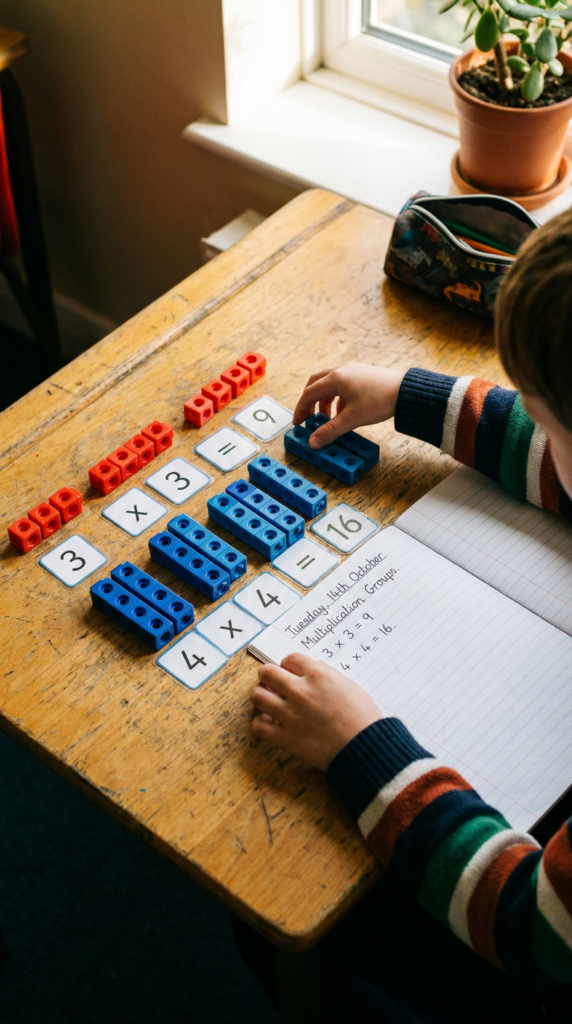
At Spark Logic Academy we use the Singapore Math CPA method to teach every maths concept. CPA stands for Concrete, Pictorial and Abstract, and the order matters.
Before a child ever writes a number on paper, they work with real physical objects. Blocks, counters, cards, and other hands-on materials are used to represent the concept. The child can hold it, move it, and experience what the maths actually means in the real world.
This is the step that most programs skip.
Once the child can demonstrate the concept with physical objects, the learning moves to drawings and diagrams. Bar models, dot patterns, and visual representations allow the child to see the concept without needing the physical materials in front of them.
The brain is building a picture it can return to.
Only after a child has experienced the concept concretely and pictorially do we introduce the numbers and symbols. By this point the equation makes sense because the child already understands what it represents.
Maths stops being a set of rules to memorise and becomes something logical that the child can work through with confidence.
For a deeper look at how this method works and why it is used at Spark Logic Academy, read our full guide: Singapore Math and Spark Math for Brisbane Parents.
The following patterns are worth paying attention to, particularly for children in Years 4 to 7:
None of these mean your child is behind in any permanent sense. They mean the foundation needs attention now, before the gap widens further.
The Year 6 to Year 7 transition in Queensland is one of the most important academic moments for a child’s maths confidence. The jump in content difficulty is significant, and children who enter Year 7 with shaky foundations often struggle in ways that affect their confidence for years.
Getting ahead of this is far easier than catching up from behind.
Spark Logic Academy is a small group learning centre in Rochedale, Brisbane. We work with children from age 3 through to Year 7, in classes of no more than 8 students.
Our Spark Math program uses the Singapore Math CPA method described above. Every concept is taught in the correct order, at the right pace, with enough individual attention to ensure each child genuinely understands before moving on.
Small classes mean our teachers notice the gap before it becomes a problem. They notice when a child is following steps without understanding them. They adjust. They go back to concrete materials if needed. They do not move on until the understanding is there.
We also offer programs in English, Phonics, Coding and our Pre-Prep Bridging Course for children preparing to start school.
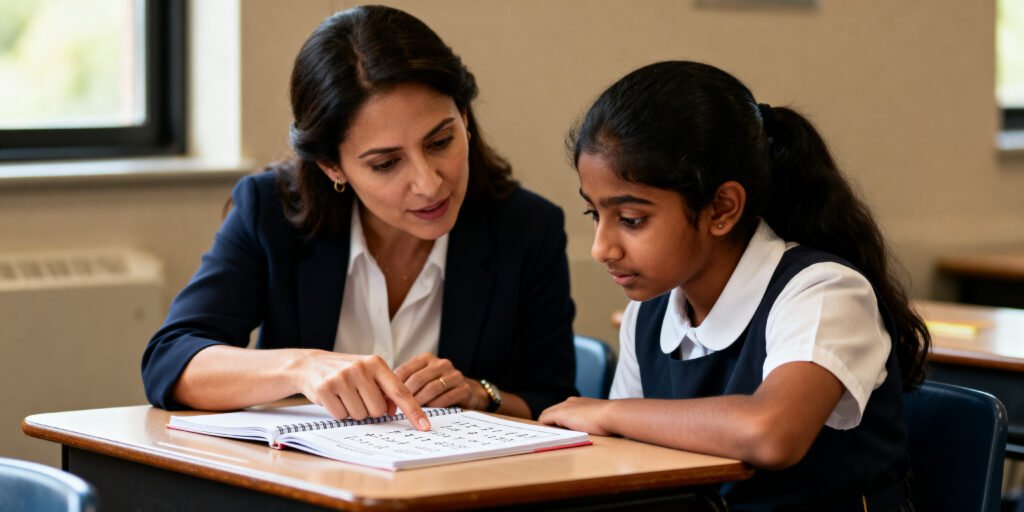
If anything in this article sounds familiar, the simplest next step is to book a free trial for your child.
There is no obligation and no pressure. Your child experiences the class, our teacher sees where they are, and we give you an honest recommendation on whether and how we can help.
You can book through the link below or call us directly.
Book a Free Trial →
Phone: 0417 226 366
11 Lorisch Way, Rochedale, Brisbane QLD 4123








Your information will never be shared with any third party