



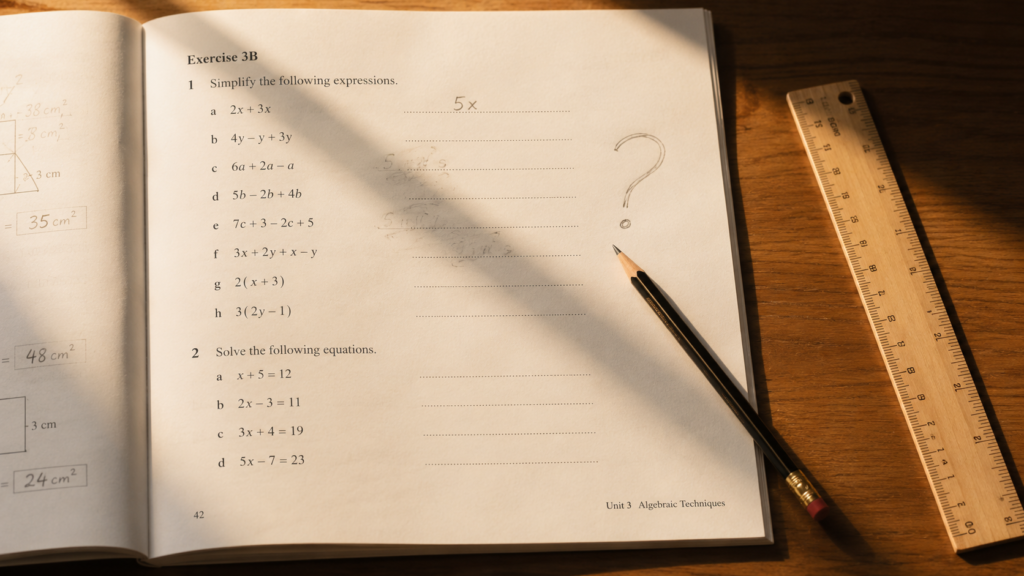
They understood it in the session. Every step. You watched it click. The tutor confirmed it. The questions were answered correctly. Then the homework arrived the following evening, and it was as if the session had never happened.
This is one of the most common patterns parents describe. It is also one of the most misread. This guide explains what is actually happening, why it matters, and what the most useful response looks like.
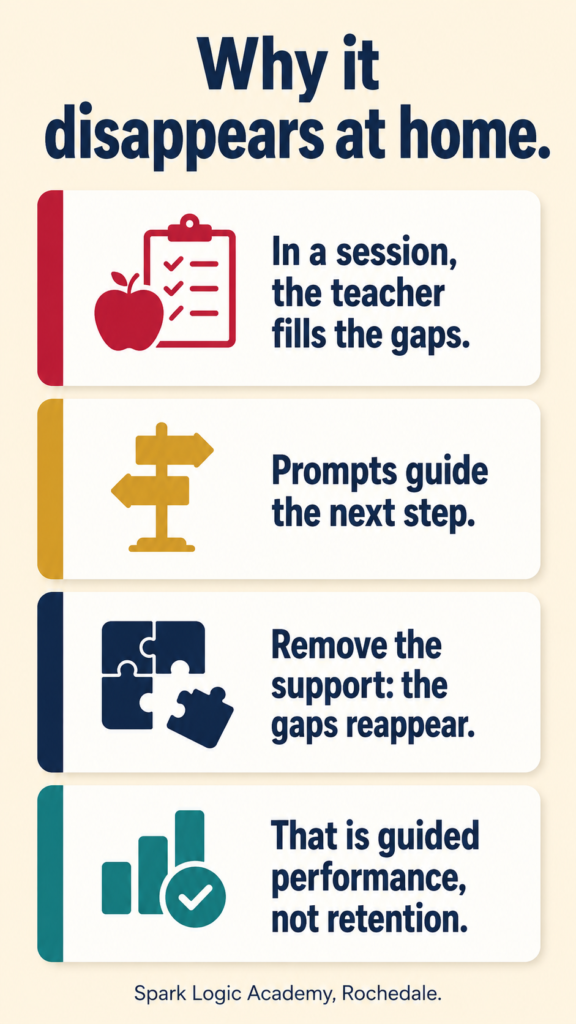
In a guided session, a teacher or tutor is present throughout. They do more than explain the concept. They fill in the gaps as they appear. They prompt the next step when a student pauses. They confirm when the student is heading in the right direction and redirect when they are not. They answer questions in the moment and adjust their explanation when something has not landed.
Under those conditions, most students can perform correctly. The session feels productive. The student feels confident. The parent watching feels reassured. All of this is real. The student is genuinely doing the work, and doing it correctly.
But what is supporting that performance is worth examining. A significant part of what makes the session work is the presence of the teacher. The teacher is filling in pieces that the student has not yet fully consolidated. The student is performing correctly, but some of that performance is borrowed from the structure around them.
Homework is independent work. There is no teacher present to fill in the gaps, prompt the next step, or confirm the direction. The student has to retrieve what they know entirely from their own understanding, without any scaffolding around them.
When a student sits down to do homework and finds that they cannot access what seemed clear in the session, they are not being lazy or forgetful. They are experiencing the difference between guided performance and genuine independent retention. Those are two different things, and they are easy to confuse because they look identical from the outside during a session.
The concept was not fully retained. It was partly borrowed from the support that was present during the session. Remove the support, and the gap that was being bridged becomes visible.
This pattern is common because of how learning actually works. Understanding something in the moment and being able to retrieve it independently later are two different stages of the learning process. A student can reach the first stage without yet reaching the second.
In a classroom or tutoring session, the conditions that support the first stage are always present. A teacher who is good at their job creates an environment where most students can follow along and perform correctly. That is exactly what a good session should do. But the second stage, genuine independent retention, requires a different kind of practice: working at the right level, retrieving the concept without support, and doing so repeatedly over time.
Sometimes the pattern points to something more specific than consolidation. If a student consistently understands guided explanations but cannot work independently, it is worth asking whether there is a gap in an earlier concept that the current work is building on.
In a session, a teacher can bridge that gap without either of them realising it. The explanation naturally covers the missing piece. The student follows the logic correctly. But at home, without that bridging, the gap reappears. The student cannot do the current work because the earlier piece it depends on is not there.
This is a different problem from consolidation, and it requires a different solution. Finding the gap and addressing it directly is what changes the pattern of independent performance.
Doing more guided sessions without addressing independent retrieval can reinforce guided performance without building genuine retention. The student continues to perform correctly in sessions, and the problem stays invisible until homework time. The sessions are not wasted, but they are not solving the right problem.
A student who cannot retrieve a concept independently is not choosing not to. They are missing something, either the independent consolidation of what was taught or a piece of the foundation underneath it. Applying pressure or increasing expectations does not address either of those things.
The gap between session performance and independent performance is not a sign that the teaching was poor. It is a sign that the next stage of the work, building independent retention, has not yet happened. That is a solvable problem, not a reflection of anyone’s quality.
The most useful step is to find where the student can work independently without any prompting. This is almost never at the level the current homework assumes. Going back to find that level and building from there is what produces genuine independent retention, rather than coached performance.
If the pattern suggests a gap in an earlier concept, addressing that gap directly is what changes the experience of independent work. Once the underlying piece is in place, the current work becomes accessible without support, and the pattern of understanding in the session but forgetting at home begins to shift.
When a family describes this pattern at Spark Logic Academy, the free 30-minute trial assessment is designed to find out what is actually behind it.
The session is one-on-one and low-pressure. The goal is to find where the student can work independently without support, not to measure them against their year level. In many cases, within a single session, it becomes clear whether the pattern reflects a consolidation issue or a gap in an earlier foundation. That is the starting point for the work that follows.
Students who begin working at the right level, the level where independent recall is actually possible, tend to find that the experience of homework changes. What felt impossible without support starts to feel manageable. The pattern of understanding in the session but losing it at home begins to resolve as the gap is addressed.
You can also read related guides at Spark Logic Academy: why children suddenly fall behind after doing fine, whether homework resistance is normal or a warning sign, and the difference between a struggling student and a bored one.
30 minutes. One-on-one. Find where the understanding actually sits. Every new student. Ages 3 to 12. Small groups. Qualified teachers. Rochedale, Brisbane.
WhatsApp: 0494 719 869
Tel: 0417 226 366 | info@sparklogicacademy.com.au
11 Lorisch Way, Rochedale QLD 4123
Is this the same as having a bad memory?
Not usually. What looks like forgetting is often the absence of independent consolidation, not a memory problem. A student who performed correctly with support but cannot retrieve the same material without it has not experienced a memory failure. They have experienced the removal of the scaffolding that was making the performance possible. The material was never fully consolidated to the point of independent recall. That is a different problem, and a much more solvable one.My student does fine in tests at school. Why is homework different?
Tests at school often follow a period of classroom instruction where the concept is fresh and recently practiced. Homework often arrives after a gap, without the benefit of that immediate context. Some tests also follow a format that allows students to work through familiar question types, which can mask gaps in genuine understanding. Homework that requires independent retrieval without that support is a different demand. When the two diverge significantly, the homework picture is usually the more accurate one.How long should it take before something is genuinely retained?
It depends on the concept, the student, and whether the foundation underneath it is solid. For a concept that builds on a secure foundation and is practiced independently at the right level, genuine retention can develop within a few weeks of consistent work. For a concept that is sitting on an earlier gap, retention is unlikely to develop until the gap is addressed. In that case, the timeline depends on how long it takes to identify and close the underlying piece.Should I sit with my student while they do homework to help?
It depends on the kind of help you are providing. Being present in the room but not actively filling in gaps is fine, particularly for younger students. Answering questions, explaining steps, or walking them through problems is a different matter. That replicates the guided session conditions, which means the homework gets done but the gap stays hidden. If you notice that your student cannot start or cannot continue without your active input every session, that pattern is worth paying attention to rather than resolving by stepping in.








Your information will never be shared with any third party