


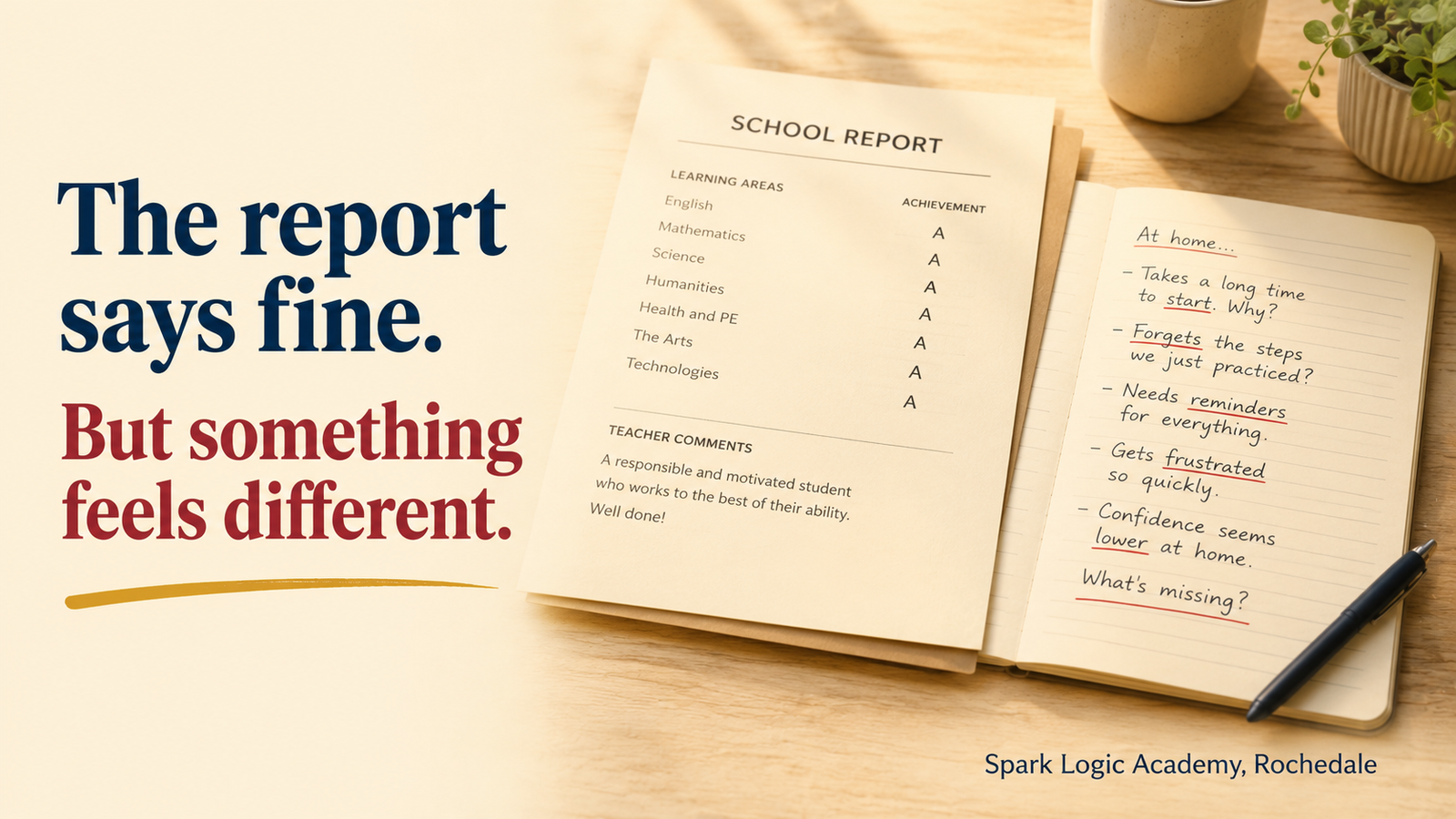
The teacher says there is nothing to worry about. The grades are passing. The reports are positive. Your child is recorded as doing fine. But at home, something feels different, and you are not sure how to name it or whether you are right to be concerned.
This is one of the most common situations parents describe when they first contact Spark Logic Academy. This guide explains why the school report and the parent’s experience can tell very different stories, and what that gap usually means.
In a class of thirty students, a teacher is assessing each child against the group. A child who completes their work, keeps up with the class, and does not raise concerns is recorded as performing adequately. The report reflects how the child is doing relative to their year level peers and the curriculum benchmarks for that period.
What the report does not capture is your child’s own individual baseline. It does not show whether they are performing at the level they were capable of six months ago, or whether that level is quietly changing. It does not record the quality of effort required to produce the same result, or whether the result is being maintained only because of significant support at home.
A child can appear fine in a class of thirty while something in their foundation is slowly shifting. This is not unusual, and it is not a failure of teaching. It is simply what class-level assessment can and cannot see.
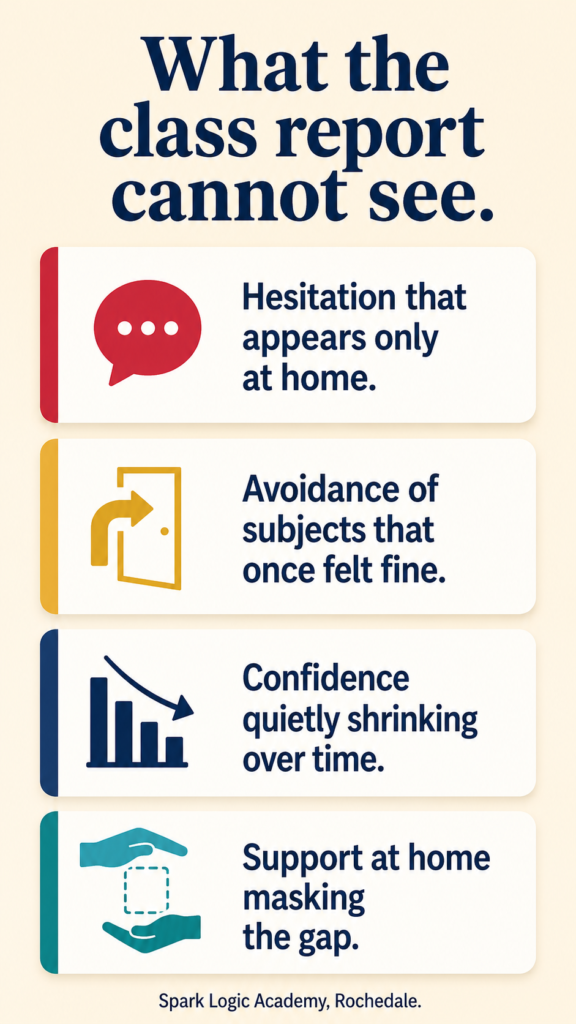
Parents have access to information that the classroom does not provide. You see the hesitation before homework that was not there six months ago. You notice the avoidance of particular subjects, the complaints that have a different quality to ordinary resistance, the reluctance to attempt something independently when once they would have tried.
You observe the confidence. Not the confidence they perform in front of others, but the quieter one, the one that shows up when they sit down with something difficult. A shift in that confidence, even a slow and gradual one, tends to register with parents before it shows up in results.
These observations are not anxiety or overprotection. They are often accurate readings of something real. The parent who says “I know something is not right even though the reports are fine” is usually identifying a pattern that is genuinely there.
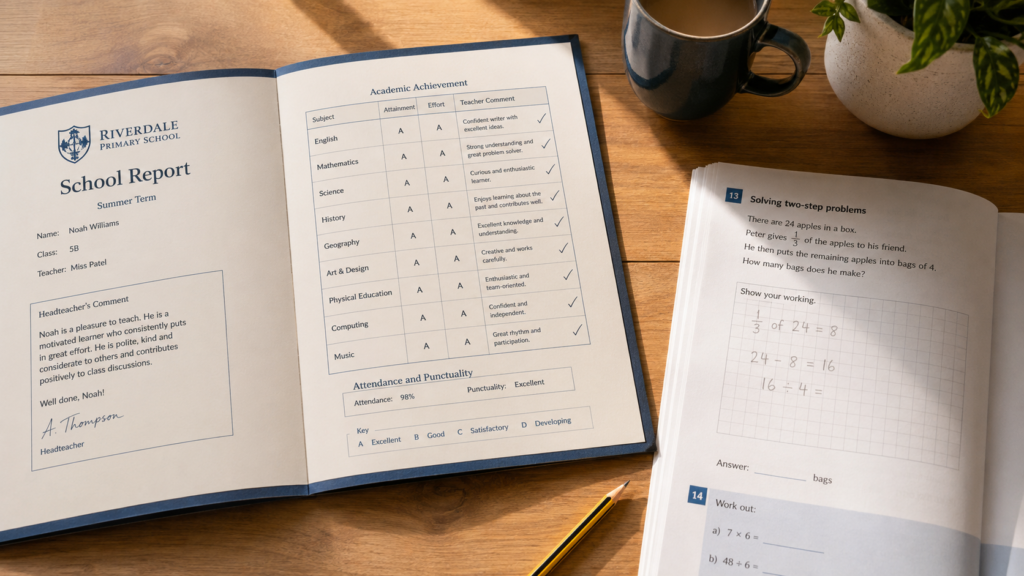
There are several reasons a learning gap can remain hidden in positive school reports for an extended period.
A child assessed against a class average is measured at a single point in time against a fixed benchmark. A downward trend in their individual performance can be invisible if they remain above the benchmark. The report shows where they are today, not whether they are moving toward or away from their potential.
When a parent sits with a child during homework, explains steps, re-reads questions together, or helps them organise their thinking, that support does not appear in the school result. The result looks independent even when significant support is going into producing it. The gap becomes visible when the support is removed and the child has to work alone.
A sudden fall in performance is easy to notice. A gradual erosion of confidence or a slowly widening gap in a specific area is much harder to track within a busy classroom. By the time it becomes visible in results, it has often been present for considerably longer.
Parent instinct about a child’s learning is worth investigating rather than dismissing. If what you are observing at home is inconsistent with the report, the most useful question is not “who is right” but “what am I seeing that the report is not capturing, and why?”
A single difficult homework session is not a signal. A consistent pattern of hesitation, avoidance, or reduced confidence over several weeks is. The pattern is what tells you whether something is shifting.
The most revealing question is not what your child can do with help, but what they can do without it. A child who can only complete work with significant adult support is in a different position from one who can work independently at their level. Finding that level, and working from there, is what produces genuine progress rather than managed performance.
When parents describe this pattern at Spark Logic Academy, the free 30-minute one-on-one trial assessment is designed to find what the school report did not show.
The session is not a test against the year level. It starts from where the child can work comfortably and independently, without prompting or support, and identifies whether that level is where it should be. In many cases, within a single session, it becomes clear whether there is a gap in the foundation and, if so, where it is sitting.
This is different from the kind of information a school report provides. The report reflects the class. The trial finds the individual starting point. That distinction matters because work at the wrong level, even skilled work, does not close the right gap.
You can also read related guides at Spark Logic Academy: why children suddenly fall behind after doing fine, why a child understands in the session but forgets at home, and whether homework resistance is normal or a warning sign.
30 minutes. One-on-one. Find what the school report did not. Every new student. Ages 3 to 12. Small groups. Qualified teachers. Rochedale, Brisbane.
WhatsApp: 0494 719 869
Tel: 0417 226 366 | info@sparklogicacademy.com.au
11 Lorisch Way, Rochedale QLD 4123
Should I tell the teacher I am concerned even if the report is positive?
Yes. A conversation with the teacher is useful not because the report is wrong, but because you have information the teacher does not have access to. What you observe at home, the patterns of hesitation, avoidance, and changes in confidence, is relevant context. A good teacher will take that seriously. If the response is dismissive, the parent’s concern does not go away, and the most useful step is to investigate independently rather than wait for the report to confirm what you are already seeing.Is it possible for a child to appear fine at school and genuinely have a gap?
Yes, and it is more common than most parents expect. School assessment is designed to track progress against curriculum benchmarks at the class level. A child who is meeting those benchmarks while their individual baseline quietly erodes can remain categorised as fine for a significant period. The gap tends to become visible in reports only once it has grown large enough to affect performance relative to the class, by which point it has usually been present for considerably longer.What if my child performs well in the trial session and there is no gap?
That is a useful outcome too. If the trial session finds no gap, and the child can work comfortably and independently at or above their expected level, the session will show that clearly. In that case, the concern may be about something other than a foundation gap, and the conversation can focus on what is actually behind what you are seeing at home. Either way, you will have more specific information than the school report provides.How quickly can a gap become visible once I know what to look for?
In a single one-on-one session, it is usually possible to identify whether a gap is present and roughly where it sits. The session is not designed to be exhaustive, but to find the level at which the child can work independently. That finding, even if approximate, is more specific than a year-level assessment against a class group, and it gives a clear starting point for the work that follows.








Your information will never be shared with any third party