


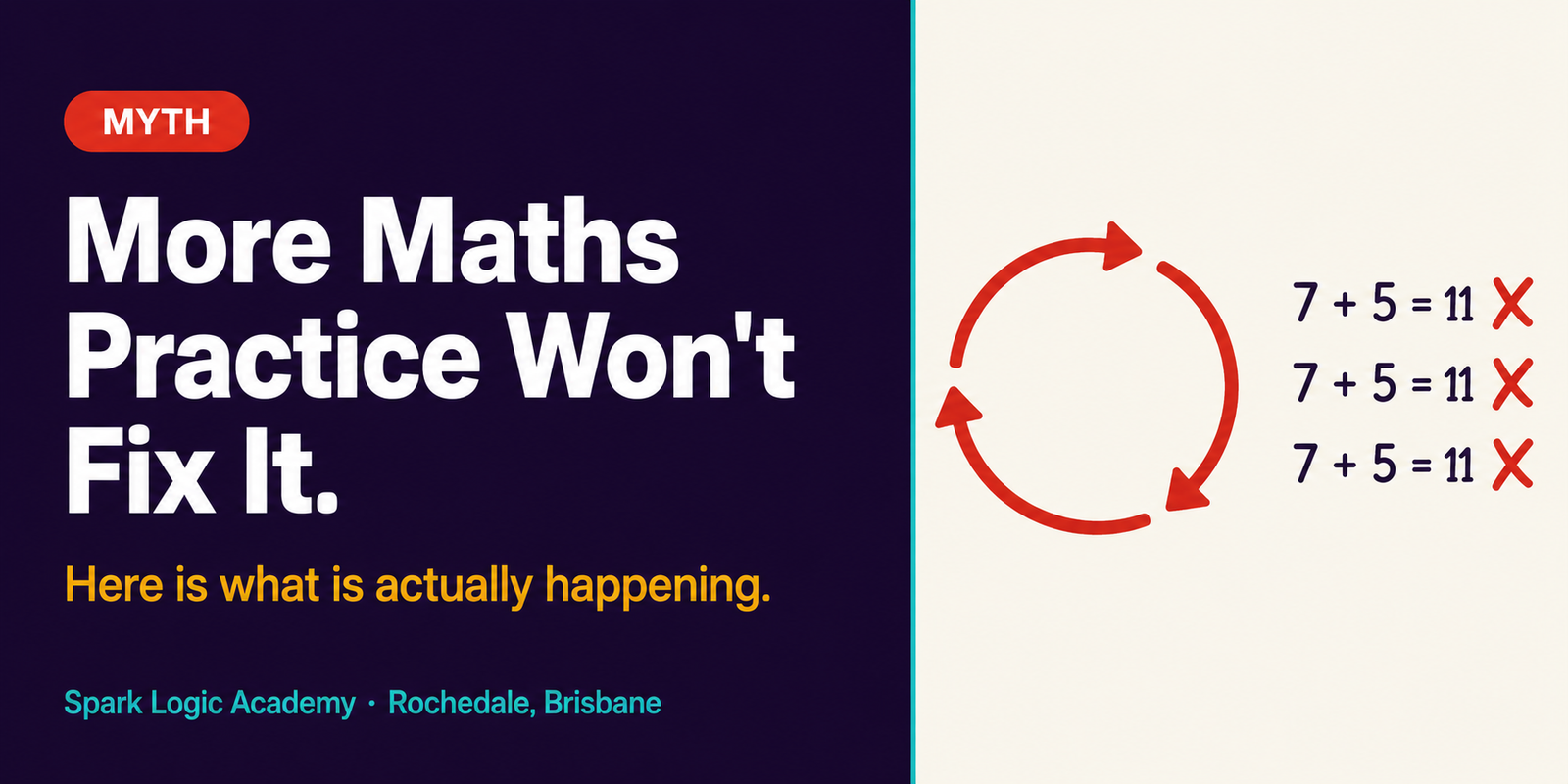
If your child sits down to practise maths every night but keeps making the same mistakes, the most natural response is to add more practice. More worksheets, more revision, more time at the table. The logic seems sound. But for a large number of children, more practice is not the answer. It is part of the problem.
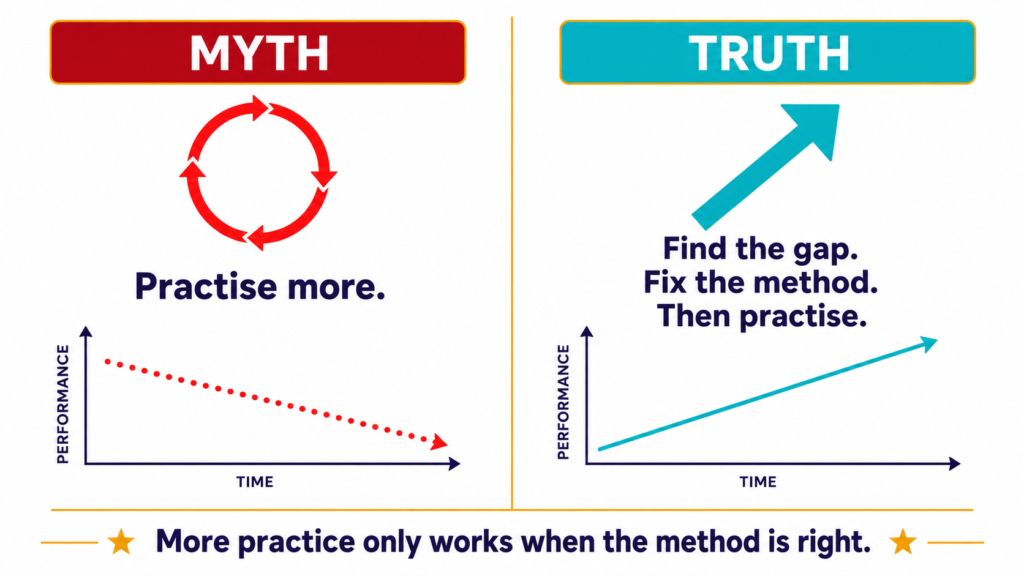
Myth
“My child just needs to practise more maths.”
Truth
If the method is wrong, practising more cements the mistake. The gap grows wider, not smaller.
This is not a criticism of effort. Most children who struggle with maths are putting in real effort. The issue is that effort applied to a broken method does not produce improvement. It produces fluency in the wrong approach. And the more confident a child becomes in that wrong approach, the harder it is to correct later.
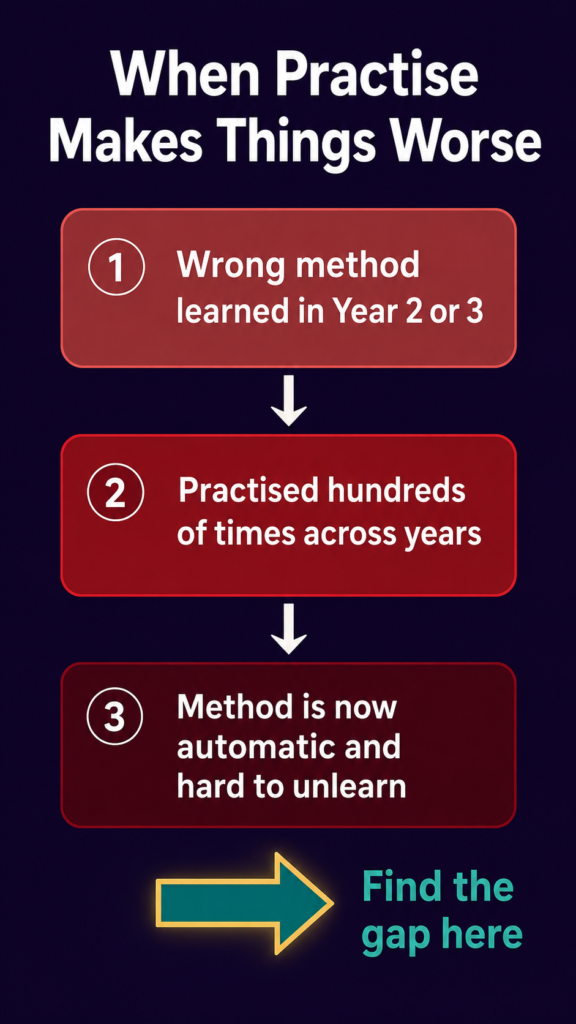
When a child does not understand why a maths process works, they still learn to execute it. They get fast at it. They get consistent at it. But what they are getting fast and consistent at is the wrong process. By the time the gap becomes obvious, it has been repeated hundreds of times and feels completely natural to the child. Unlearning it is harder than learning it was in the first place.
A child who does not understand why each step in a maths problem works will hit the same wall every time the numbers change. The method they have memorised applies only to the exact format they have seen before. As soon as the question looks different, they are lost. More practice in the same format gives the illusion of progress during revision but fails under test conditions because real understanding was never built.
Most maths difficulties at primary level trace back to one specific concept from an earlier year that was not fully understood before the class moved on. It might be place value, or fractions, or the relationship between multiplication and division. Once that foundation cracks, everything built on top of it is unstable. More practice at the current year level does nothing to identify or address a gap from two years ago. In fact, it tends to mask it, because the child is busy and appears to be working.
“A child who practises the wrong method a thousand times does not get better at maths. They get very good at being wrong.”
The starting point is identification, not more content. Before adding more practice, the question that needs answering is: where exactly did the method break down? Not which topic are they currently struggling with, but where in the foundational sequence did understanding stop and memorisation take over?
Once that point is identified, the correct approach is to rebuild from there, step by step, with methods the child can understand and explain rather than just replicate. This takes less time than most parents expect because the child’s existing knowledge and effort can be redirected rather than started from scratch.
The other critical piece is the learning environment. Children who have experienced a long run of maths frustration often carry a belief that they are simply not a maths person. That belief shapes how they engage with every session, whether at school or at home. Small group environments, where mistakes are part of the process and understanding is the goal rather than speed, tend to rebuild both the skill and the confidence simultaneously.
Every child at Spark Logic Academy starts with a free 30-minute trial assessment. The purpose is to find exactly where the method gap sits, not to confirm that a gap exists. From there, the program is built around that specific gap, not around the current year level or homework topic. Small groups of up to 8 students, ages 3 to 12, in Rochedale, Brisbane. Maths, English Writing and Reading, Phonics, Logic, STEM and Coding.
Practice is not the enemy. Once the correct method is understood, regular practice is exactly what builds speed, fluency, and lasting confidence. The difference is that at this point, the child knows why each step works, which means they can adapt when the question changes. Fluency built on genuine understanding transfers. Fluency built on memorised steps does not.
The progression that produces real results is: identify the gap, teach the correct method, build understanding until the child can explain it, then introduce regular practice to build speed and fluency. That sequence, done properly, is usually faster than years of extra homework with the wrong foundation.
Almost certainly yes. Homework usually repeats familiar formats. Tests introduce variations. A child who has memorised a method without understanding it will perform well on familiar problems and fail when the question looks different. This is one of the clearest signs that the method rather than the effort needs attention.
In the free 30-minute trial, we work backwards through foundational concepts to find the point where understanding became memorisation. It is a conversation as much as an assessment. Children usually know where things stopped making sense, even if they cannot name it. We find it together.
Very common. Maths is cumulative. A concept that was not fully understood in Year 2 will create difficulty in every topic that builds on it. By Year 5 the symptoms look like a Year 5 problem, but the root is often much earlier. Addressing the root is faster and more effective than trying to manage the symptoms year by year.
Ages 3 to 12, from Pre-Prep Bridging through to upper primary. We offer Maths, English Writing and Reading, Phonics, Logic, and STEM and Coding programs in small groups of up to 8 students at our centre in Rochedale, Brisbane.
Free 30-minute trial assessment. We find exactly where to start, not where the curriculum says your child should be.
11 Lorisch Way, Rochedale QLD 4123








Your information will never be shared with any third party