



After six weeks of holidays, children’s brains have been in a genuinely different operating mode, low demand, self-directed, low-stakes, and largely free of sustained concentration. The first day back requires something completely different: sustained attention across multiple subjects, following instructions from multiple adults, managing a timetable, and sitting still for long stretches. That is a significant cognitive shift, and it is exhausting even for adults.
Friendships shift over holidays. Children spend much of the first day quietly working out who is still their friend, who has changed, what the social landscape looks like now, and where they fit. That social processing happens alongside all the academic demands, and it is often the part parents underestimate most. By the time they get home, the social tank is empty.
Even children who had a reasonable holiday routine experience something like routine shock on the first day back. Earlier wake up, uniform, packed bag, structured timetable, bells, transitions between classrooms or activities, each of those small demands adds friction. The body and brain that had relaxed into holiday pace are suddenly working overtime.
Many children eat poorly on the first day back. They are too busy, too anxious, or too distracted at lunch to eat properly. A hungry brain cannot regulate emotion well, which means that a significant portion of the grumpiness you are seeing tonight may simply be low blood sugar.
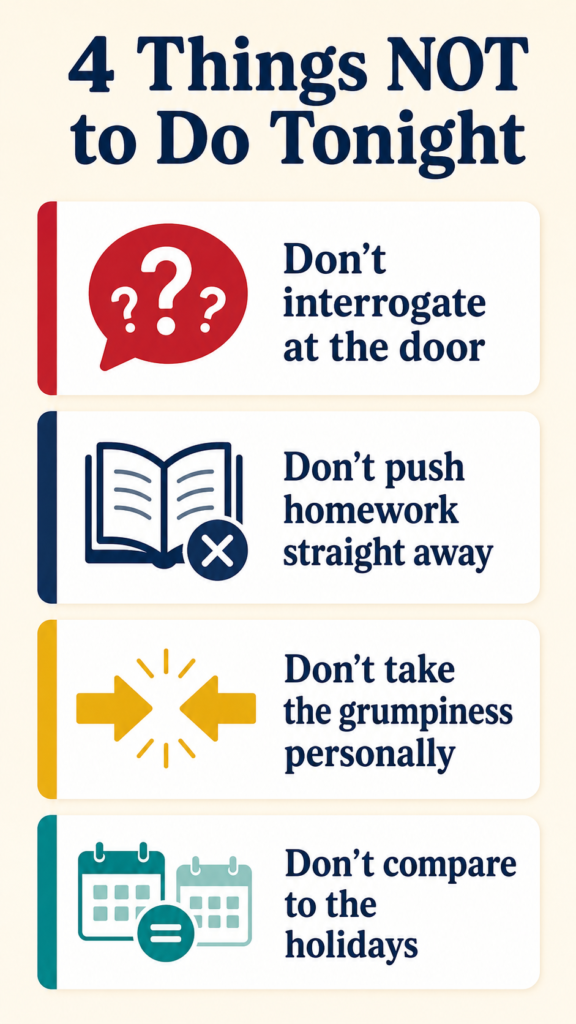
This is where most parents accidentally make things harder, with the best of intentions:
For most children, first-day grumpiness resolves by the next morning. A good night’s sleep, a normal breakfast, and the second day tends to be noticeably easier.
If the grumpiness or resistance does not ease as the week progresses, if your child is consistently flat, avoidant, or difficult throughout the first week, that is worth paying attention to.
Two things tend to produce persistent after-school grumpiness that goes beyond the first day:
Social difficulty. If something went wrong socially today, or if your child was anxious about friendships before school, the grumpiness often has a specific source. Gentle, low-pressure conversation over a few evenings usually reveals it. Children rarely volunteer this directly — they need an opening and time.
Academic anxiety. Children who are not confident in their current level of work often dread returning to school. The grumpiness you see at home can be the visible surface of anxiety about being asked to do things they find genuinely difficult. This is more common than most parents realise, and it often goes unnoticed at school where children are practised at masking it.
If the grumpiness is specifically connected to homework time, a particular subject, or the mention of school in general — that pattern is worth taking seriously. It is worth reading alongside our articles on why children resist homework and signs your child might need extra support.
If your child’s after-school grumpiness does not ease by the end of the first week, or if it is clearly connected to school subjects or homework, it is worth investigating whether there is an underlying knowledge gap driving it.
At Spark Logic Academy in Rochedale, we regularly work with children who appear to be struggling with attitude or motivation, where the actual driver is that the schoolwork has quietly become too hard and they have not said so. A free 30-minute trial assessment identifies exactly where a child’s understanding sits — and whether there is a gap worth addressing before it compounds further through Term 3.
Every new student starts with a free trial. Small groups of up to 8. Qualified teachers across Maths, English, Science, Coding and more. Ages 3 to 12. Rochedale, Brisbane.
Find out exactly what is making school hard. Free 30-minute trial for every new student. Small groups. Qualified teachers. Ages 3 to 12. Rochedale, Brisbane. Term 3 places available now.
WhatsApp: 0494 719 869
Tel: 0417 226 366 | info@sparklogicacademy.com.au
11 Lorisch Way, Rochedale QLD 4123
Is it normal for my child to be grumpy after the first day back at school?
Yes — extremely common. The first day back requires significant cognitive and social effort after weeks of unstructured time. Most children hit a wall when they get home and it comes out as grumpiness, silence, or irritability. It is rarely a sign of a problem and almost always resolves after rest and food.
How long should first-day grumpiness last?
Most children are noticeably better by the next morning. The first week back can be tiring, and some grumpiness in the afternoons is normal for several days. If your child is still consistently flat or difficult by the end of the first week, that is worth paying more attention to.
Should I make my child do homework on the first night back?
In most cases, no — or at least not immediately. Give them time to recover first. A depleted child who is forced into homework immediately after school often produces poor work and more resistance. An hour of decompression, a snack, and a calmer child will get more productive homework done in less time.
What if my child refuses to talk about their day at all?
This is very normal, especially after an exhausting first day. Do not push. Try low-demand, specific questions after they have eaten and rested — “anything annoying happen?” or “what was lunch like?” tends to open things up better than “tell me about your day.” Some children need an hour or two before they can talk.
When should after-school grumpiness become a concern?
If grumpiness persists beyond the first week, is specifically connected to homework or a subject, or if your child seems anxious rather than just tired — it is worth investigating further. Persistent academic anxiety often presents as mood and behaviour at home before it shows up at school.








Your information will never be shared with any third party