



Your child sits at the kitchen table and works through the maths. You explain it, they follow along, they do a few on their own, and they get them right. You feel reasonably confident they understand it. Then a few days later the test comes back and it is like they have never seen the topic before. No working out. Wrong answers. Blank spaces.
This is one of the most common things parents describe to us. It is frustrating, and it is genuinely confusing. And it tends to lead parents in a few wrong directions before they find what actually helps.
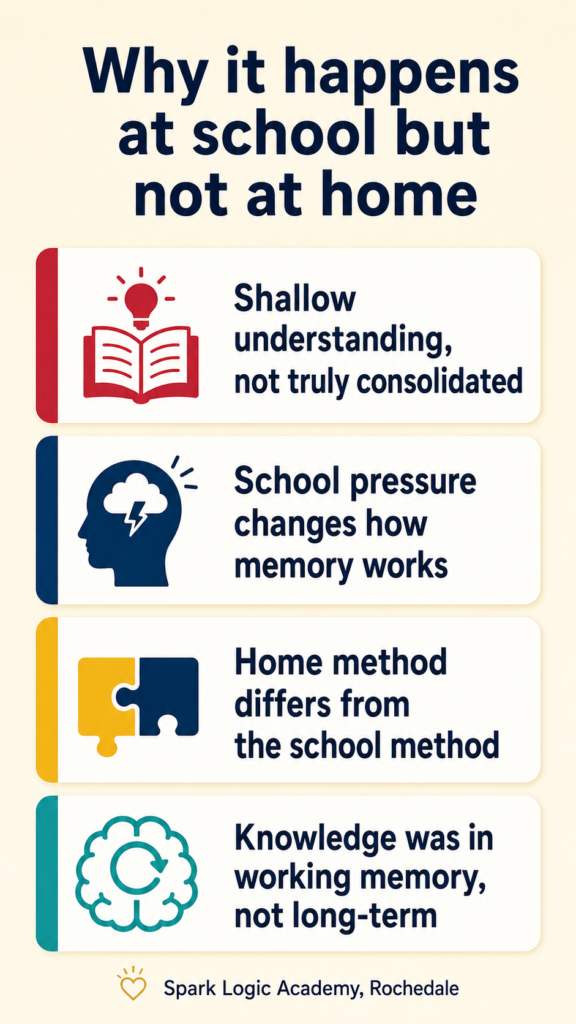
Here are a few reasons this pattern tends to happen, and what is worth paying attention to.
These are patterns that many families notice. They are not diagnoses, and more than one of them can apply at the same time.
There is a difference between a child who understands a worked example and a child who has understood the underlying idea. When you sit beside them and walk through the steps, they are often following your logic rather than building their own. They can complete the next question correctly because the pattern is still fresh and you are there to confirm each step. When they sit down at school without that scaffolding, the pattern is gone because it was never fully theirs yet.
This is not a reflection on the child. It is just how learning tends to work at the early stages of a new concept. It usually takes more varied practice across different conditions before understanding becomes retrievable anywhere.
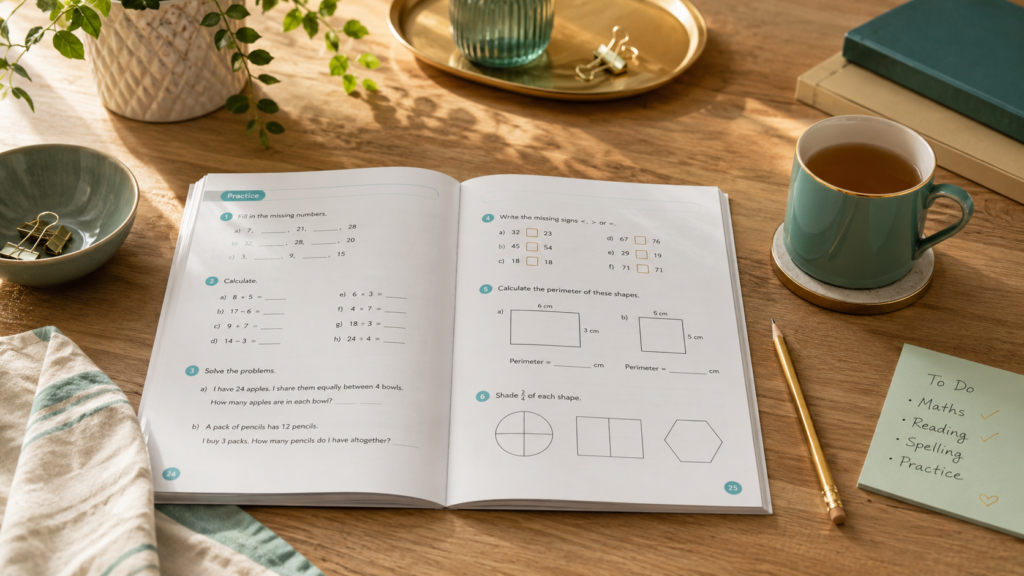
Many children perform noticeably differently when they know they are being assessed. This is not unusual at all. The combination of time pressure, the physical classroom environment, surrounding classmates, and awareness that the answer matters can all affect how readily a child accesses what they know. Some children find this motivating. Others find it genuinely interfering, and their performance under those conditions does not reflect what they actually know.
If your child does well in relaxed conditions and struggles in assessed ones specifically, that is a pattern worth noting.
This one catches many parents off guard. Modern primary maths in particular uses specific methods and language that differ from how most adults were taught. If you explained something at home using a different approach, your child may have understood your method without connecting it to what their teacher is asking for. At school, the question looks unfamiliar even if the underlying concept is the same.
If this is happening, it is not that your explanation was wrong. It is just that the connection between the two methods has not been made yet.
When children learn something new and then practise it immediately, they can often do it correctly in that session. But if they do not revisit it again before the assessment, what felt like understanding at the time can fade more quickly than expected. Working through homework the night before it is due, for instance, often produces good results in the moment but limited retention a week later.
This is not about intelligence or effort. It is about how memory consolidation tends to work, and how spaced practice over time builds more durable recall than a single session does.
Most children go through periods where their home performance and school performance do not match. That is fairly normal, especially early in a new topic or at the start of a new term.
The pattern becomes more worth investigating when it is consistent across multiple subjects, when it has been happening for more than a few weeks, or when the gap between what a child can do at home and what they produce at school is significant and growing.
In those cases, the most useful thing is not more practice at home. It is a clear picture of where the understanding actually sits, what is solid, what is shaky, and what the gap between their current level and their year level looks like. That is what makes it possible to address the right thing rather than just doing more of what is not working.
At Spark Logic Academy in Rochedale, our free 30-minute trial assessment does exactly that. It is not a test. It is a structured conversation with a qualified teacher that maps where your child’s understanding is sitting across their core subjects. You can also read more in our guides on how long homework should take by year level and why children resist homework and what that usually signals.
30 minutes. Find out where your child’s understanding actually sits. Free for every new student. Small groups. Qualified teachers. Ages 3 to 12. Rochedale, Brisbane. Term 3 places available now.
WhatsApp: 0494 719 869
Tel: 0417 226 366 | info@sparklogicacademy.com.au
11 Lorisch Way, Rochedale QLD 4123
Why does my child get maths right at home but wrong at school?
There are a few things that commonly contribute to this. The understanding built at home may have been shallower than it appeared, based on following your steps rather than independently grasping the concept. The school environment may add pressure that affects recall. Or the method used at home may differ from what the teacher is using, which means the answer looks familiar at home but the question looks unfamiliar at school. Any of these can produce the pattern you are describing.Is it possible my child is just anxious at school?
It is possible, and it is worth paying attention to. Some children perform noticeably differently when they know they are being assessed. If your child consistently does well in relaxed or informal settings and struggles specifically when they know something is being marked or observed, that gap in performance is worth noting. A conversation with the classroom teacher can help clarify whether this pattern is visible at school as well.Should I teach my child maths differently at home?
Not necessarily differently, but more closely aligned with what the teacher is doing. Modern primary maths uses particular methods and language. If your approach at home uses different steps or terminology, your child may understand your version without being able to apply it to the way the question is framed at school. Ask the teacher which methods are being used and try to support those rather than introducing a parallel approach.How do I know if my child actually understands something or just thinks they do?
Ask them to explain it to you without doing a question. A child who genuinely understands something can usually put it in their own words, even simply. If they can only demonstrate it by working through a specific example they have seen before, that is a sign the understanding is narrower than it needs to be. The ability to explain is often a more reliable indicator than the ability to answer correctly in context.At what point should we get extra help?
If the gap between home performance and school performance has been consistent for more than a few weeks, or if it is showing up across more than one subject, it is worth getting a clearer picture of where the understanding actually sits. Not to add more pressure, but to identify what is solid and what needs building. A structured assessment with a qualified teacher is usually the most efficient way to find that out.








Your information will never be shared with any third party