


You worked through a maths concept together and they got every example right. A few days later, you ask about it and they stare at you as if you have never mentioned it. No recognition. No partial recall. Just a blank look, and the quiet frustration of wondering whether last session ever happened at all.
This is one of the most common things parents describe, and it is almost never a sign that something is seriously wrong. There are usually a few specific things going on that explain the forgetting, and knowing what they are makes it considerably easier to respond.
These tend to be patterns rather than diagnoses. More than one may apply at the same time.
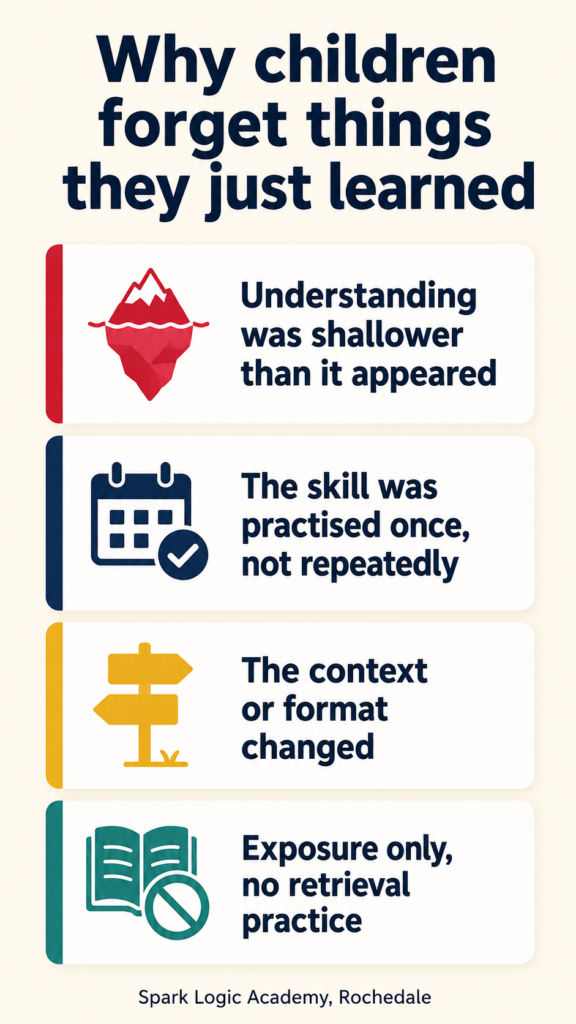
It is easy to mistake performance for understanding. A child who can answer a question correctly when the explanation is still fresh in their mind may simply be following a pattern they just observed, rather than understanding the concept behind it. This kind of surface-level performance tends to fade quickly, because there is no deep structure holding it in place. A day or two later, the pattern has faded and the concept was never there to begin with.
This is particularly common with procedural skills in maths, where a child might follow steps correctly without understanding why those steps work. When the same skill appears in a different form, the steps no longer apply in the same way and the performance breaks down.

A single practice session tends to produce temporary retention, not durable learning. This is not a criticism of how much effort went into that session. It is simply how memory tends to work. Information that is encountered once, even with full attention and apparent understanding, decays more rapidly than information that is encountered, partially forgotten, and retrieved again across multiple sessions.
Children who seem to forget things quickly often benefit not from longer single sessions, but from shorter, repeated practice spread across several days or weeks.
Children often learn something in a specific context and then struggle to apply it when the context changes. A child who can answer ten questions about fractions on a familiar worksheet may find the same concept harder to handle in a word problem, a slightly different format, or a test setting with additional pressure.
This is not the same as not knowing the content. It is about whether the knowledge has become flexible enough to transfer across situations.
One of the most reliable predictors of retention is not how many times something is explained, but how many times the learner has to retrieve it from memory without looking at the answer. Re-reading notes, watching an explanation again, or having something explained a second time all feel productive but tend to produce weaker retention than being required to produce the answer from memory.
When children are only re-exposed to content rather than asked to retrieve it, the information often stays fragile and fades quickly.
Some degree of forgetting is entirely normal, particularly for children who are learning new content rapidly or encountering skills in narrow, single-context ways. The pattern tends to shift naturally when spaced and retrieval practice become part of how studying is structured.
It is worth investigating further when forgetting is extremely rapid, when it affects a broad range of subjects at once, when the child consistently cannot retain simple foundational knowledge despite repeated practice across multiple sessions, or when the forgetting is accompanied by significant distress at learning time. In those cases, it is often more useful to look at whether there are gaps in earlier foundational knowledge that are making the current content harder to retain.
At Spark Logic Academy in Rochedale, our free 30-minute trial assessment looks at where a child’s understanding is actually sitting, not just what they can perform on a good day. You can also read more in our guides on why children seem to understand at home but forget at school, why children give up when work feels hard, and why children need daily homework reminders.
30 minutes. Find out where your child’s understanding actually sits. Free for every new student. Small groups. Qualified teachers. Ages 3 to 12. Rochedale, Brisbane. Term 3 places available now.
WhatsApp: 0494 719 869
Tel: 0417 226 366 | info@sparklogicacademy.com.au
11 Lorisch Way, Rochedale QLD 4123

Is it normal for children to forget things they just learned?
Very common. Short-term retention after a single session does not reliably predict long-term retention. Most children who seem to forget things quickly are simply not getting enough spaced or retrieval practice. The forgetting tends to reduce significantly once that changes.What is spaced practice and how does it help?
Spaced practice means revisiting the same content across multiple sessions, with gaps in between rather than covering it all at once. The gap is the part that matters. When a child returns to material after a period of time, the act of retrieving it strengthens the memory more than an equivalent amount of practice in a single sitting. Even brief reviews of older material across several sessions tend to produce stronger retention than one long study block.How can I tell if my child really understood something or just remembered it temporarily?
Ask them to explain it in their own words, or apply it to a slightly different question than the one you practised together. A child who can do this is likely working with genuine understanding. A child who can only reproduce the exact steps shown but cannot explain why they work, or cannot handle a small variation, may have surface-level familiarity rather than durable understanding.My child keeps forgetting the same thing no matter how many times it is explained. What is going on?
Repeated forgetting of a specific skill can have several causes, and most of them are not about learning difficulties. The most common causes are a gap in a prerequisite skill that makes the current skill hard to retain, a teaching approach that does not match how the child processes information, or insufficient spaced and retrieval practice. It is worth ruling these out before drawing broader conclusions. If the issue persists despite genuine spaced and retrieval practice over several weeks, that is a reasonable point to seek a more structured assessment.When should I consider getting extra support?
Extra support tends to be most useful when forgetting is rapid and widespread, when the child is falling behind in core subjects and the gap is widening, or when you suspect there are foundational gaps that are making it hard for new content to stick. A structured assessment that identifies where understanding is actually sitting, rather than what the child has been taught, tends to be the most useful starting point.








Your information will never be shared with any third party