

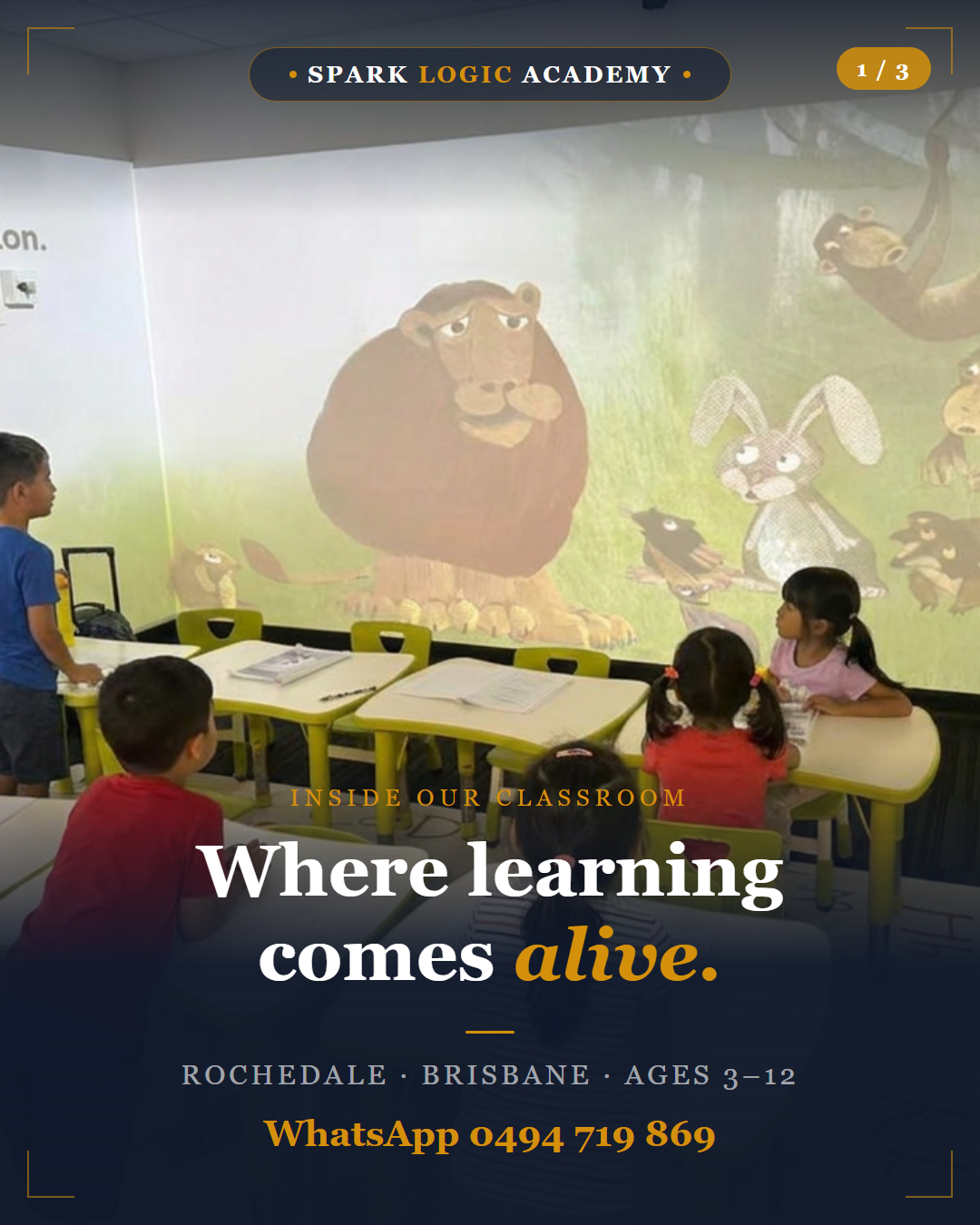
The first thing most families notice when they walk into Spark Logic Academy is the lion mural on the wall. It is hard to miss. It covers most of one wall and it was put there deliberately, because the environment children learn in matters more than most people initially expect.
This post is a look inside our classroom in Rochedale. What we built, why it is set up the way it is, and what a session actually looks like for a child who attends.
Children spend a significant amount of their life in environments they did not choose and cannot change. School classrooms, homework tables, and learning spaces designed for efficiency rather than engagement are the norm. Many children arrive at tutoring centres expecting more of the same.
The research on learning environments is consistent. Children settle faster, concentrate for longer, and recall information more reliably when they are in spaces that feel purposeful and calm. A space that has been designed for children, rather than adapted for them, communicates something to a child from the moment they walk in: that someone thought about what they needed.
This is the thinking behind every decision we have made about the Spark Logic Academy space at 11 Lorisch Way, Rochedale.
The classroom has small tables rather than a single long row. Children sit in their own space without being crowded, and the teacher can see every student at once without needing to move to the back of the room. The tables are at child height. The materials are set up before students arrive so that the session begins with clarity, not rummaging.
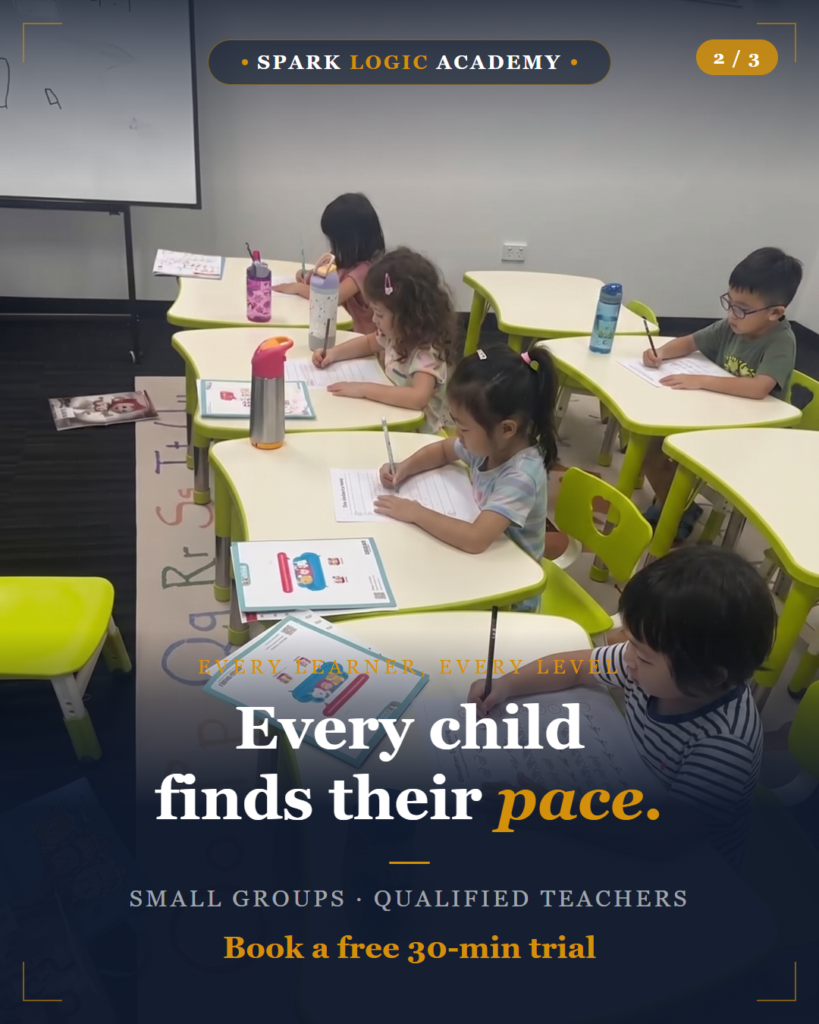
Every group at Spark Logic Academy has a maximum of eight students. This is a firm limit, not an average. It means that throughout any session, a teacher has genuine visibility over what each individual student is doing and whether they are following, struggling, or ready to move forward.
In a group of eight, a teacher can redirect a child who has drifted, answer a question from a student who is stuck, and still return to the rest of the group within a few seconds. This is the practical difference between a class of eight and a class of twenty-five. It is not just about attention. It is about the speed at which a child’s confusion gets noticed and addressed.
All teachers at Spark Logic Academy are qualified. Our team includes teachers with backgrounds in mathematics, English, early learning, and TESOL. You can read more about our teaching team here.
Students arrive and settle quickly because the routine is consistent. Materials are already out. The teacher knows each child’s current level before they sit down because progress is tracked across sessions, not re-assessed from scratch each week.
Each child works at their own level within the group. A student who is ahead of their year level is not slowed down to match the group. A student who needs more time on a concept is not moved past it because the group has moved on. This is the part of small-group learning that parents most often remark on after the first few sessions.
Sessions run for either 30 or 60 minutes depending on the program and age. The first session for every new student is a free 30-minute trial assessment, which is used to identify where the child’s understanding currently sits before placing them in the right group and level.
You can read more about common reasons families book a trial in our guides on children who give up when work gets hard, children who keep forgetting things they have just learned, and children who spend an hour on homework without making progress.
Spark Logic Academy offers programs across the following areas:
All programs run in small groups of up to eight students. Every new student begins with a free 30-minute trial assessment before joining a group, so that the placement is right from the start.
30 minutes. We find out exactly where your child’s understanding sits, then recommend the right group and level. Free for every new family. Ages 3 to 12. Rochedale, Brisbane.
WhatsApp: 0494 719 869
Tel: 0417 226 366 | info@sparklogicacademy.com.au
11 Lorisch Way, Rochedale QLD 4123
Where is Spark Logic Academy located?
Spark Logic Academy is at 11 Lorisch Way, Rochedale QLD 4123. Rochedale is in the southern suburbs of Brisbane, approximately 18 kilometres from the CBD. The centre is accessible from Sunnybank Hills, Calamvale, Stretton, Wishart, and surrounding suburbs.What ages do you teach?
Programs are available for children from age 3 through to Year 6, covering ages 3 to 12. The youngest programs include Phonics for ages 3 to 5 and our Pre-Prep Early Learning and Bridging Course. Older students join Spark Math, English Writing, Science, Logic, or STEM and Coding depending on their year level and interests.How large are the groups?
The maximum group size at Spark Logic Academy is eight students. All programs run in groups of up to eight, with a qualified teacher for each group. This limit is fixed and does not increase based on demand.What happens at the free trial?
The free 30-minute trial is a one-on-one assessment with a qualified teacher. The goal is to identify where the child’s understanding currently sits across the subjects relevant to their age and year level. At the end of the session, we give parents a clear picture of the child’s current level and recommend the right starting point if they decide to enrol.Can my child start mid-term?
Yes. Students can join at any point during the year. Each child begins with their own trial assessment and is placed at the right level regardless of where the existing group is in the program. Joining mid-term does not put a child at a disadvantage because placements are individual, not cohort-based.








Your information will never be shared with any third party