



The workbook slid across the table. Five minutes. Done. Every answer wrong. If this sounds familiar, you are not alone, and your child is almost certainly not lazy.
When a child rushes through homework and gets everything wrong, they are almost always communicating something about how the work feels right now. The rushing is a signal. And like most signals, it points somewhere specific.
This guide looks at the four most common reasons children rush through homework, what the pattern usually means, and what tends to help.
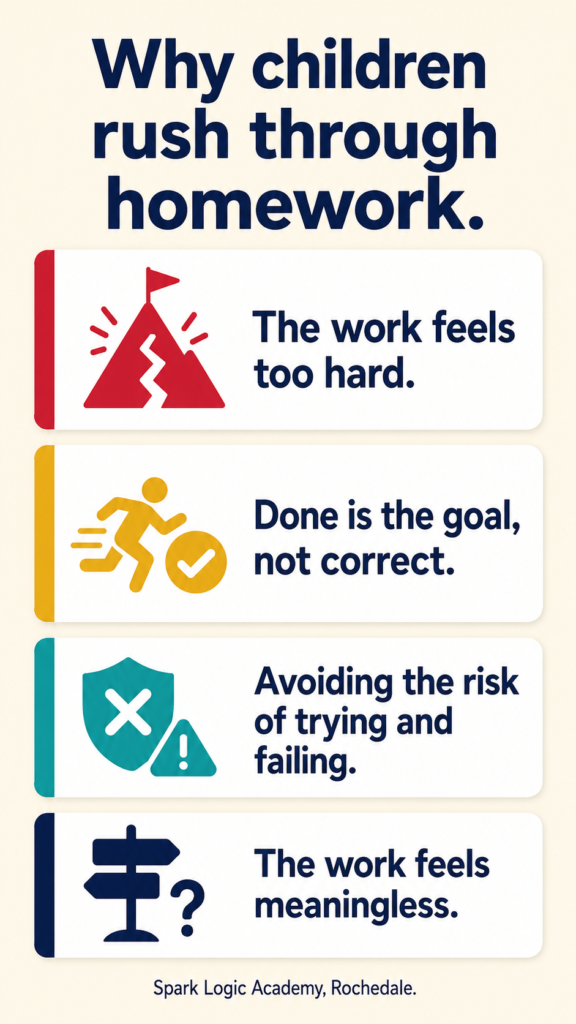
Rushing through homework is rarely about not caring. Children who rush and get everything wrong are almost always in one of four situations. Understanding which one applies changes the response entirely.
When a child does not understand the work, sitting with it feels genuinely uncomfortable. The longer they sit, the more obvious the gap becomes. Rushing through and getting it done is the exit from that discomfort.
This pattern often looks like a child who is distracted or unmotivated. In practice, what is happening is that they are completing the work in the only way available to them given their current understanding. The answers are wrong not because they did not try, but because they do not yet have the knowledge to get them right.
In many households, finishing homework is the thing that ends the obligation. Done means the table can be cleared, the device can come back, the evening can begin. Children are observant. When finishing reliably produces the reward and accuracy is rarely noticed or checked, the logical goal becomes done rather than correct.
This is not a character issue. It is a child responding rationally to the incentive structure in front of them. The work gets done as fast as possible because speed has been the thing that mattered. Changing what gets noticed changes the goal over time.
For some children, the worse outcome is not getting answers wrong. The worse outcome is putting in real effort and still getting answers wrong. That feels like evidence of something permanent about their ability. Rushing provides protection: if you did not really try, the wrong answers do not count as proof.
This tends to show up in children who have already developed some anxiety around a subject. They have decided on some level that they are not good at this. Getting it wrong confirms that. Rushing means you never really tested it, so the belief stays insulated from challenge.
Children who cannot see the connection between what they are doing and anything real or interesting will apply minimum effort. Not because they are lazy, but because rational creatures apply effort in proportion to perceived meaning. A worksheet that feels arbitrary gets the effort it deserves: enough to be done with it.
This is more common in children who are curious and engaged in other areas. The contrast between things they care about and things they are asked to do affects how they show up to the task.

Before looking at what helps, it is worth being clear about what the pattern almost never is.
The response that helps for a child who does not understand the work is very different from the response for a child who is avoiding failure, or who has learned that done is the only thing that matters. Getting the diagnosis right is the first step.
Some questions that help: Does the child rush on all subjects, or just specific ones? Do they rush more on the things they find harder? Do they rush equally on work they understand well? Is their classroom work equally rushed, or is it mainly a home behaviour?
If done has been the goal, shifting what gets commented on changes the goal over time. Noticing accuracy, asking about one question in detail, or sitting together for part of the work changes the implicit contract around homework without making it feel punitive.
The shift does not need to be dramatic to be effective. Even briefly checking one answer and asking how the child got there begins to signal that the process matters, not just the completion.
If the rushing is driven by not understanding the content, the most useful thing is to find where the understanding actually is. Not where the class is. Not where the year level says it should be. Where the child’s current, actual understanding sits.
From that specific starting point, the work begins to feel manageable. When work feels manageable, there is less urgency to rush through it.
At Spark Logic Academy, every new student starts with a free 30-minute one-on-one assessment. When a family comes in describing the homework rush pattern, the assessment is not focused on the rushing itself.
The focus is on finding what the rushing is communicating. Is the content at an appropriate level? Where does the child’s understanding actually sit? Is there specific content that is genuinely beyond them, or content that feels pointless because it is too easy? Is there evidence of avoidance behaviour around particular subject areas?
The answers to these questions determine where the real work starts. A child joining a group at Spark Logic Academy starts at the level where their understanding is solid, not at the level the school calendar requires. From that starting point, work that previously felt impossible begins to feel manageable. Manageable work gets done properly.
You can also read more in our related guides: why children give up when work feels too hard, why homework takes an hour with nothing to show for it, and what to do when your child says they are not a maths person.
30 minutes. Find out what is going on under the speed. Every new student. Ages 3 to 12. Small groups. Qualified teachers. Rochedale, Brisbane.
WhatsApp: 0494 719 869
Tel: 0417 226 366 | info@sparklogicacademy.com.au
11 Lorisch Way, Rochedale QLD 4123

Should I make my child redo all the wrong answers?
It depends on why the answers were wrong. If the child rushed because the work was too hard, making them redo it without first addressing the understanding gap usually produces frustration rather than progress. If the rushing was habitual or goal-driven, redoing a subset of answers can help shift the goal from done to correct. The most useful response is to understand which situation you are in before deciding what to do next.
My child rushes at home but seems fine at school. Why?
Home and school involve different conditions. At school, there is a teacher present, a class context, and often an expectation of visible effort. At home, the only visible outcome is completion. Children are very good at reading environments and responding to the specific incentives in them. If rushing only happens at home, the behaviour is almost certainly being shaped by what finishing homework at home has historically produced rather than by a learning difficulty.
Is this a sign of ADHD or another learning difficulty?
Rushing through work can be associated with attention difficulties, but it is far more commonly explained by one of the four reasons above. A child who rushes through work they do not understand, or who has learned that done is the goal, does not need an ADHD assessment before the behaviour can be addressed. If the behaviour persists after the underlying cause has been addressed, or if it shows up consistently across all settings and all types of tasks, it may be worth discussing with a professional. But in most cases, the explanation is simpler and more directly addressable.
How long does it take to change the pattern?
If the rushing is habit-driven, changes in the home environment can shift it within a few weeks. If it is driven by a gap in understanding, most families notice a change within the first four to six weeks at Spark Logic Academy, because the child begins experiencing genuine success at the right level. When work feels achievable, the urgency to rush through it reduces. The behaviour follows the experience rather than the other way around.
What if my child rushes even the things they know well?
If a child rushes through work they genuinely understand, the rushing is almost certainly habitual or goal-driven rather than difficulty-based. The goal has become done as fast as possible, regardless of the content. In this case, the most effective response is to change what gets noticed at home: ask about one question, sit together for part of the time, or briefly check one answer before the session ends. Over time, the implicit message shifts from done to done properly.








Your information will never be shared with any third party