



Your child sits down at the table. The homework is done in five minutes. There are no complaints, no requests for help, no visible frustration. You tell yourself this is a good sign.
In some cases it is. But in many cases, fast homework completion is a pattern worth investigating. This guide explains what it usually means and what to do about it.
Mastery leaves evidence. A child who has genuinely understood something and is consolidating it through homework practice tends to pause, re-read, self-correct, and occasionally ask questions. They slow down at the harder parts. They check their work. This is what learning looks like from the outside.
A child who flies through homework in five minutes with no visible engagement is not demonstrating mastery. They are demonstrating that the task did not require it. The homework was completed, but not necessarily processed.
There are two common reasons for consistently fast homework completion, and neither of them is a reassuring sign for long-term learning outcomes.
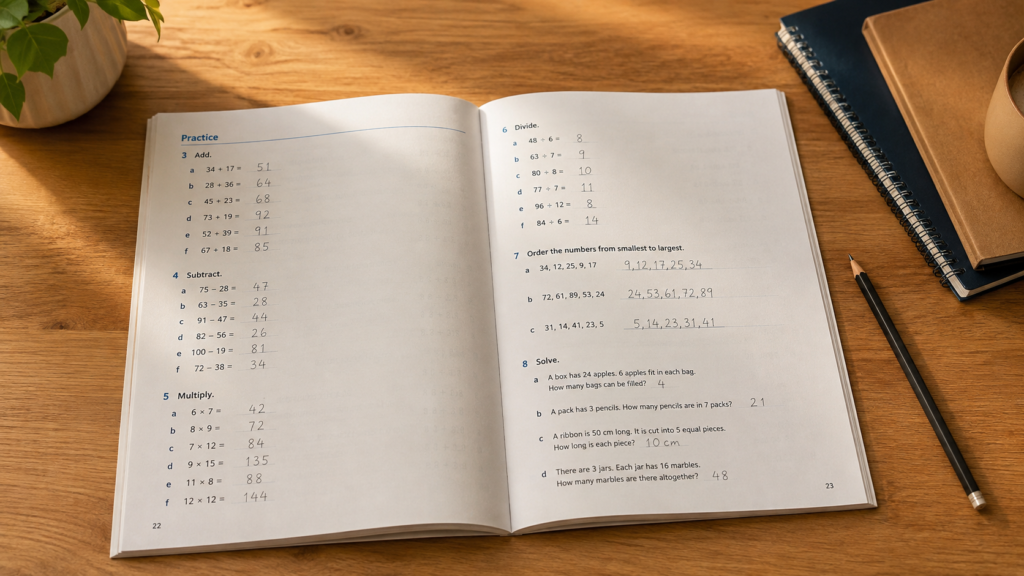
When homework sits below a child’s actual working level, they can complete it without effort. This sounds positive but it is not. A child completing tasks they already know how to do is not building new skills. They are practising something they have already consolidated, which means the homework is not functioning as a learning tool.
This pattern is common when a child has moved ahead of their year level in a subject but the homework is year-level set. It is also common when a child has strong surface fluency in a topic but has not yet encountered the more complex variations that require deeper understanding.
Some children develop a habit of completing homework as quickly as possible in order to finish the task and move on. This is not a reflection of their ability. It is a learned behaviour that prioritises speed over engagement. These children often complete work correctly on familiar question types but struggle significantly when the question format changes or the topic increases in complexity.
The habit of rushing through homework can mask a gap that does not show up until an assessment. The child appears capable and efficient at home, then underperforms on a test that asks the same content in a different way.
The discomfort of not being able to answer something immediately, of having to think through a problem, of getting something wrong and trying again, is not a sign that a child is behind. It is a sign that they are working at the edge of their current understanding, which is where genuine learning happens.
A child who never struggles with homework is a child who is not being genuinely challenged by what they are working on. The absence of struggle is not something to celebrate. It is information.
This does not mean homework should be difficult every night. It means that if homework is consistently effortless across weeks and months, that pattern is telling you something about where the work is pitched relative to where the child actually is.
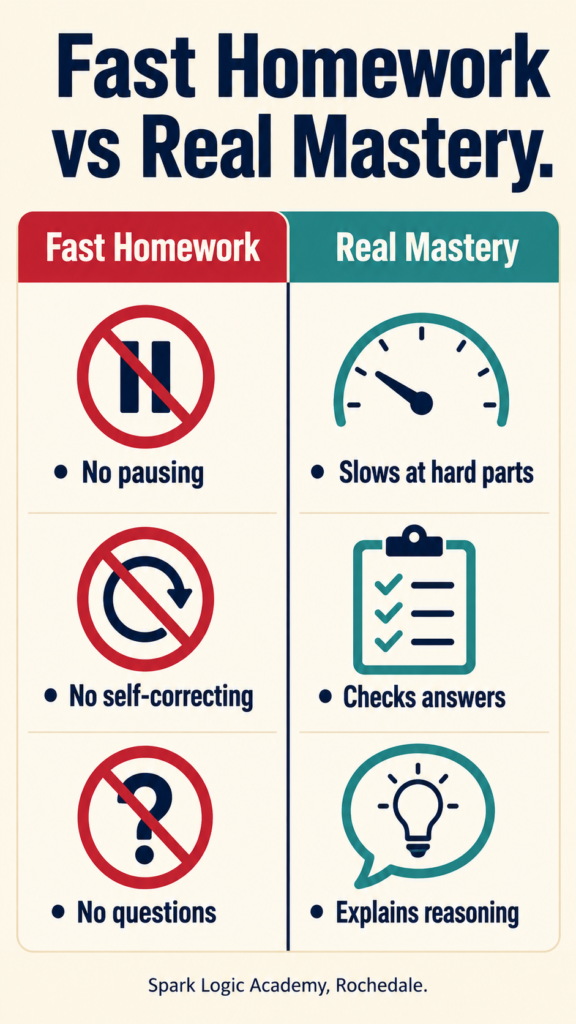
If your child finishes homework in five minutes, try giving them one question from the same topic that is slightly different in format from what they just completed. If they can answer it confidently, the speed likely reflects real fluency. If they struggle or need help, the speed reflected familiarity with the format rather than genuine understanding.
After a homework session, pick one completed question and ask your child to explain how they got the answer. A child with genuine mastery can explain their reasoning. A child who completed the work without fully engaging may be able to give the answer but not explain the process behind it.
A child who is working at their genuine level will occasionally make mistakes and then correct them. A child completing work that is too easy will rarely make mistakes, but when they do make one, they may not be able to identify it or fix it without help.
When parents describe this pattern at Spark Logic Academy, the free 30-minute one-on-one trial is designed to find where the child can work independently at genuine challenge level.
The session does not use the child’s homework as a reference point. Homework measures what a child can do with familiar formats, in their home environment, often with prompts available. The trial finds what they can do alone, without support, on material that requires real thought.
In many cases, the gap between the homework level and the independent working level is the exact explanation for the pattern parents have noticed. And in some cases, the child is genuinely ahead of their year level and needs more challenging work, which is a different kind of finding but equally useful.
You can also read related guides at Spark Logic Academy: why a child understands at home but the test results say different, what to do when the teacher says your child is fine but something feels off, and whether homework resistance is normal or a warning sign.
30 minutes. One-on-one. Find where the real level sits. Every new student. Ages 3 to 12. Small groups. Qualified teachers. Rochedale, Brisbane.
WhatsApp: 0494 719 869
Tel: 0417 226 366 | info@sparklogicacademy.com.au
11 Lorisch Way, Rochedale QLD 4123
Is it possible my child is just naturally fast and genuinely understands the work?
Yes, this is possible. Some children work at a faster pace than their peers and do have genuine fluency in certain topics. The key distinction is whether the speed is consistent across all topics or specific to certain areas, and whether they can apply the knowledge in a different format or context. A one-on-one assessment is the most reliable way to distinguish natural fluency from work that is simply pitched too low.My child’s teacher says the homework is appropriate for their year level. Should I be concerned?
Year-level homework is designed for the average range within that year group. If your child is working ahead of that range, the homework may feel effortless not because it is wrong, but because your child is ready for more. This is worth exploring, particularly if other signs suggest they are not being sufficiently challenged in class.Could rushing through homework be a sign of anxiety rather than the work being too easy?
Yes. Some children rush through homework because they find it stressful and want to finish as quickly as possible. In this case, the speed is driven by avoidance rather than fluency, and the pattern looks similar from the outside but has a different cause. Signs that anxiety may be involved include reluctance to start, physical discomfort when homework is mentioned, or a significant drop in speed when the topic changes. A low-pressure one-on-one session can help identify which pattern is present.What if my child finishes fast and also gets everything correct?
Fast and correct on familiar homework is not the same as deep understanding. The test is what happens when the format changes, the question is worded differently, or the topic appears on an assessment without the home environment and familiar cues. If fast and correct at home is followed by unexpectedly average results on tests, that gap is exactly what the trial assessment is designed to find and explain.








Your information will never be shared with any third party