


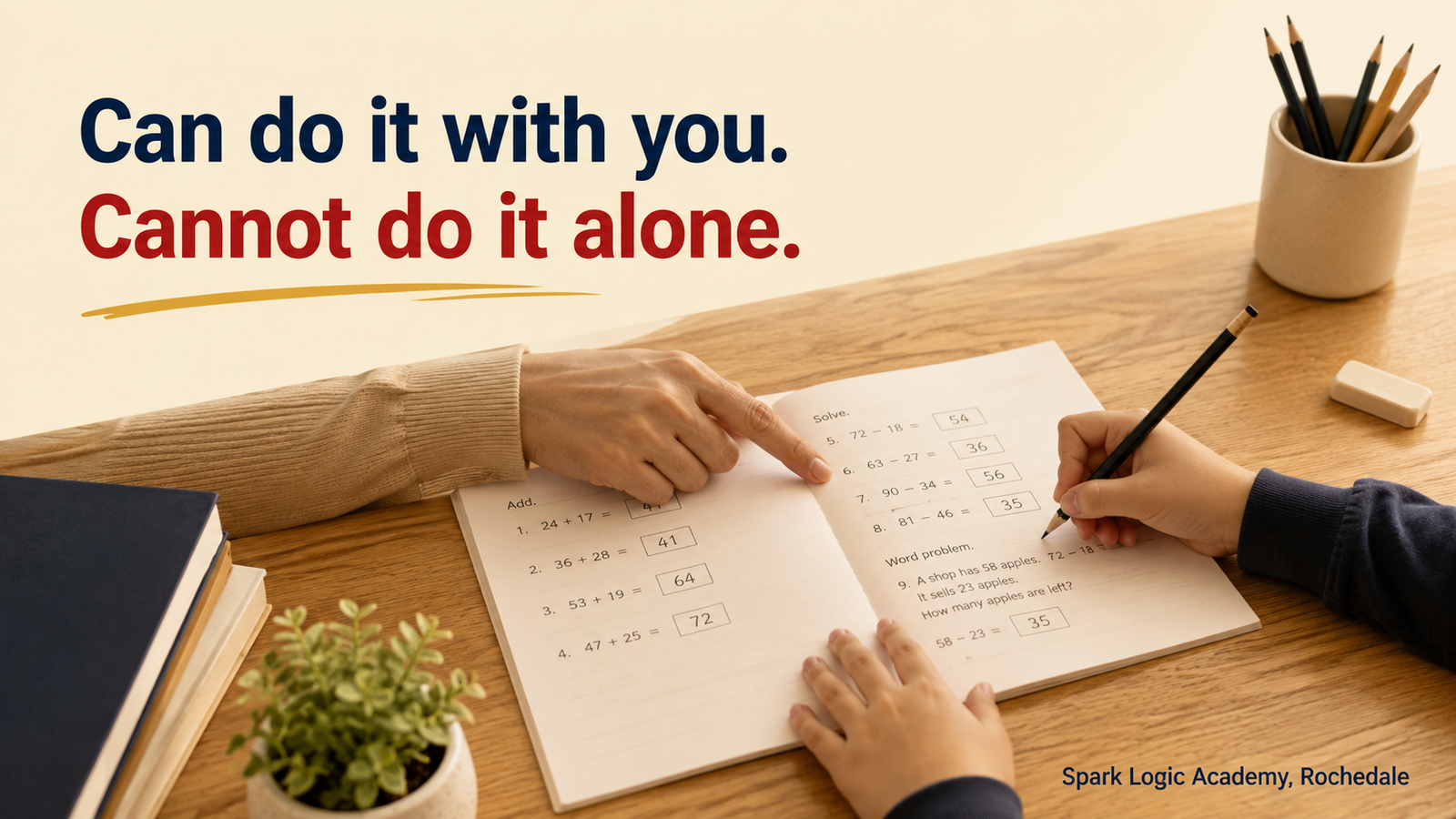
You sit down next to your child at the end of the day. You work through the homework together, step by step. They get every answer right. There are no complaints, no frustration, no requests to give up. You think: they understand this. You can step back.
The next evening, or the morning of the test, they sit down alone. The same content. No parent beside them. And they cannot start.
This pattern, a child who performs correctly with support but cannot perform independently, is one of the most important and most commonly misread signals in a child’s learning. It does not mean the child is not trying. It means the learning is not yet where it needs to be.
When a parent sits beside a child during homework, they provide support the child may not even notice is happening. A pause at the right moment when the child is about to go wrong. A slight shift in tone that signals they are on track. A redirect when the approach is not working. A quiet confirmation that the method being used is correct.
None of these need to be deliberate or explicit. They happen naturally as part of any collaborative working session. And they work. The child completes the homework correctly, with neat working and the right answers. From the outside, the session looks like evidence of understanding.
But what has actually happened is that the child has performed correctly within a scaffolded environment. The scaffolding, the invisible support provided by the adult presence, is doing part of the cognitive work. When the scaffolding is removed, so is that part of the work, and the child is left with what they can actually do alone.
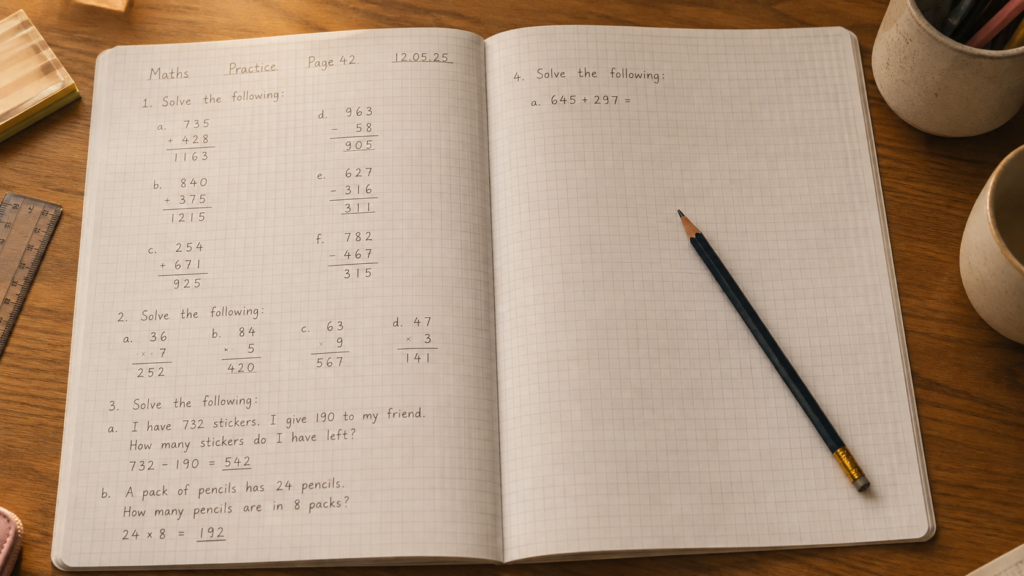
Learning, in the sense that matters for school performance and long-term development, is the ability to retrieve and apply a skill or concept independently, without prompts, without support, and in conditions that may differ slightly from the conditions under which the skill was first practised.
A child who can answer a maths question correctly when a parent is sitting beside them has demonstrated that they can perform the task in a supported context. A child who can answer the same question correctly alone, at a different time, with no adult present, has demonstrated something much closer to genuine consolidation.
Tests measure the second kind. Homework, when completed with parental support, often measures the first. The gap between those two things is where underperformance on assessments comes from.
The difficulty is that supported performance looks exactly like independent performance from the outside. The answers are correct. The child seems confident. The homework comes back completed and tidy. There is no obvious signal that anything is wrong.
Parents who sit with their children during homework are doing something genuinely helpful. The problem is not the support. The problem is that supported performance can mask the gap between what the child can do with help and what they can do without it, and that gap can go undetected for a very long time.
In many cases, the first time the gap becomes clearly visible is on an assessment. The child sits down alone with the same material they completed correctly at home and produces a very different result. This is not inconsistency or carelessness. It is the difference between scaffolded and independent working, made visible.
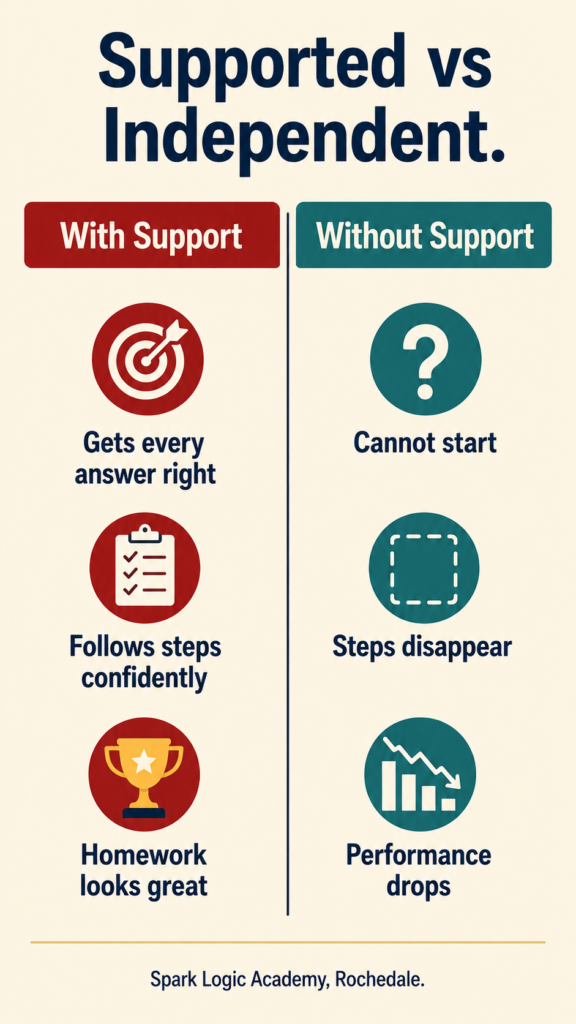
A child who can only begin a task when someone is with them has not internalised the first step of the process. Starting independently is itself a skill. A child who consistently requires a prompt to begin is signalling that their independent working level is below the level at which they perform with support.
Some children can begin a task independently but cannot sustain it. They work correctly while attention is on them but stall or go wrong when the adult steps away, even briefly. This is a version of the same pattern. The adult presence is providing ongoing support that the child’s independent capability has not yet replaced.
If a child completes a type of question correctly with support one evening and then cannot recognise or attempt the same type of question the following morning, the knowledge was not consolidated overnight. It was performed in context and then did not transfer to independent recall. This is one of the clearest signs that the supported and independent levels are significantly different.
After completing a homework task together, wait until the following morning and give your child one question of the same type, without sitting with them. Do not set up the context or remind them what they did the night before. Just present the question and see what happens. The response to that single question, without scaffolding, tells you much more about the independent level than the completed homework did.
A child who has genuinely understood a concept can explain it to someone else. After working through a homework task together, ask your child to explain to you how they would do one of the questions, as if you did not know how. A child who has consolidated the skill can do this. A child who was performing within the scaffolded session may struggle to separate the method from the context in which they used it.
Give your child a slightly different version of a question they just completed correctly. Change the numbers, the setting, or the format. A child who has understood the underlying concept will adapt. A child who performed correctly by following the familiar structure of the task may find that a surface change makes the question feel completely different.
When parents describe this pattern at Spark Logic Academy, the free 30-minute one-on-one trial is specifically designed to find the independent working level, not the supported level.
The session does not use homework as its reference point. A child’s homework, completed with parental involvement, tells us what the child can do with support. The trial finds what the child can do alone, without prompts, on material that requires genuine independent application.
In many cases, the gap between those two levels is the exact explanation for the pattern parents have noticed. Understanding where the independent level actually sits is the starting point for targeted instruction that genuinely closes the gap, rather than providing more support at the level where the child can already perform when helped.
For related reading, visit Spark Logic Academy: what it means when your child finishes homework too quickly, why a child understands at home but test results say something different, and why a child can read every word but not understand what they read.
30 minutes. One-on-one. Find the independent working level. Every new student. Ages 3 to 12. Small groups. Qualified teachers. Rochedale, Brisbane.
WhatsApp: 0494 719 869
Tel: 0417 226 366 | info@sparklogicacademy.com.au
11 Lorisch Way, Rochedale QLD 4123
Is it wrong to sit with my child during homework?
No. Parental involvement in homework is not the problem, and this guide is not suggesting you should stop. The point is that supported performance and independent performance are two different things, and homework completed with parental involvement tells you about one, not the other. Being aware of that distinction helps you ask better questions about where your child actually is, rather than assuming that correct homework means consolidated learning.My child says they understand it at home but cannot do it in the test. Is this anxiety?
It may be, but it may also be the supported versus independent gap. These two explanations can produce similar-looking outcomes: a child who performs well in a familiar, supported context and underperforms in an unfamiliar, unsupported one. The distinction matters because the response is different. Anxiety responds to strategies that address the emotional experience of testing. The supported versus independent gap responds to structured practice at the independent level. An assessment that tests the child in low-pressure, independent conditions can help identify which factor is more significant.My child insists they can do it and gets frustrated when I suggest they need more help. What should I do?
This is a common response, particularly from children who have been performing correctly in supported conditions and have internalised the experience of getting things right as evidence of understanding. It can be helpful to frame the conversation around the difference between doing something with help and doing something alone, rather than around capability. Most children can understand that even things they are good at feel harder the first few times they do them alone. The goal is not to undermine their confidence but to help them see that the independent practice is the next step, not a reflection of failure.At what age does this pattern typically become a problem?
The gap between supported and independent performance can be present at any age from the point where formal learning begins. However, it tends to become significantly more visible from around year three or four, when assessments become more frequent and the volume of material that needs to be independently recalled increases. The earlier the gap is identified, the more straightforward it is to address. But it is also very common to see this pattern identified for the first time in older primary school children, and it responds well to targeted instruction at any stage.








Your information will never be shared with any third party