

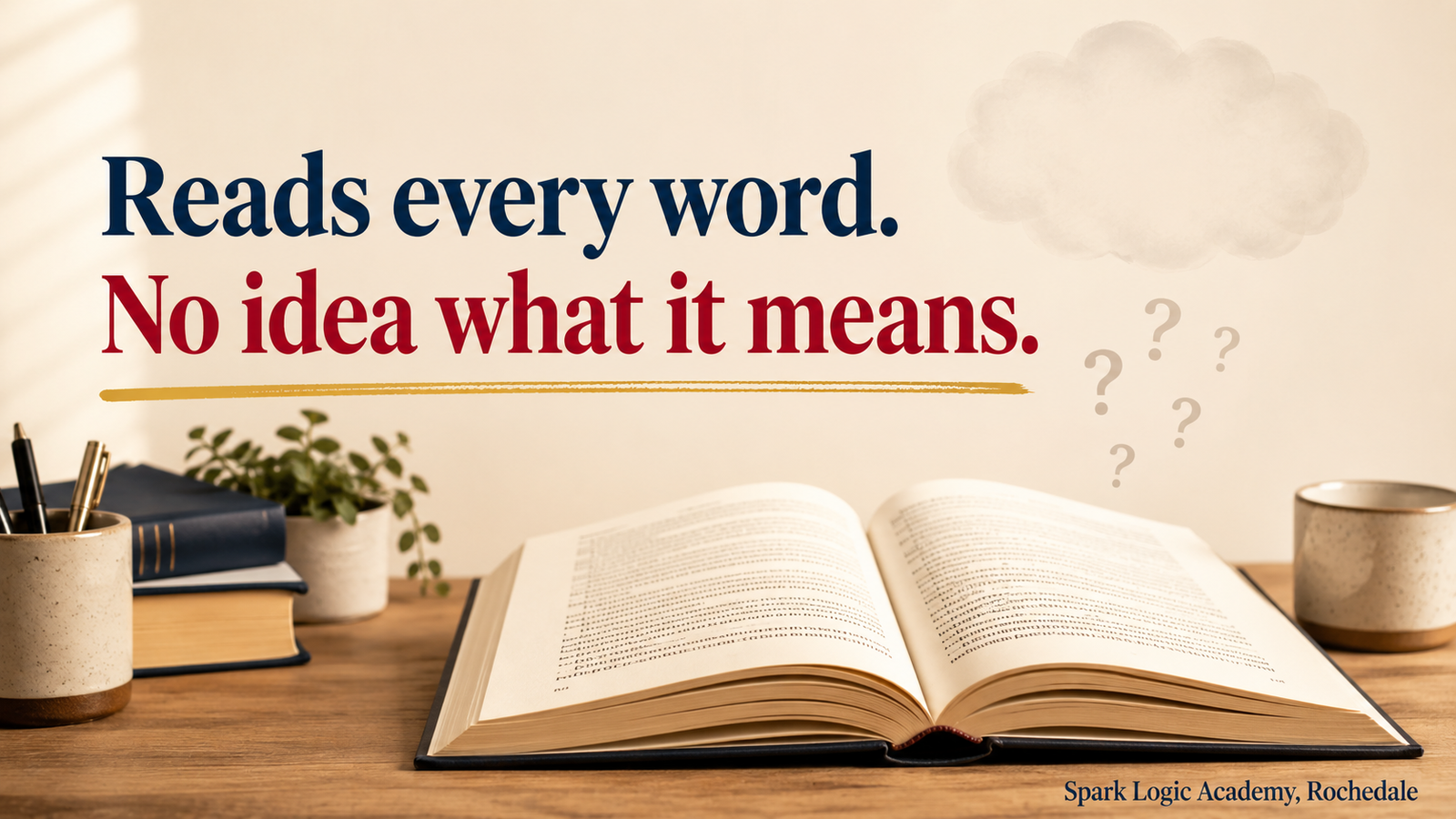
Your child picks up a book and reads every word out loud. No stumbles, no hesitation, no requests for help. You think: they can read. They are doing well.
But fluent reading and reading comprehension are two completely different skills. A child can master one without the other, and the gap between them is one of the most commonly overlooked issues in primary school English.
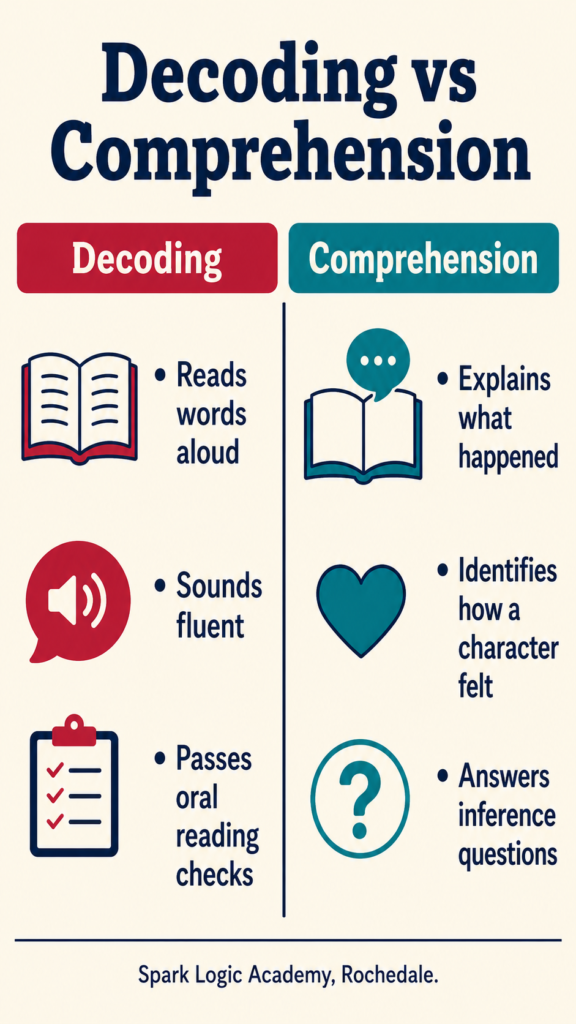
Decoding is the mechanical process of translating written symbols into sounds and words. It is what we usually mean when we say a child is learning to read. A child who can decode fluently can look at any sentence, read each word correctly, and get through the text at a reasonable pace with no visible effort.
Decoding is a skill that improves with practice. Children who read regularly tend to become fluent decoders. Their reading sounds smooth, confident, and accurate. From the outside, this looks like reading ability. It is only part of it.

Reading comprehension is a thinking skill. It is the ability to understand what a text means, not just what it says. A child with good comprehension can identify the main idea of a paragraph, explain what a character was feeling and why, infer what is implied but not directly stated, and summarise what they have just read in their own words.
Comprehension requires vocabulary depth, the ability to hold information across multiple sentences, and the capacity to connect what is being said now to what was said earlier. It also requires something decoding does not: active thinking while reading, not just active looking.
These are different cognitive processes. A child can have high decoding ability and poor comprehension at the same time. And because fluent decoding sounds impressive, the comprehension gap can go undetected for a very long time.
Most reading assessments in the early primary years focus on decoding. Teachers listen to children read aloud, note accuracy and fluency, and assess their reading level based on those observations. A child who reads every word correctly and at an appropriate pace will receive a positive reading assessment.
The problem is that reading assessments often happen orally, which tests decoding. The comprehension component only becomes visible when a child is asked to write about what they have read, answer questions independently, or explain something from the text. In many classrooms, that kind of task comes less frequently, and the gap has longer to grow before anyone notices it.
By the time the gap becomes visible, often at around year four or five when comprehension demands increase significantly, it has usually been present for two or three years. The child has spent that time practising decoding without practising the thinking skills that go alongside it.
These patterns often show up in children who are good decoders but poor comprehenders. They are worth paying attention to because each one points to a specific gap in the reading for meaning skill set.
A child who is decoding rather than comprehending can often retrieve factual information from a text. They read the sentence, recognised the words, and can repeat back what was stated directly. But questions that require inference, cause and effect reasoning, or understanding of motivation are much harder. These questions require the child to think about the text rather than just look at it.
Summarising requires the reader to identify which information is most important, organise it, and express it in their own words. A child who has been decoding without comprehending will often be able to tell you individual things that happened on a page, but not what the page was mostly about. The inability to distinguish important information from detail is a reliable sign that comprehension is not happening at a deep level.
Inference means reading between the lines. It is the ability to understand things the author did not state directly but implied through word choice, context, or the sequence of events. A fluent decoder who has not been taught to read for meaning will often pause significantly or guess when asked an inference question, even if they can decode the relevant passage without any difficulty.
After a reading session, ask your child to tell you what they just read about in one sentence. Not a retelling of every detail but a single sentence that captures the main idea. A child with good comprehension can do this. A child who has been decoding without comprehending will often start with details and find it hard to prioritise or organise them into a summary.
Find a sentence in what they just read that implies something rather than stating it directly. For example, if the text says a character walked slowly with their head down, ask how the character was feeling. A child who is reading for meaning can answer this. A child who is only decoding may give a factual answer from elsewhere in the text or say they do not know.
Ask a question that the text does not answer directly but that the reader should be able to work out from context. This is a straightforward inference test. If your child struggles consistently with this kind of question across different texts, the gap between their decoding and comprehension is likely significant enough to address.
When parents at Spark Logic Academy describe a child who reads fluently but does not seem to retain or understand what they have read, the free 30-minute one-on-one trial is designed to separate decoding ability from comprehension ability.
The session does not use oral reading as its primary measure. It uses tasks that require the child to demonstrate comprehension: summarising, inferring, identifying main ideas, and explaining their reasoning. In many cases, children who have received positive reading reports at school demonstrate a significant gap between what their decoding suggests and what their comprehension actually shows.
Understanding where the gap sits is the starting point for addressing it. A child who has been taught to decode but not to read for meaning needs a specific kind of instruction that targets thinking alongside reading. That is different from what extra reading practice alone provides.
You can read related guides at Spark Logic Academy: why a child understands at home but the test results say different, what it means when homework takes only five minutes, and what to do when the teacher says your child is fine but something feels off.
30 minutes. One-on-one. Find where decoding ends and comprehension begins. Every new student. Ages 3 to 12. Small groups. Qualified teachers. Rochedale, Brisbane.
WhatsApp: 0494 719 869
Tel: 0417 226 366 | info@sparklogicacademy.com.au
11 Lorisch Way, Rochedale QLD 4123
My child’s reading level is assessed as being at or above grade level. Can they still have a comprehension gap?
Yes. Reading level assessments in primary school often measure decoding accuracy and fluency, not comprehension depth. A child can be accurately assessed as a strong decoder and still have a significant comprehension gap. The gap tends to become visible when written comprehension tasks increase in difficulty, which typically happens around year four or five. An assessment that specifically targets comprehension rather than oral reading will give a much clearer picture.Is a comprehension gap the same as a learning difficulty?
Not necessarily. Many children with a comprehension gap have no underlying learning difficulty. They were simply taught to decode without being explicitly taught the thinking strategies that support comprehension. Explicit instruction in inference, summarising, identifying main ideas, and reading for implied meaning is not always part of standard classroom instruction, particularly in the early years when the focus is on decoding. A comprehension gap in the absence of other difficulties is often very responsive to targeted instruction.Could my child just be a slow reader who needs more practice?
More practice at decoding will not close a comprehension gap. If the issue is that a child is reading words without understanding them, reading more of the same kind of text in the same way will reinforce the habit rather than address it. What is needed is instruction that specifically targets meaning-making: asking questions while reading, predicting, inferring, and summarising. Practice without this kind of active processing tends to produce faster decoders, not better comprehenders.At what age should I be concerned about this pattern?
A comprehension gap can be present from the point where a child has achieved basic decoding fluency, which is typically around year two or three. However, it often does not show up clearly until year four or five when comprehension demands increase significantly. If you notice that your child reads fluently but struggles to explain, summarise, or answer inference questions, that pattern is worth investigating regardless of age. Earlier identification means earlier support, and comprehension skills are teachable at any primary school age.








Your information will never be shared with any third party