


You sit your child down to do their homework. They open the book, look at the first question, and within thirty seconds they have pushed it away. “I can’t do it.” “It’s too hard.” “I don’t want to do it.” And no amount of encouragement seems to get them back to the page.
This is one of the patterns parents bring up most often. It is frustrating because from the outside it can look like a motivation problem or a confidence problem. But in many cases, something more specific is going on, and understanding what it is tends to make a real difference to how you respond to it.
More than one of these can apply at the same time, and they tend to overlap. These are patterns that many families notice, not diagnoses.
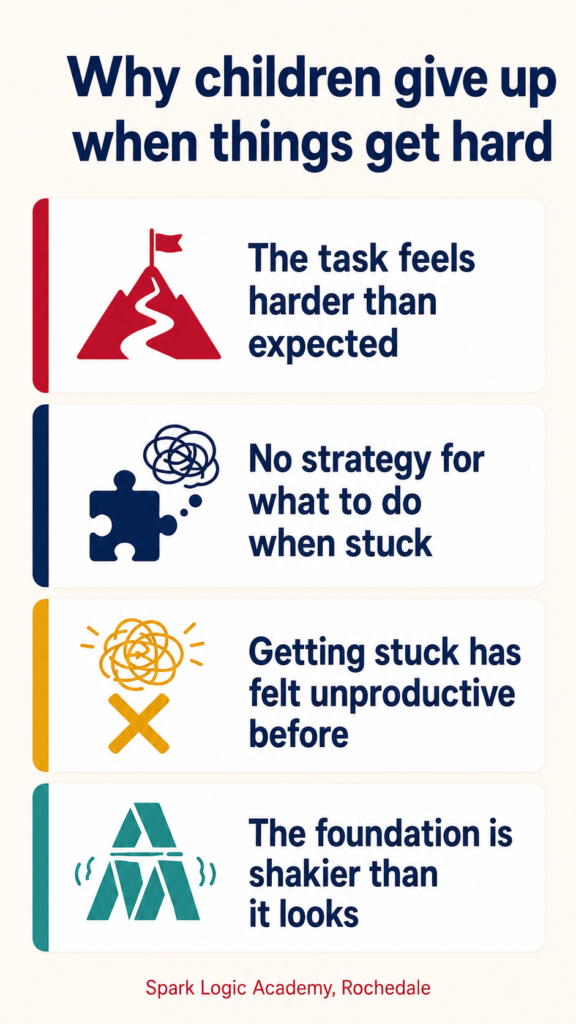
Many children have an internal expectation of how hard something is going to be before they start it. When the actual difficulty is higher than that expectation, the gap can feel disorienting rather than motivating. Instead of adjusting their effort level upward, some children shut down. The feeling of “this is harder than I thought” reads as “I cannot do this” rather than “I need to try differently.”
This is not a character flaw. It is a pattern that tends to show up when children have not yet had much experience of working through that initial discomfort and coming out the other side.
Getting stuck is an unavoidable part of learning anything. But getting stuck only feels manageable if you have something to do next. Many children who give up quickly have not yet developed a clear set of steps for what to try when their first approach does not work. Without those steps, being stuck and giving up feel like the same thing.
When you ask them why they stopped, the honest answer is often not “because I did not want to try” but “because I did not know what to try next.”
If a child has repeatedly tried to push through difficulty and found that the effort did not lead anywhere useful, giving up early starts to make a certain kind of sense. It is not laziness. It is a learned response to a pattern they have experienced before: trying hard, still not getting it, feeling worse than when they started.
Children in this situation sometimes avoid starting a task entirely because starting and failing feels worse than not starting at all.
Sometimes what looks like giving up is actually a child hitting a genuine wall. If the underlying understanding of a concept is not solid, a task that appears to be a small step up from what they know can feel impossible from where they are actually standing. They are not refusing to try. They genuinely cannot make the connection between what they know and what the task is asking for.
This is one of the more important things to investigate, because more encouragement does not help here. What helps is finding where the understanding actually sits and working forward from there.
Most children go through phases where they resist difficult work. That is fairly typical, especially at the start of a new term or when content becomes more abstract.
The pattern becomes more worth investigating when it is happening consistently across multiple subjects, when it has been going on for more than a few weeks, or when the gap between what a child can do with support and what they can do independently is growing rather than shrinking.
In those cases, a clear picture of where the understanding sits is more useful than more practice at home. It tells you what to address rather than just confirming that something needs addressing.
At Spark Logic Academy in Rochedale, our free 30-minute trial assessment is a structured conversation with a qualified teacher that maps where a child’s understanding is sitting across their core subjects. It is not a test. You can also read more in our guides on why children understand things at home but forget at school and how long homework should actually take by year level.
30 minutes. Find out where your child’s understanding actually sits. Free for every new student. Small groups. Qualified teachers. Ages 3 to 12. Rochedale, Brisbane. Term 3 places available now.
WhatsApp: 0494 719 869
Tel: 0417 226 366 | info@sparklogicacademy.com.au
11 Lorisch Way, Rochedale QLD 4123

Is my child being lazy or is something else going on?
In most cases, what looks like laziness is something more specific. A child who gives up quickly is often either missing the strategies needed to get unstuck, has a shakier foundation than the surface work reveals, or has learned from experience that pushing through difficulty does not tend to resolve. These are all addressable. “Lazy” as an explanation tends to close down investigation rather than leading anywhere useful.Should I push my child to keep trying even when they want to stop?
It depends on what is driving the giving up. If a child does not yet have a strategy for what to do when they are stuck, pushing harder does not help. If the underlying understanding is shaky, more effort in the wrong direction does not help either. What tends to help is stepping back to find the point where they can succeed, and building forward from there. The goal is persistence through the right level of challenge, not persistence through something that is currently beyond their base.How do I teach my child to keep going when things get hard?
The most practical starting point is giving them something to do when they are stuck, rather than telling them to keep going. A simple sequence helps: read the question again, try a different approach, draw the problem out, identify what part you do understand and work from there. Knowing what to try next removes the feeling that stuck means finished. Over time, children who have practised this sequence become noticeably better at working through difficulty independently.My child is fine with easy work but falls apart on harder tasks. What is going on?
This pattern often signals that the foundation underneath the harder tasks is not yet solid enough to support them. Easy work sits within what they firmly know. Harder work requires connecting to things they have partially understood or have not consolidated yet, and that gap creates the wall they keep hitting. The most useful thing is to map where the understanding actually sits so you can address the right level rather than just increasing difficulty.At what point should we get extra support?
If the pattern has been consistent for more than a few weeks, or if it is showing up across more than one subject, it is worth getting a clearer picture of where the understanding sits. Not to add pressure, but to identify what specifically needs building. A structured assessment with a qualified teacher is usually the most efficient way to find that out and decide what to do next.








Your information will never be shared with any third party