


Every child resists homework at some point. They would rather be outside, on a screen, or doing almost anything else. That kind of pushback is completely normal, and it does not usually need to become a source of concern.
But there is a different kind of homework resistance, and it looks quite different in practice. This guide explains how to tell them apart, what the more serious kind often points to, and what the most useful response looks like when you identify it.
Normal homework resistance tends to have a few recognisable features. The child complains before starting. They negotiate for more time, more snacks, or a few more minutes of something else first. They drag their feet getting to the table. Once they are there, they might complain about how long it is taking or how boring it is.
But they do it. They get through it. The work itself, once started, is manageable. The complaints are about preference and competing priorities, not about the work being impossible. When the homework is done, the distress disappears. The next session follows the same pattern, but does not seem to be getting worse over time.
This kind of resistance is annoying for parents. It can make homework time feel like a battle that no one wins. But it is not, in itself, a signal that something is wrong with the child’s understanding or foundation.
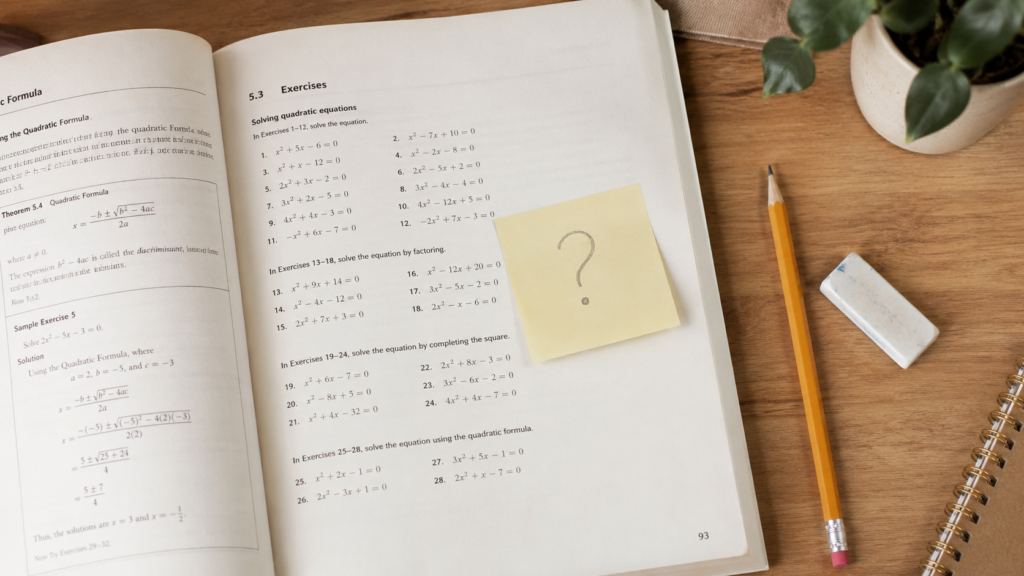
The resistance that is worth looking at more closely tends to look different in character, not just in intensity.
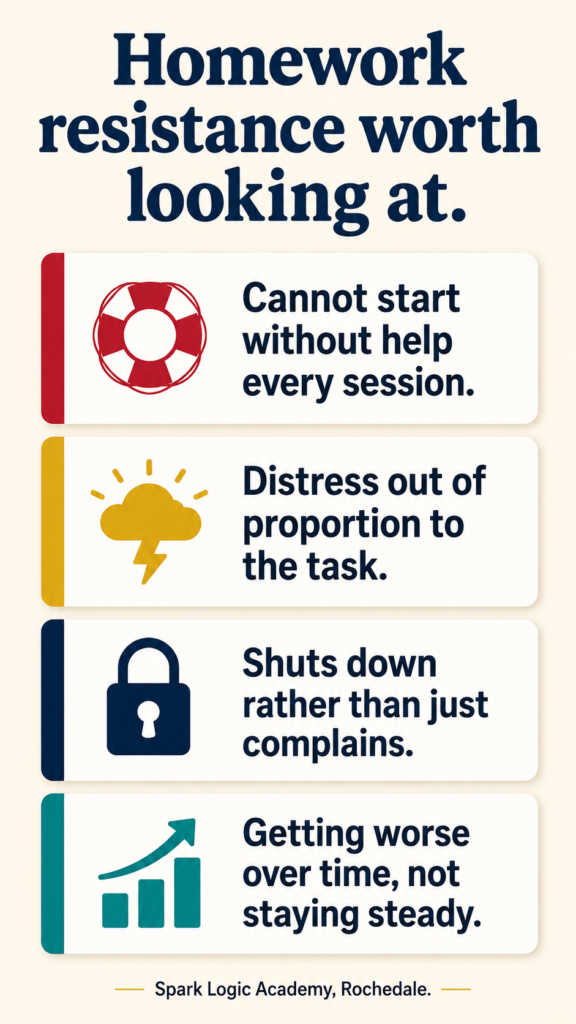
A child who occasionally needs help getting started is normal. A child who cannot look at the page and begin without a parent or sibling present to walk them into it, every single session, is showing something different. This is not preference. This is the child genuinely not being able to access the work independently. They may not be able to articulate why. They just cannot start.
A child who complains is different from a child who cries, melts down, or becomes genuinely distressed. When the emotional response to homework is significantly larger than the difficulty of the work seems to warrant, that gap is worth paying attention to. It often reflects a child who is experiencing the homework as overwhelming, not just inconvenient.
Shutting down looks different from complaining. A child who goes quiet, stares at the page without writing anything, or physically withdraws from the task is not doing the same thing as a child who is vocal about not wanting to do it. Shutdown is often the response to a child who does not know where to start because they cannot find the connection between what is on the page and what they understand.
Normal homework resistance tends to stay roughly consistent. The child always complains, and has always complained, in roughly the same way. Resistance that is escalating, that is becoming more frequent, more intense, or involving more avoidance strategies than it used to, is showing a trend that is worth investigating. Something is changing, and that change usually reflects something changing in the academic demands being placed on the child.
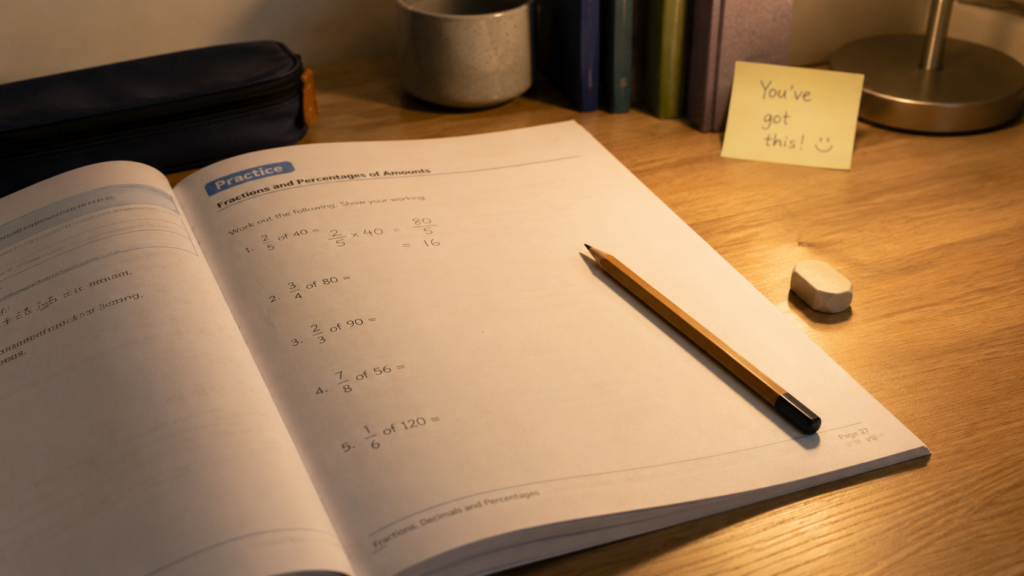
Homework is independent work. It is one of the few contexts in a child’s school life where they are expected to apply what they have learned without anyone present to fill in the blanks, prompt the next step, or help them bridge a gap in their understanding.
In a classroom, a teacher is present. A child with a gap in their understanding can often keep going: they pick up cues from the teacher’s explanations, observe what other students are doing, follow along without fully understanding, or ask questions that help them manage. The gap stays hidden or manageable.
At home, doing homework alone, none of those supports are available. If there is a gap in what the child understands, homework is often the first place it becomes fully visible, because it is the first place the child has to manage without assistance.
This is why homework resistance that follows a pattern of shutdown, distress, or inability to start often points not to the homework itself, but to something in the learning that the homework is revealing. The homework is not the cause. It is showing the problem that already exists.
The most common pattern is a concept or skill that was introduced at school and not fully understood at the time. In a classroom setting, a child can often get through a lesson without the gap becoming apparent. The worksheet is completed, the chapter is finished, and the class moves on.
When the homework for the next topic requires the previous concept, the child runs into the gap. They cannot do the work not because they are being lazy or resistant, but because the piece they need to do it is not there. From the outside, this looks like resistance. From the inside, it is the experience of not being able to find a starting point.
The same pattern appears across subjects. A child who did not fully understand a grammar concept will struggle with writing tasks that assume it. A child who has a gap in a foundational maths skill will hit a wall when a new topic builds on that skill. In both cases, the gap was present before the homework arrived. The homework just made it visible.
A parent who sits with the child, answers each question, and gets the homework done has addressed the homework. They have not addressed what the homework was revealing. The next session will follow the same pattern, because the underlying gap is still there.
This approach is understandable. It ends the distress for that evening. But it does not produce progress, and it can create a dependency on parental help that makes the gap harder to see and harder to address over time.
Removing or reducing homework can reduce the conflict at home. But it also removes one of the clearest signals that something needs attention. If homework is the context where a gap becomes visible, removing it makes the gap harder to identify and easier to miss until it shows up somewhere else, often in an assessment or at the transition to a new year level.
Motivation interventions, reward systems, consequences, incentives, can help with preference-based resistance. They do not help with resistance that is rooted in a gap. A child who cannot start because they do not know how to start does not become able to start because of a sticker chart. The sticker chart addresses the wrong problem.
When homework resistance follows the pattern described above, the most useful question is not “why won’t they do it?” but “what specifically can’t they do alone?” Sitting down and watching what happens in the first five minutes of a homework session, without intervening, can reveal a great deal about where the difficulty actually sits.
Does the child look at the page and seem genuinely blank, as if they do not know what they are being asked to do? Do they attempt the first question and immediately make a type of error that has appeared before? Do they manage the first few questions and then run into a specific type of problem and shut down? Each of these patterns points to something different.
If the homework is revealing a gap, addressing the gap at its actual location is what produces change. This almost never means doing more of the homework. It usually means going back to an earlier point in the subject, finding where the understanding is genuinely solid, and rebuilding from there.
This is a more targeted approach than general tutoring. General tutoring that covers the current year’s content will not close a gap that formed in an earlier year. Finding the specific gap and addressing it directly is what changes the experience of independent work.
When a family describes the pattern of homework resistance at Spark Logic Academy, the free 30-minute trial assessment is designed to find out what is actually behind it.
The session is one-on-one and low-pressure. The goal is not to test the child against their year level, but to understand where the understanding is solid and where it becomes uncertain. In many cases, within a single session, the specific point where the child loses their footing becomes clear. That is the starting point for the actual work.
Children who go through this process often find that the experience of working at the right level is quite different from the experience of working at a level that assumes a piece they do not have. Work that is matched to where they actually are tends to feel manageable. The resistance, the shutdown, and the distress that appeared around the gap tend to reduce as the gap is addressed.
You can also read related guides at Spark Logic Academy: why children suddenly fall behind after doing fine, the difference between a struggling child and a bored child, and what to do when your child says they are not a maths person.
30 minutes. One-on-one. Find what is behind the resistance. Every new student. Ages 3 to 12. Small groups. Qualified teachers. Rochedale, Brisbane.
WhatsApp: 0494 719 869
Tel: 0417 226 366 | info@sparklogicacademy.com.au
11 Lorisch Way, Rochedale QLD 4123
How much homework resistance is normal at primary school age?
Some resistance is normal at almost every age. Children at primary school age typically have strong preferences for play and free time, and homework competes directly with those preferences. Resistance that involves complaining, negotiating, or slow starts is common and is not in itself a cause for concern. The pattern worth paying attention to is resistance that involves genuine inability to access the work, distress that is out of proportion to the task, or a trend of escalation over weeks and months.My child does homework fine with me sitting next to them. Is that normal?
It depends on what “fine with you sitting next to them” means. If you are present but not actively helping, and the child is doing the work themselves, that kind of environmental support is not unusual for younger children and is generally fine. If you are answering questions, explaining concepts, or getting them past steps they cannot manage alone, that is a different picture. That pattern suggests the child is relying on your support to bridge a gap, rather than drawing on their own understanding. It is worth observing what happens if you deliberately step back during a session.Could it be ADHD or another learning difficulty?
It could be. But it is worth noting that a knowledge gap and a learning difficulty can look very similar in a homework context, and both can contribute to the same patterns of avoidance and resistance. The clearest distinguishing signal is whether targeted work at the right level produces progress. A child with a gap will almost always respond to well-matched work within a few weeks. A child with an underlying learning difficulty will often struggle to make the same progress regardless of the level. The free trial assessment is a practical starting point: if the child responds to work at the right level, the gap explanation is likely the primary factor. If they do not, further assessment may be worthwhile.What if my child is just lazy?
“Lazy” is a description of behaviour, not a cause. A child who appears lazy about homework is showing a pattern of avoidance. The question worth asking is what the avoidance is doing for them. Avoidance protects a child from the experience of being confronted with something they cannot do. If the work is genuinely accessible to the child, avoidance is usually about preference. If the work regularly requires something they do not have, avoidance is often the rational response to a repeated experience of being unable to succeed. Addressing the underlying gap typically changes the avoidance pattern more reliably than addressing the avoidance directly.








Your information will never be shared with any third party