


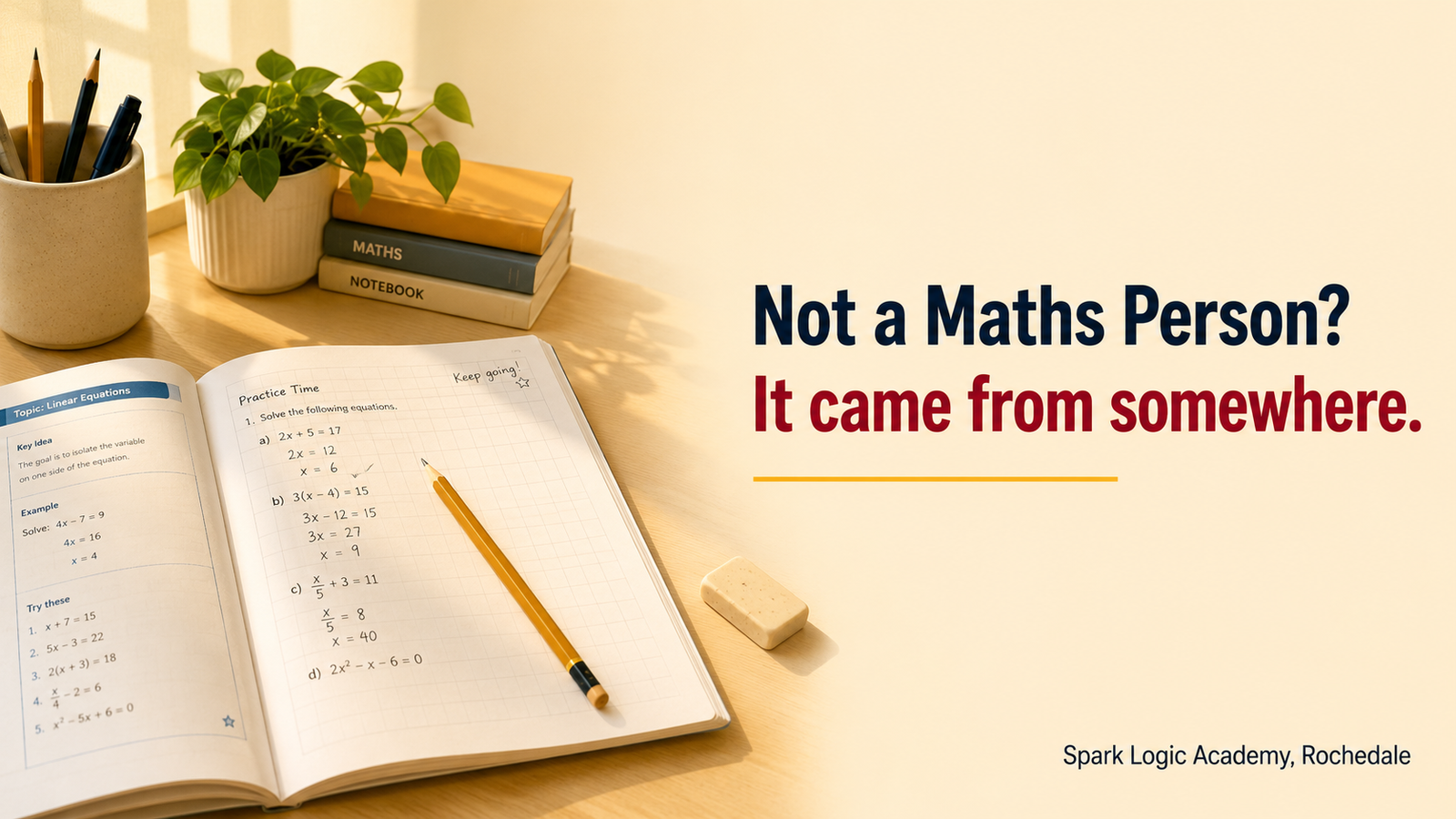
“I’m not a maths person.” If your child has said this, you probably know the feeling of not quite knowing how to respond. Arguing feels pointless. Agreeing feels wrong. And there is a sense that the belief has already settled in.
The good news is that this belief almost never reflects something fixed about a child’s ability. It is a conclusion they have reached based on something that actually happened. And because it came from somewhere specific, it can change.
This guide looks at where “I’m not a maths person” usually comes from, what tends not to help, and what does.
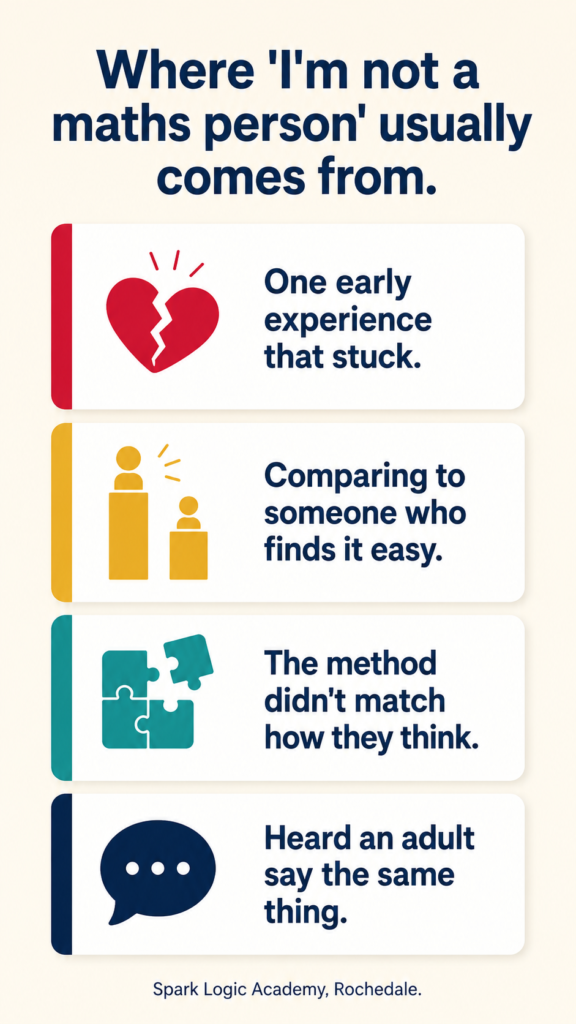
Children rarely arrive at this belief on their own. It almost always develops in response to a specific experience, a comparison, or something they heard from someone they trusted. Here are the four most common sources.
A bad test result announced in class. A question they could not answer when the teacher called on them. A worksheet sent home with red marks throughout. These experiences land harder than most adults expect, particularly when they happen in a social context where other children are watching.
The experience itself does not have to be extreme to produce a lasting effect. What matters is whether the confusion was resolved afterwards. When a child feels stuck and the moment passes without anyone finding out where the confusion started, the conclusion they draw is often about themselves rather than about the specific concept.
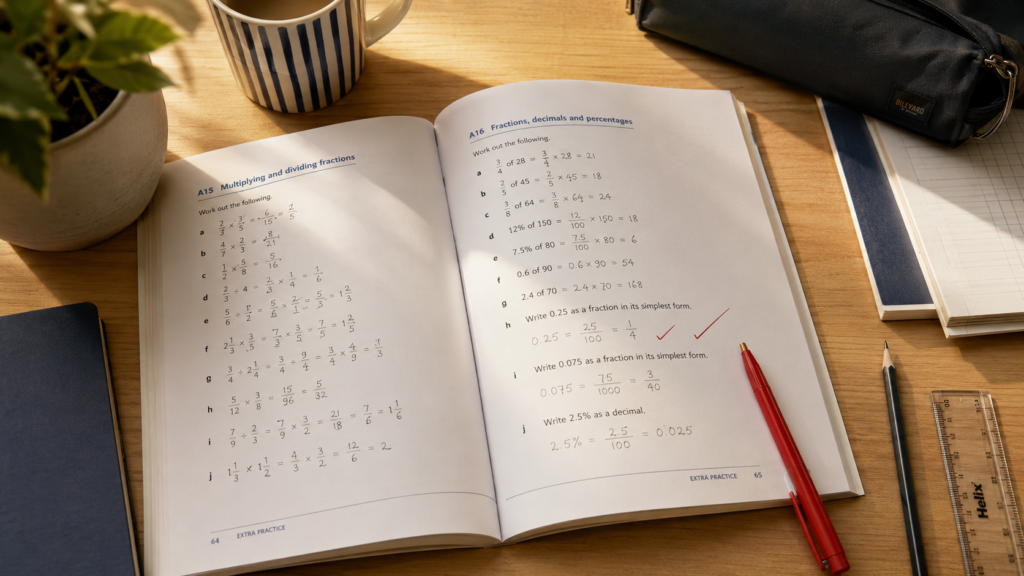
When a child watches a sibling or classmate move through maths problems with apparent ease while they themselves struggle, the interpretation is almost never “they have practised more” or “they were taught this differently.” It is almost always “I am not like them. I am not good at this.”
This comparison does not require anyone to say anything unkind. The observation itself is enough to shift how a child understands their own ability, particularly when the contrast repeats across multiple settings.
There are multiple ways to understand and work with numbers. Children who are taught in one way and who are wired to think in another will often appear to struggle with maths itself, when what is actually happening is a mismatch between the approach and the child’s natural processing style.
This is particularly common when a child moves between different schools or programs, or when a new concept is introduced in a way that assumes a particular prior knowledge that the child does not have. When effort does not produce results, children often conclude that the ability is missing rather than that the method is wrong.
“I was never good at maths either.” Most parents say this without thinking, usually to make a struggling child feel less alone. But children absorb this differently. What they often hear is: “this is something our family doesn’t do well.” It becomes part of how they understand what is possible for them.
This does not make parents responsible for their child’s maths difficulties. It is simply worth knowing that these statements carry more weight than they appear to, and that a child is more likely to update the belief when they see evidence that it was based on incorrect information.
The research on maths identity in children is consistent on a few points.
The belief that a child is not a maths person almost always has a specific origin in the content. There is a concept, or a small set of related concepts, where the understanding is incomplete. Everything built on top of that concept feels unmanageable because the foundation is not there.
Identifying this specific gap changes the problem. Instead of “my child is not good at maths,” the question becomes “my child has not yet fully understood how multiplication relates to place value”: a solvable, bounded problem rather than a statement about identity.
One of the most common reasons extra tuition fails to change the belief is that it begins at the wrong point. A child who has a gap at Year 3 level is often given Year 5 content because that is what their current school program requires. Progress feels impossible because it is impossible from that starting point.
When a child begins working at the level where their understanding is actually solid, and moves forward from there, the experience of succeeding at maths begins. That experience is what changes the identity.
The belief “I am not a maths person” is an identity. Identities do not change through single large events. They change through repeated evidence that points in a new direction. A child who experiences genuine success in maths (not performed encouragement, but real problems they solve correctly) begins to update what they understand to be true about themselves.
This is why the pace of progress matters as much as the direction. Moving too fast from one success before the child has fully absorbed it does not build confidence in the same way that working thoroughly through a concept and experiencing mastery does.
Every new student at Spark Logic Academy begins with a free 30-minute one-on-one assessment. The purpose is not to test the child. It is to find out where their understanding is solid and where the specific gaps are.
This is the information that determines the right starting point. A child does not join the group that matches their age or year level. They join the group that matches where their understanding actually sits, which is often different from what their school report suggests.
From the right starting point, with small groups of up to eight students and qualified teachers who can see what each individual child needs, the experience of maths begins to change. The belief follows the experience.
You can also read more in our related guides: why children give up when work feels too hard, why children keep forgetting what they have just learned, and why homework takes an hour with nothing to show for it.
30 minutes. Find the gap. Start there. Every new student. Ages 3 to 12. Small groups. Qualified teachers. Rochedale, Brisbane.
WhatsApp: 0494 719 869
Tel: 0417 226 366 | info@sparklogicacademy.com.au
11 Lorisch Way, Rochedale QLD 4123

Is it normal for children to say they’re not good at maths?
Very common, and it tends to peak in the middle primary school years when maths becomes more abstract and comparisons with peers become more visible. The belief itself is not unusual. What matters is whether it becomes fixed. When it is addressed early, by finding the specific gap and working from the right starting point, it tends to resolve. When it is left unaddressed, it often strengthens over time and begins to affect the subjects and pathways a child considers available to them.My child is actually quite bright. Why does this keep happening with maths?
General ability and maths confidence are often disconnected. A child who is articulate, creative, and capable in many areas can still have a specific gap in mathematical understanding that makes maths feel impossible. This is particularly common in children who are strong readers and verbal reasoners, because they often prefer to understand things conceptually before practising them. Maths teaching that leads with repetition before concept can frustrate them specifically. The gap is real, but it is usually narrow and addressable.How long does it take to change a child’s attitude toward maths?
It depends on how long the belief has been in place and how far back the gap is. In our experience at Spark Logic Academy, most children begin to feel differently about maths within four to six weeks of working at the right level, because they start experiencing genuine success rather than continued struggle. The identity shift tends to follow the evidence rather than precede it, which is why starting at the right point matters more than any motivational approach.What is Singapore Maths and why do you use it?
Singapore Maths is a curriculum approach that builds mathematical understanding through concrete objects, then pictorial representations, then abstract number work, in that order. It is the approach used in the Spark Math program at Spark Logic Academy. Children who have struggled with abstract number work often find that working back through the concrete and pictorial stages fills in the gaps that were causing the difficulty, because they understand what the numbers actually represent rather than just following a procedure they do not fully understand.Should I talk to the school as well?
Yes, and the trial assessment gives you something specific to share. Rather than a general concern that your child is struggling with maths, the assessment identifies the specific concepts where the understanding is incomplete. This gives you and the school a concrete starting point for the conversation, and it means any support from the school can be targeted rather than general. Many families find that the school and tutoring centre work well together when both know what the specific gap is.








Your information will never be shared with any third party