


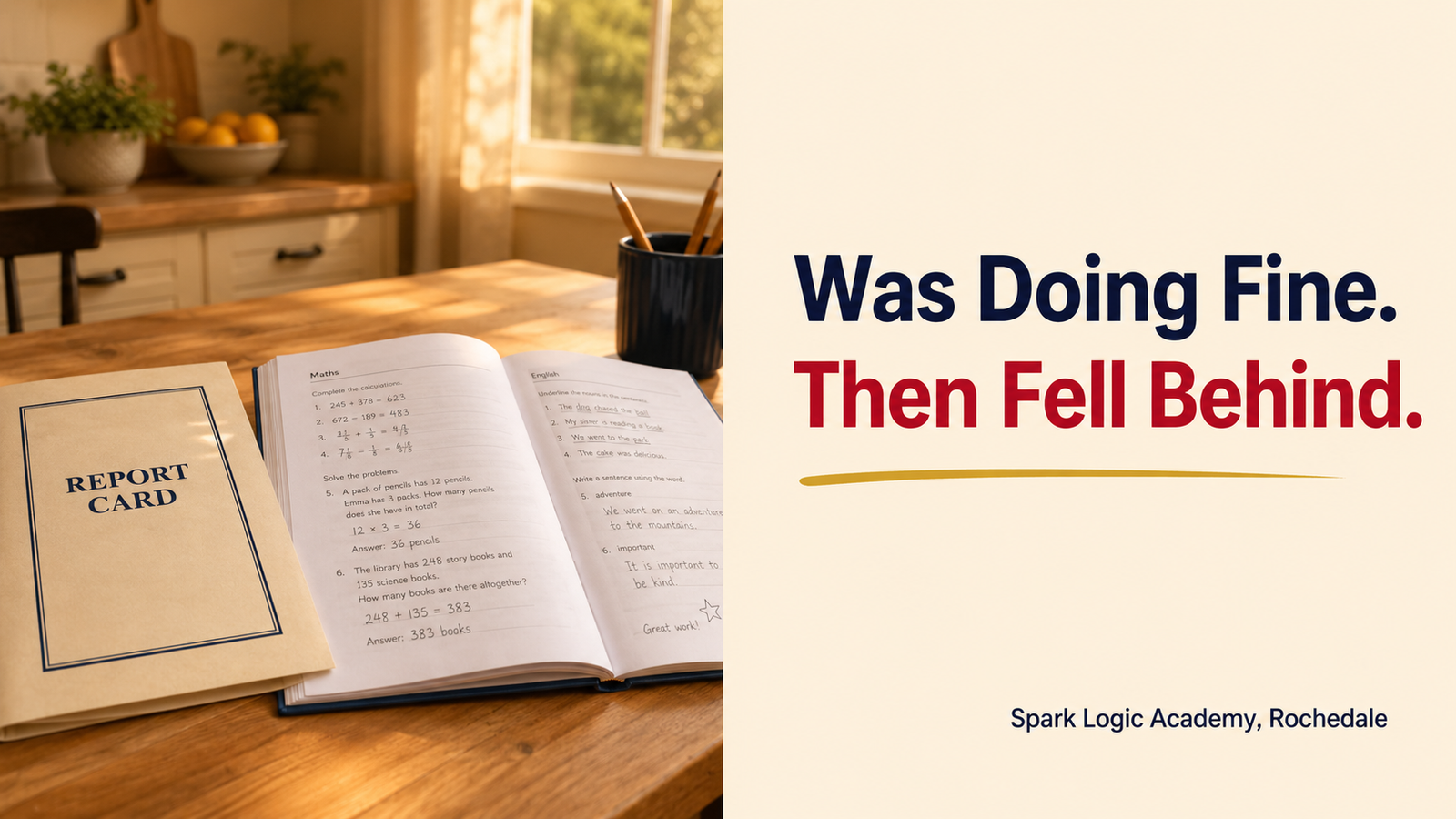
Last term, everything seemed fine. This term, nothing is making sense, and you do not know what changed. This is one of the most confusing experiences parents describe, and it almost always turns out to have a straightforward explanation.
A child does not fall suddenly behind in most cases. What looks sudden from the outside is usually a gap that formed months or even a full term earlier, quietly hidden inside grades and work that looked acceptable. This guide explains how that happens, why it is more common than most people realise, and what the most useful response looks like.
Maths and reading are not collections of separate facts. They are sequential. Each level of understanding depends on the one below it. Multiplication depends on addition. Fraction operations depend on multiplication. Reading comprehension depends on vocabulary, inference skills, and the ability to hold meaning across a paragraph, all of which develop over time.
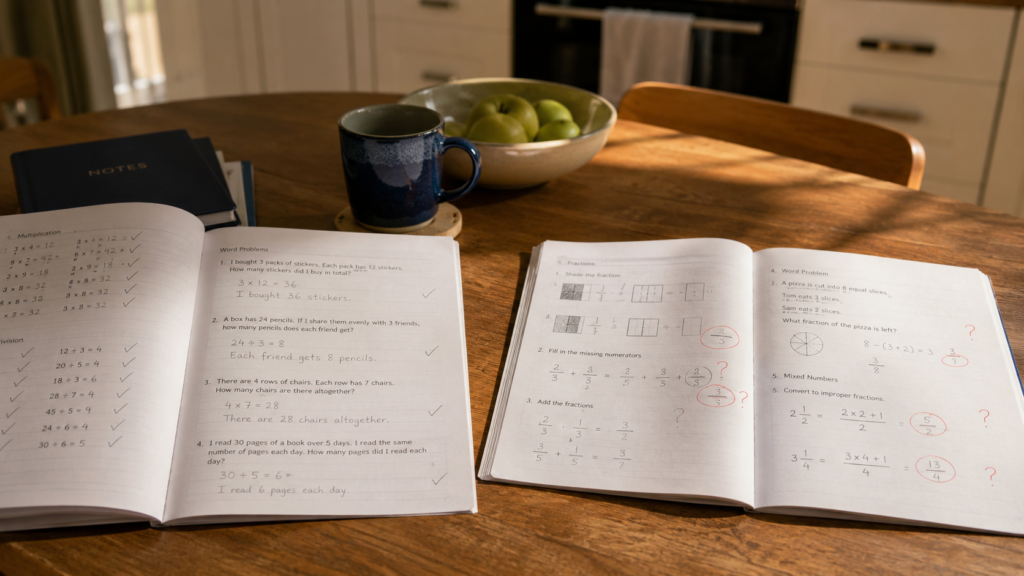
When a gap forms in a sequential subject, a child can often keep going. They may pass tests, complete worksheets, and appear to understand, because the work at that level does not yet require what is missing. The gap stays invisible because nothing has needed it yet.
At some point, the next concept does need it. When that moment arrives, the child runs into a wall. The new topic is not just a little hard. It is incomprehensible, because the foundation it requires is not there. This is when the drop becomes visible. And this is why the fall you see at report time rarely marks the moment the problem began.
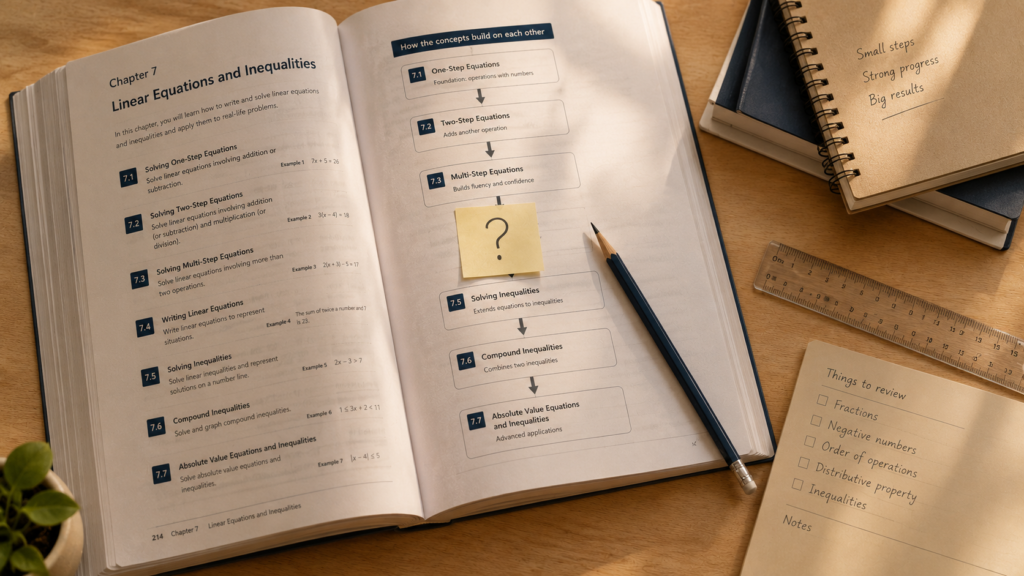
Most families can identify the moment they noticed the problem. Fewer can identify when the problem actually formed. The two moments are almost always different, and usually separated by weeks or months.
A child who develops a shaky understanding of how to handle negative numbers in one term may look fine all the way through until the algebra unit that requires fluency with negatives. At that point the shakiness becomes a barrier, and the grades reflect it. But the algebra unit did not cause the problem. It revealed it.
This distinction matters because the right response to a revealed problem is different from the right response to a new one. Drilling the algebra is not going to help if the gap is in how negative numbers work.
This surprises many parents: a child can receive acceptable grades at school while carrying a gap that will matter later. There are several reasons this happens.
School assessments test what was just taught. A child who understood most of a unit, but not all of it, may still perform well enough on the assessment to pass. The portion they did not understand may not have appeared on that particular paper. The gap goes undetected until a later topic requires it.
Children are resourceful. A child who does not fully understand one operation will often find ways to produce acceptable answers that do not require that understanding. These compensating strategies can work for a surprisingly long time, particularly in computation-heavy work. They break down when the work becomes more conceptual or when the volume of what needs to be tracked increases.
A child can follow a procedure without understanding why it works. Following a procedure reliably produces correct answers at the level where the procedure applies. It breaks down when the work requires knowing why, not just how, because the next level builds on the why rather than the how.
This is particularly common in maths, where a child who has learned a rule without the concept behind it can appear capable until the point where the rule runs out.
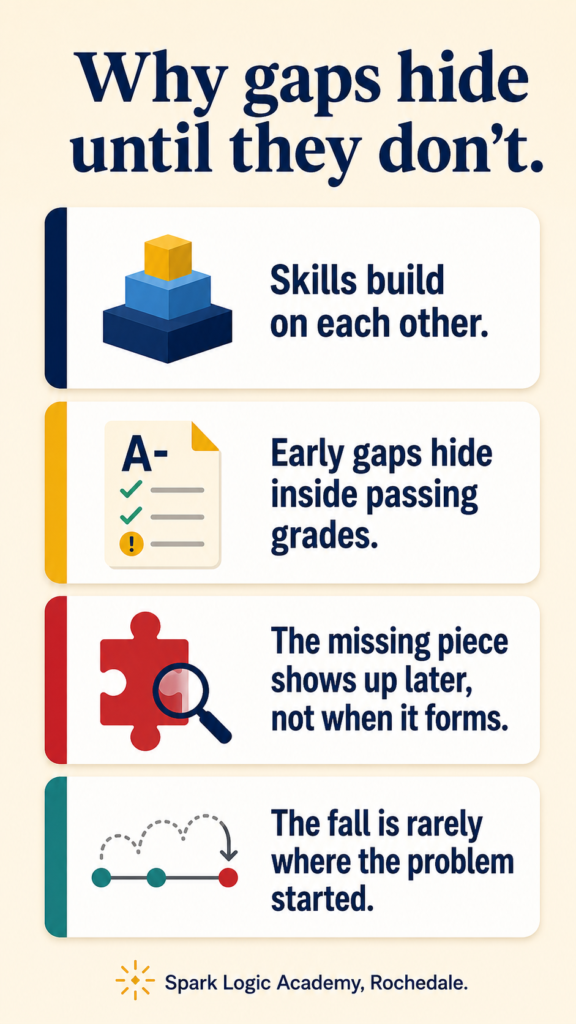
The experience of a child carrying a cumulative gap often follows a recognisable pattern. The child manages, then manages with effort, then manages with frustration, then does not manage. Each stage may be gradual enough that it does not register as a significant change until the last one arrives.
By the time a parent notices that this term looks completely different from last term, the child may have already spent weeks or months in the difficult middle stages. The sudden shift visible to the parent is the end of a much longer sequence that was largely invisible to everyone.
The most common mistake when a child has fallen behind is to try to catch them up from the point of the visible failure. If the failure showed up in algebra, the instinct is to do more algebra. But if the gap is in a foundation topic, more algebra practice makes things more confusing, not less, because the child still does not have the piece they need.
The most useful starting point is the last place the understanding was genuinely solid. This is almost never where the school curriculum is. It may be a topic from earlier in the same year, or from a previous year. Starting from that point and working forward means the child actually builds understanding rather than accumulating more confusion on top of a gap.
Gaps have specific shapes. They are rarely in a whole subject. A child who is struggling with maths is almost never struggling with all of maths equally. There is almost always a specific point, a specific concept or operation, where the understanding became shaky. Finding that specific point is more useful than a general effort to improve maths across the board.
The same applies to reading. A child who is behind in reading comprehension may have a gap in vocabulary, in decoding, in inference, in sustained reading stamina, or in some combination of these. The response to each is different. Knowing which one it is makes the work concrete rather than general.
When a child has fallen behind, the initial instinct is often to do more: more practice, more worksheets, more homework. In some cases more volume helps. In cases where a specific gap is causing the difficulty, more volume on top of the gap increases the child’s frustration without addressing the cause. Finding the gap first, then building volume from the right point, is more effective and less distressing for the child.
At Spark Logic Academy, every new student starts with a free 30-minute one-on-one assessment. When a family comes in describing a sudden drop, the assessment does not start at the level of the visible failure.
The goal is to find where the understanding is genuinely solid. This means moving back through the topic sequence until the child is working confidently, and mapping the specific point where confidence becomes uncertainty. That is the starting point for the actual work.
Children who have been confused for a period of time often experience some relief at this stage. Work that is at the right level, where the foundation is there, feels manageable rather than overwhelming. When work is manageable, the pattern of avoidance, confusion, and declining performance tends to shift relatively quickly.
You can also read related guides at Spark Logic Academy: why children give up when work feels too hard, why children rush through homework and get it all wrong, and what to do when your child says they are not a maths person.
30 minutes. Find the gap. Start from the right point. Every new student. Ages 3 to 12. Small groups. Qualified teachers. Rochedale, Brisbane.
WhatsApp: 0494 719 869
Tel: 0417 226 366 | info@sparklogicacademy.com.au
11 Lorisch Way, Rochedale QLD 4123
How far back do I need to go to find the gap?
This varies by child and subject. For some children the gap is in the current year’s work, formed a few topics back. For others, particularly in maths, the gap may be in foundational content from a year or more earlier. The most reliable approach is to move back through the topic sequence until the child is working confidently, and start the forward work from there. This is what the free trial assessment at Spark Logic Academy is designed to establish.
Will catching up take a long time?
It depends on the size and nature of the gap. In many cases, targeted work at the right level produces visible improvement within four to six weeks, because the child is no longer trying to build on something that is not there. The work that felt impossible at year level often feels straightforward once the missing foundation has been addressed. Catching up from the right starting point is faster than trying to catch up from the point of visible failure.
Should I mention this to the school as well?
In most cases, yes. The classroom teacher may have observations that are useful, and letting them know that you are addressing the issue outside school can help them support your child appropriately in class. A good tutoring programme and a good classroom teacher complement each other: tutoring fills the gap in understanding, and classroom support reinforces the new foundation as it builds.
What if my child has been behind for a long time?
Longer-term gaps are more common than most parents realise. A child who has been managing with confusion for a year or more has usually developed coping strategies that have become habits. Addressing a long-term gap takes longer than a recent one, but the process is the same: find the specific point where the understanding is solid, start from there, and build forward. Children who have been in this situation for a while often make faster progress than expected once the work is at the right level, because the confusion they have been experiencing is suddenly absent.
Could this be a sign of a learning difficulty?
A cumulative gap can look like a learning difficulty from the outside, because both produce a child who is struggling with work that their peers are managing. The clearest distinguishing factor is whether targeted work at the right level produces progress. A child with a gap will almost always respond to work at the right level within a few weeks. A child with an underlying learning difficulty will often need a different or more specialised approach. The free trial assessment is a practical starting point: if the child responds to work at the right level, the gap explanation is correct. If they do not, more specialist input may be worthwhile.








Your information will never be shared with any third party