


You mention homework when they get home from school. Nothing happens. You mention it again after their snack. Still nothing. You mention it a third time and they wander toward the desk. By the fourth reminder they are actually sitting down, and by that point you have already used up more patience than the task was ever worth.
This pattern comes up constantly in conversations with parents. And it is almost never about a child being deliberately awkward or lazy. There are usually a few specific things going on, and once you understand what they are, responding to the pattern becomes considerably easier.
These tend to be patterns rather than diagnoses. More than one can apply at the same time.
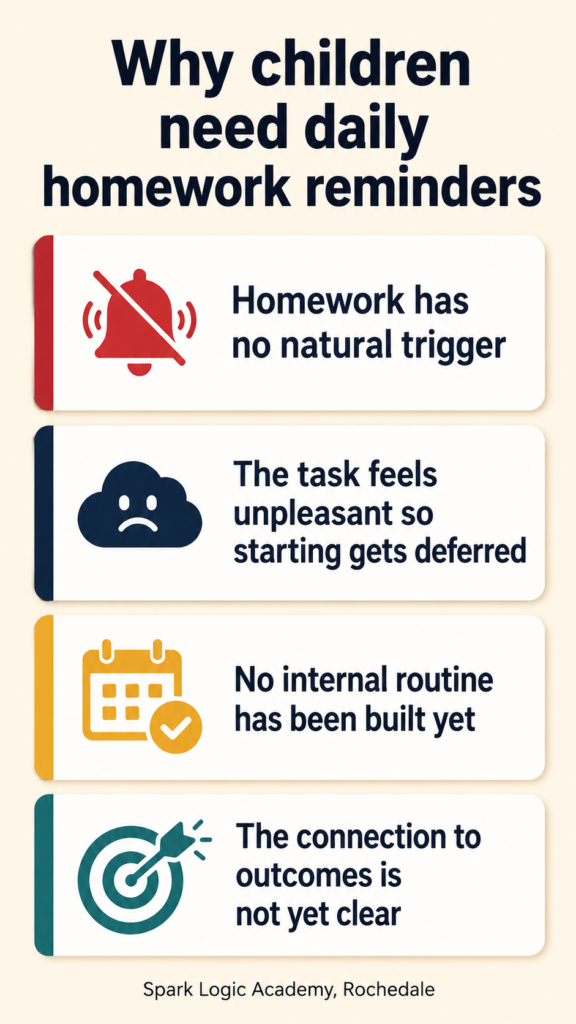
Most things children do after school happen because something prompts them. Lunch is prompted by hunger. Television is prompted by boredom. Sport has a scheduled time. Homework does not have any of these. It sits in an ambiguous zone that requires the child to independently decide to start something effortful at a time when nothing else is pushing them toward it.
For many children, especially at primary school age, that kind of self-directed initiation is genuinely difficult. It is not that they are ignoring homework. It is that without an external trigger, it simply does not occur to them to begin.
If homework is challenging, boring, or associated with negative feelings like frustration or confusion, the mind naturally moves away from it rather than toward it. This is not unique to children. Adults do the same thing with tasks they find aversive. The difference is that adults have a better-developed sense of consequence that pushes them to do things they would rather avoid. That sense develops gradually and is not fully formed at primary school age.
When the homework itself feels hard or unpleasant, reminders become the only external pressure that temporarily overrides the avoidance.

Some children develop the habit of starting homework without prompting because they have internalised it as a fixed part of their afternoon. Others have never built that habit, and without it, each afternoon is treated as a fresh decision rather than a routine. Every fresh decision requires effort and is vulnerable to competing activities. A habit, by contrast, does not require a decision at all.
Children who need daily reminders are often in the position of making a new decision every afternoon rather than following an established pattern. The reminders are doing the work that a habit would otherwise do automatically.
Adults start difficult tasks partly because they can see far enough ahead to understand why the task matters. Children’s sense of future consequence is much shorter. The argument that homework helps at school, which helps with future options, which matters for adult life, is genuinely too far away to carry motivational weight for a nine-year-old. If the immediate reason to do homework is not clear to them, the immediate reason to avoid it tends to win.
Most primary school children need some prompting for homework, particularly in the earlier year levels. Daily reminders are common and not automatically a sign that anything is wrong.
The pattern becomes more worth investigating when the resistance is extreme rather than mild, when the child becomes very distressed at homework time rather than simply reluctant, when the work itself seems to be the source of the avoidance rather than the routine, or when the pattern has not shifted despite a consistent homework anchor being in place for several weeks.
In those cases, it is often more useful to look at whether the work itself feels manageable than to focus entirely on the routine. If a child is consistently stuck or confused on homework, addressing the understanding gap will often reduce the avoidance far more effectively than any routine adjustment.
At Spark Logic Academy in Rochedale, our free 30-minute trial assessment maps where a child’s understanding is sitting across their core subjects. You can also read more in our guides on why children give up when work feels hard, how long homework should take by year level, and why children understand things at home but forget at school.
30 minutes. Find out where your child’s understanding actually sits. Free for every new student. Small groups. Qualified teachers. Ages 3 to 12. Rochedale, Brisbane. Term 3 places available now.
WhatsApp: 0494 719 869
Tel: 0417 226 366 | info@sparklogicacademy.com.au
11 Lorisch Way, Rochedale QLD 4123

Is it normal for my child to need homework reminders every day?
Very common, particularly in primary school. Many children have not yet built the internal habit of self-starting on tasks they find unpleasant or uninteresting. Daily prompting is the norm rather than the exception for many families, especially before a consistent routine has been established. If the reminders are mild and the homework gets done, this is a routine issue rather than a concerning one.
How do I get my child to do homework without being reminded?
The most reliable approach is anchoring homework to a fixed time that is treated as non-negotiable, the same as meals or bedtime. When homework happens at the same time every day without exception, it stops being a decision and becomes a routine. The reminders are currently doing the work that a habit would do automatically. Building the habit removes the need for the reminder over time.
What if my child has a fixed homework time but still refuses to start?
If the routine is in place but the resistance remains strong, the homework itself may be the source of the avoidance rather than the routine. A child who finds the work confusing or consistently gets stuck will resist starting it much more strongly than a child who finds it straightforward. In that case, it is worth investigating whether the content feels manageable, rather than focusing only on the routine.
Should I just do the homework with them to get it done?
Sitting nearby and being available to help is generally fine. Doing the homework for them is less useful, partly because it removes the practice that homework is intended to provide, and partly because it can create a pattern where the child expects to need an adult present to complete any work independently. The goal is to reduce the scaffolding gradually over time, not to increase it.
When should I consider getting extra support?
If the resistance to homework is extreme rather than mild, if your child becomes very distressed at homework time, or if the avoidance is clearly coming from the work feeling too hard rather than from the routine itself, those are signs that the underlying understanding may need attention. Extra support tends to be most useful when it addresses the specific content the child is finding difficult, rather than just adding more time on task.








Your information will never be shared with any third party