


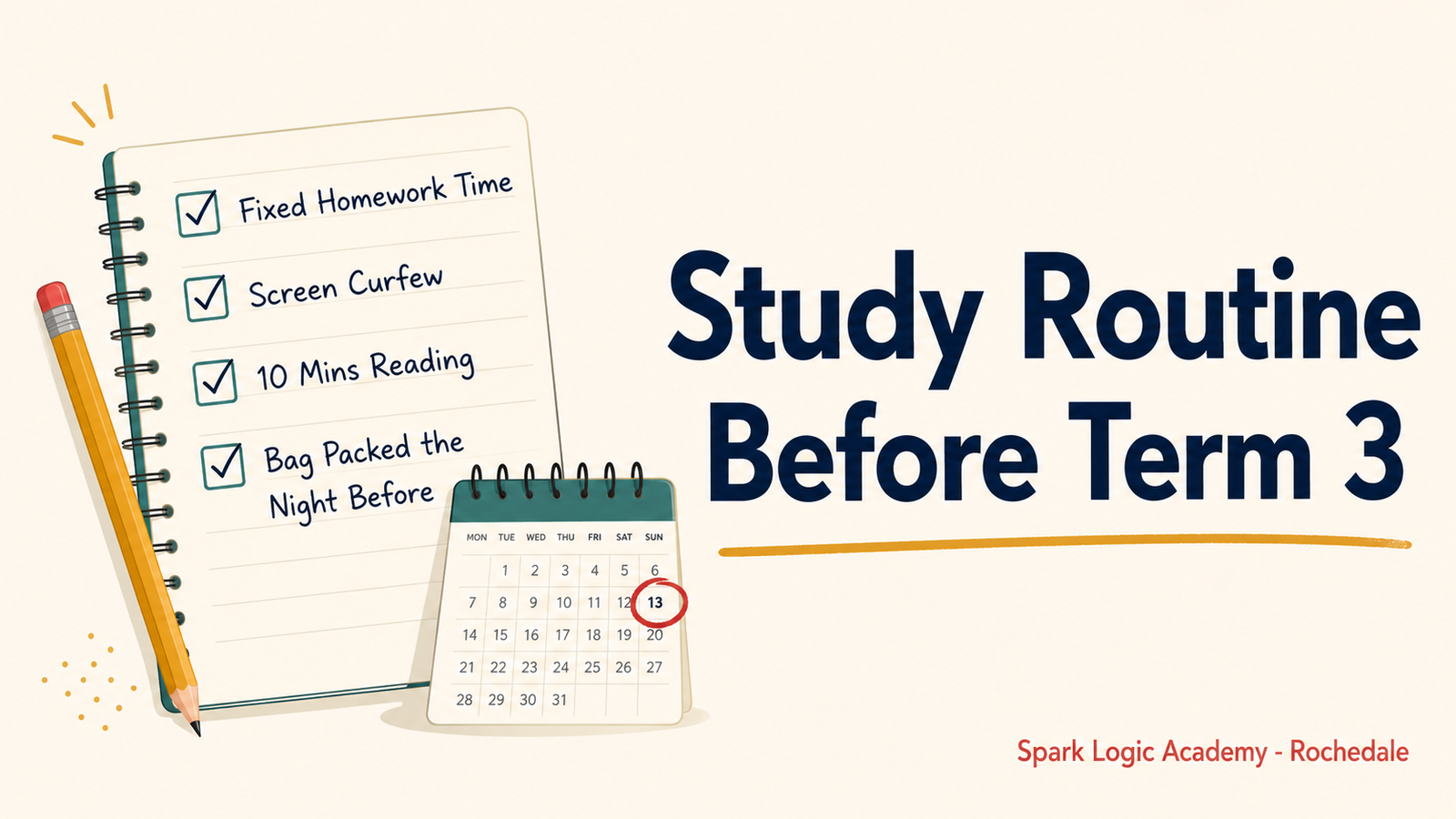
Term 3 starts Monday 13 July. If you have not set up a study routine yet, this weekend is the right time to do it.
A study routine is not about adding more pressure to a child’s afternoon. It is about removing the daily friction that makes homework feel like a battle. When the routine is in place before the term begins, Week 1 is noticeably smoother. Children know what is expected. Parents spend less energy negotiating. And the habits that support learning, steady homework time, daily reading, good sleep, are already running before the curriculum gets harder.
This article gives you four practical things to do this weekend, the science behind why they work, and what to do if the routine reveals a gap that home practice alone cannot close.
Research into children’s self-regulation consistently shows that predictable environments reduce the cognitive effort required to start tasks. When a child knows that homework always happens at a specific time, they stop spending mental energy resisting, negotiating, or thinking about when it will happen. The decision has already been made by the routine. That saved energy goes into the actual work instead.
The same principle applies to sleep. A predictable evening routine signals the brain and body to begin winding down at a consistent time. Children who follow a regular bedtime routine fall asleep faster, sleep more deeply, and wake up more alert. Given that sleep is when the brain consolidates what was learned that day, this matters directly for school performance.
Routine also reduces the emotional load on parents. The daily negotiation about homework, screens, and bedtime is one of the most consistently reported stressors in families with primary school children. A routine that is in place and understood by everyone in the household removes most of that negotiation automatically.
Choose a specific time that will work every school afternoon. For most primary school children, this is after school with a short snack break first: something like 4:00 to 4:30pm, or after dinner if the afternoon is too busy.
The key is that it is the same time every day. Not “when we get to it.” Not “after sport on Tuesday and after dinner on Wednesday.” The same time. When homework always happens at the same time, children stop treating it as negotiable. It becomes part of the afternoon the same way that cleaning teeth is part of bedtime.
For children in Prep to Year 2, fifteen to twenty minutes is sufficient. Year 3 and 4 students typically need twenty to thirty minutes. Year 5 and 6 students may need thirty to forty-five minutes, depending on what has been set.
This is the single change with the highest return for sleep quality. Light from screens, particularly the short-wavelength blue light emitted by tablets, phones and televisions, suppresses the production of melatonin, the hormone that prepares the body for sleep. Device use in the hour before bed delays sleep onset and reduces the quality of the sleep that follows.
A one-hour screen curfew before bed gives the brain time to shift into a sleep-ready state naturally. Children who follow this tend to fall asleep faster, wake up more alert, and arrive at school in a noticeably better state to learn.
Replace that final hour with reading, quiet drawing, a bath, or preparation for the next day. Expect some resistance in the first week, particularly if screens have been part of the bedtime routine for a while. Stay consistent. Most families notice a clear improvement in morning alertness within five to seven days.
If screen time has already been affecting your child’s learning, our article on how much screen time is too much explains the specific learning impacts and what to look for.
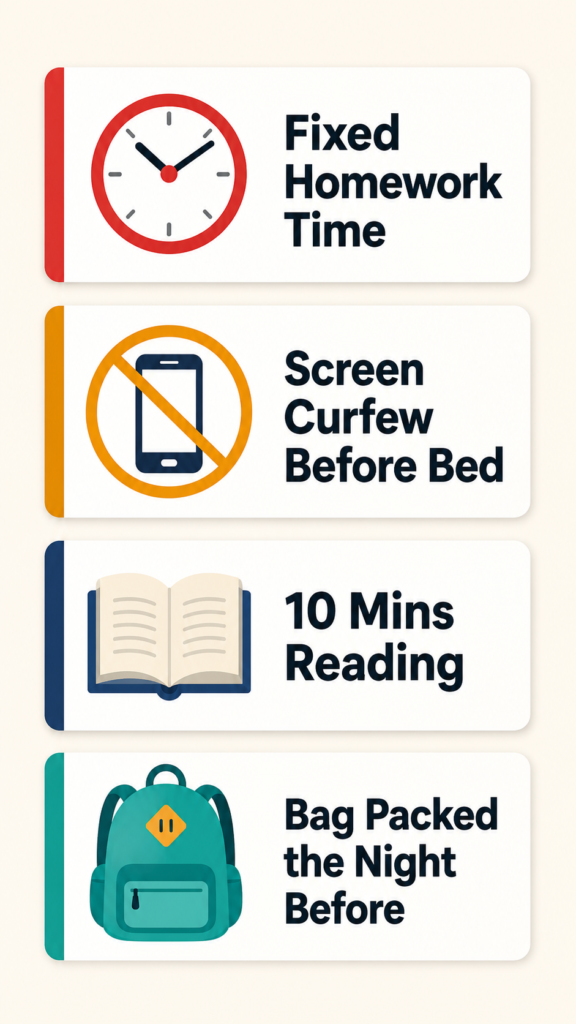
Ten minutes of reading every evening does not sound like much. But ten minutes per day across a 20-week school term adds up to more than 33 hours of reading practice per term, or over 60 hours across a full school year. That is more reading than many children currently do in a week.
Reading every day is the highest-return academic habit a parent can build at home. It builds vocabulary, comprehension, background knowledge, and the ability to sustain attention on written text. These are not just English skills. They are the foundational skills that determine how well a child can learn every subject.
For younger children in Prep to Year 2, read with them or alongside them. For older children, the habit of reading independently for ten minutes before bed is sufficient. The book does not need to be a school book. Any reading counts.
This one is simple and consistently underrated. Packing the school bag the night before removes one decision from the morning and eliminates the scramble for missing items, unsigned forms, and forgotten lunch boxes.
Morning chaos affects children’s readiness to learn. A child who leaves the house stressed, rushed, and disorganised arrives at school in a state that makes it harder to listen, focus, and engage from the first lesson. A calm, prepared morning produces the opposite: a child who arrives settled and ready.
Make bag-packing part of the evening routine, five minutes after dinner or after homework is checked. After a few weeks it becomes automatic.
A good home routine does something useful beyond building habits. It makes gaps visible.
When homework time is consistent and there is a quiet environment to work in, it becomes clear very quickly whether a child can do the work independently or not. A child who consistently struggles with the same type of question, takes much longer than expected to complete straightforward tasks, or needs constant help with content that should be manageable for their year level, is showing you something important.
A home routine can maintain skills and build habits. It cannot fill a curriculum gap. If your child is missing a foundational concept in maths, struggling with a specific aspect of reading comprehension, or working well below where the Queensland curriculum expects them to be for their year level, that gap will not close through daily homework practice alone. It needs targeted, structured support that starts from where the gap actually is.
This is also worth reading alongside our articles on the holiday learning slump and what Queensland students learn in Term 3, both of which explain how gaps develop and what they look like at different year levels.
At Spark Logic Academy in Rochedale, we work alongside the home routine, not instead of it. Our small-group programmes give children the structured, targeted support that identifies the exact gap and starts closing it directly, while the home routine builds the consistency and habits that make that support more effective.
Every new student starts with a free 30-minute trial assessment. That session tells us exactly where your child is relative to the Queensland curriculum for their year level, which specific concepts are secure and which have gaps, and what the right starting point for support looks like. From there, students join a small group of up to eight students with a qualified teacher.
Term 3 places are open now. The earlier support starts, the more of the term there is to close the gap before the assessment period begins.
Set up the routine at home. Let us handle the gap. A free 30-minute trial assessment for every new student. Small groups. Qualified teachers. Ages 3 to 12. Rochedale, Brisbane. Term 3 starts Monday 13 July.
WhatsApp: 0494 719 869
Tel: 0417 226 366 | info@sparklogicacademy.com.au
11 Lorisch Way, Rochedale QLD 4123
What is the best homework time for primary school children?
Most children do best with homework in the late afternoon, after a short snack and break from school. The exact time matters less than the consistency. Pick a time that works for your household and keep it the same every day. Prep to Year 2: 15 to 20 minutes. Year 3 to 4: 20 to 30 minutes. Year 5 to 6: 30 to 45 minutes.How long does it take for a routine to become a habit?
Research on habit formation in children suggests most routines become established within two to three weeks of consistent practice. The first week usually involves the most resistance. Staying calm and consistent through that first week is the most important thing a parent can do.Does 10 minutes of reading really make a difference?
Yes. Ten minutes per day across a 20-week term is more than 33 hours of reading practice. Across a full school year it exceeds 60 hours. Consistency matters more than duration. Daily short reading sessions build vocabulary, comprehension and reading fluency more effectively than occasional longer sessions.What if my child resists the routine?
Some resistance in the first week is normal, especially if the routine is new. Stay consistent, stay calm, and avoid making homework the subject of a negotiation. If resistance is severe and persistent, it may indicate the work itself is too difficult, which is worth investigating with a targeted assessment.When should I consider tutoring as well as a home routine?
When the routine reveals that your child consistently struggles with the same type of task, needs significant help with content that should be manageable for their year level, or is working well below Queensland curriculum expectations. A home routine builds habits. It cannot fill a foundational gap. Contact Spark Logic Academy for a free trial assessment if you are concerned about a specific gap.








Your information will never be shared with any third party