


Your child sits down to do homework. Five minutes later, they are restless, distracted or asking for a break.
Reading feels harder than it used to. Writing takes longer. Maths questions that should be manageable suddenly feel overwhelming. Bedtime becomes later, mornings become harder, and schoolwork starts to feel like a daily battle.
For many families, screen time is part of that pattern.
This does not mean all screen time is bad. Screens are now part of school, homework, communication and modern life. The real issue is usually the balance between active learning and passive screen use.
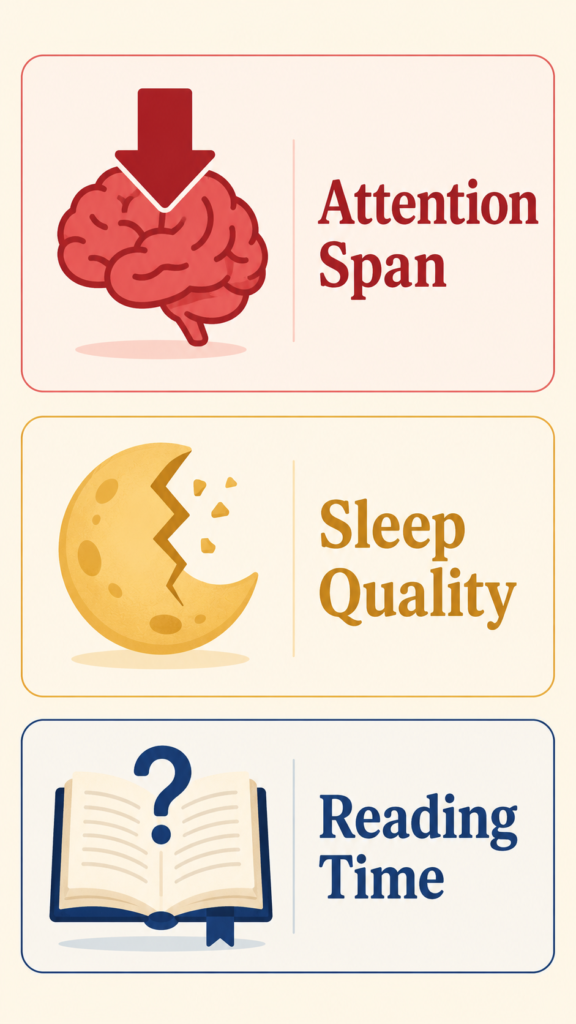
When children spend too much time watching videos, scrolling, gaming or jumping between fast-moving content, it can affect three important areas of learning: attention, sleep, and reading and writing habits.
Once parents understand what is happening, it becomes much easier to make small changes that actually help.
Australian health guidelines recommend limiting sedentary recreational screen time for children and young people.
The important phrase is recreational screen time. This means passive watching, gaming, scrolling and content-browsing. It does not include screen time needed for schoolwork or structured educational use.
The problem for many children is not that they use screens at all. The problem is that passive screen use can quietly replace the activities that build learning stamina: reading, writing, problem-solving, sleep, conversation and focused practice.
Children do not build strong learning habits by accident. They build them through repeated practice: staying with a task, thinking through a problem, reading a full page, writing a sentence, making a mistake and trying again.
Passive screen content often works in the opposite direction. It gives fast rewards, quick changes and constant stimulation. After a lot of fast-moving screen content, slower learning tasks can feel harder than they should. This can show up in schoolwork, homework and confidence.
Many modern videos, games and apps are designed to keep attention by changing quickly. There is always a new sound, movement, image or reward. Homework does not work like that.
Reading a paragraph requires slow attention. Solving a maths problem requires working memory. Writing requires planning, patience and revision. These skills need children to stay with one task even when it is not instantly exciting.
When a child is used to fast entertainment, slower learning tasks can feel boring, frustrating or unusually difficult. A task that used to take 20 minutes may now take 45 minutes. A worksheet that should feel manageable may feel exhausting.
Parents often see this as:
This is often mistaken for laziness or attitude. But if the change is recent, it may be a sign that sustained learning tasks are feeling harder than before, and that the child needs help rebuilding sustained attention.
Avoidance is one of the clearest signs that a child is struggling. They may say things like “this is boring,” “I do not want to do it,” or “can I do it later?”
Passive screen content is low-effort and high-reward. Reading and writing are high-effort and slower to reward. A child whose brain has adjusted to expect fast, easy reward will experience reading and writing as genuinely harder than before. The resistance is real, not performance.
Sometimes children avoid work because the task genuinely feels too hard. Other times, screens have made slower, effortful tasks feel less rewarding. Either way, the response should not only be more pressure. The child may need structure, routine and small wins to rebuild confidence.
If your child is avoiding specific subjects, our article on the holiday learning slump explains how gaps open up and how to close them before Term 3.
Sleep is not just rest. Sleep is when the brain organises and strengthens what was learned during the day. When children do not sleep well, learning the next day becomes harder. They may be more emotional, less patient, slower to think and more likely to forget what they have practised.
Screen use before bed makes this worse. Light from screens can suppress melatonin, the hormone involved in preparing the body for sleep. Many children use screens close to bedtime: watching videos, playing games, or messaging friends when their brain should be winding down.
This can create a pattern: bedtime becomes later, sleep quality drops, mornings become harder, attention at school falls, and homework feels more difficult. A child who is tired every morning may not simply need an earlier bedtime. They may need a screen-free evening routine.
The goal is not to remove every screen. That is usually unrealistic and unnecessary. The better goal is to shift the balance: less passive screen time, more sleep, reading, writing, problem-solving and active learning.
This is one of the highest-impact changes because sleep affects everything else. Try a family rule: no recreational screens in the final hour before bed.
Replace that hour with reading, quiet drawing, preparing school bags, conversation, puzzles or a calming bedtime routine. Children may resist at first, especially if screens have become part of their evening. Stay calm and consistent. After a week, many families notice mornings become easier.
“Less screen time” is hard for children to understand. A replacement works better. Instead of “stop using the iPad,” try: “After dinner, we will read for 15 minutes, then you can choose a puzzle, drawing or board game.”
Good replacements include reading together, short writing tasks, maths games, puzzles, Lego or construction play, drawing, cooking, outdoor play or family board games. The replacement does not need to be perfectly academic. It just needs to build patience, thinking, focus or communication.
If a child has been doing a lot of passive screen use, do not expect them to suddenly focus for one hour. Start smaller: 10 minutes of reading, 10 minutes of maths practice, 5 sentences of writing. Then gradually increase.
The aim is to help the child experience success again. Confidence grows when work feels manageable.
Some children need more than a home routine. They need a structured learning environment where someone can guide them, hold their attention and help them rebuild confidence.
This is where small-group tutoring can help. A good small-group learning environment provides a clear routine, a teacher who adjusts the pace, active participation, guided problem-solving, real-time feedback, peer learning and accountability without pressure.
For children whose attention habits have shifted, this structure can be very effective. They are not sitting alone with another worksheet. They are learning with a teacher, a small group and a clear process. That combination helps children practise focus in a more engaging way.
One reason screen time becomes powerful is that it is engaging. Learning also needs to be engaging, but in a healthier way. In a small group, a teacher can ask questions, check understanding, break tasks into steps, notice when a child is lost, encourage participation, and help the child experience small wins. This builds real learning habits.
If your child is struggling with focus, confidence, reading, writing or maths, the start of a new term is a good time to reset.
At Spark Logic Academy in Rochedale, we offer small-group learning programs for children aged 3 to 12. Our programs include:
Our approach uses visual learning, interactive resources and step-by-step teaching strategies to help children build stronger foundations and positive learning habits. A trial session helps us understand your child’s current level, confidence and the best starting point.
Concerned about your child’s focus, confidence or learning habits before Term 3? A free 30-minute trial helps us understand your child’s current level and the best starting point. Small groups. Qualified teachers. Ages 3 to 12. Rochedale.
WhatsApp: 0494 719 869
Tel: 0417 226 366 | info@sparklogicacademy.com.au
11 Lorisch Way, Rochedale QLD 4123
How much screen time is recommended for children in Australia?
For children aged 5 to 17, Australian guidelines recommend no more than two hours of sedentary recreational screen time per day, excluding screen time required for schoolwork.Does homework on a laptop count as screen time?
School-required screen use is different from recreational screen time. However, children still benefit from regular breaks, good posture, outdoor time and screen-free routines before bed.Can too much screen time affect reading?
It can, mainly because passive screen time can replace the time children might otherwise spend reading, writing, talking, playing, sleeping or practising focused learning tasks. See our article on the holiday learning slump for more on how reading gaps develop over breaks.What is the best first step for parents?
Start with a one-hour screen curfew before bed. This is a simple change that can support better sleep routines and make mornings easier within a week.Should children stop using screens completely?
Usually no. Screens are part of modern learning and life. The goal is balance: reduce passive recreational screen time and increase active learning, sleep, reading, writing and offline activities.What should I do if my child already struggles with focus?
Start small. Build short routines, reduce screens before bed and create manageable learning tasks. If the problem continues, structured support such as small-group tutoring may help rebuild learning stamina and confidence. Contact Spark Logic Academy to find out how we can help.








Your information will never be shared with any third party