

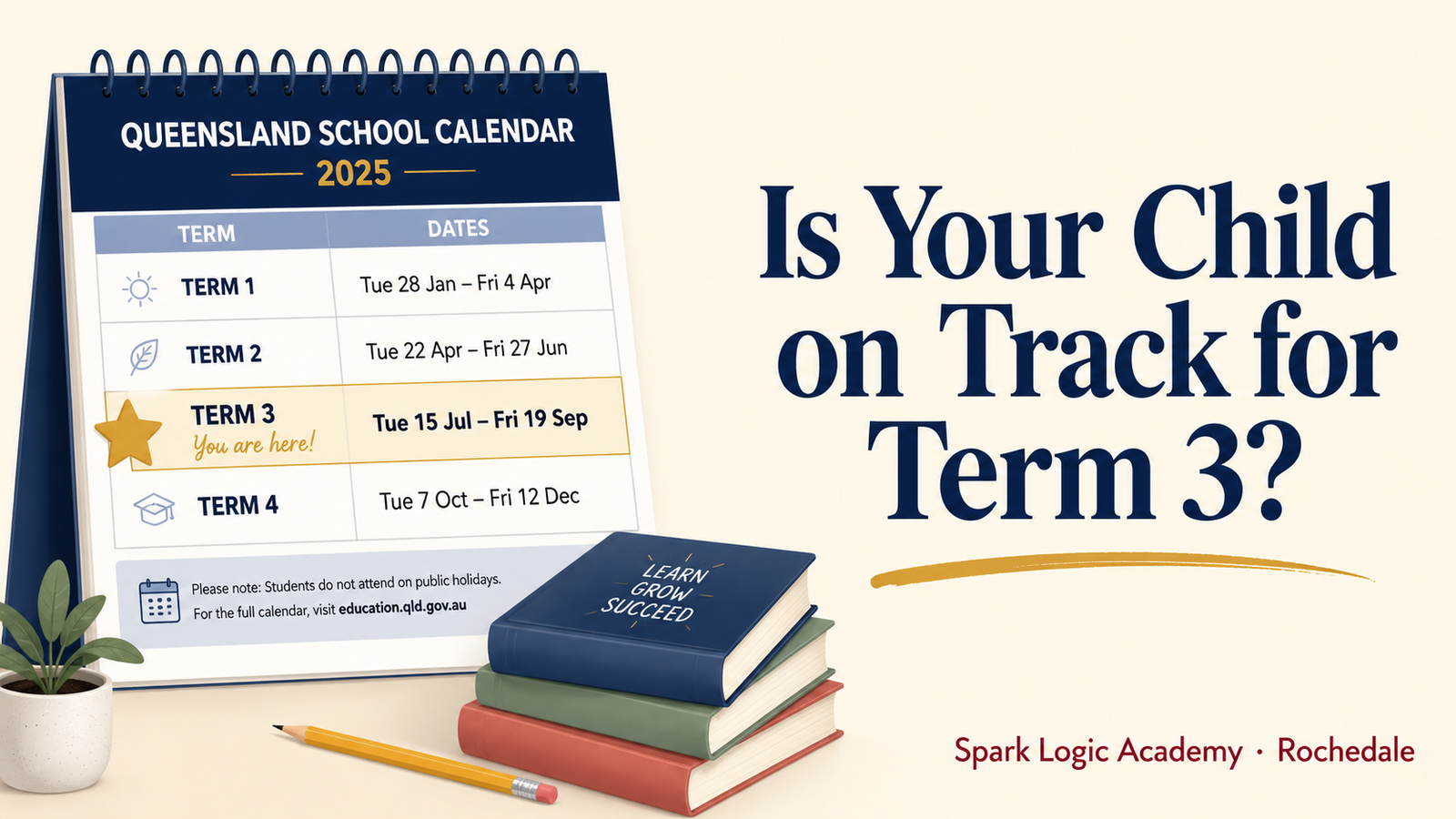
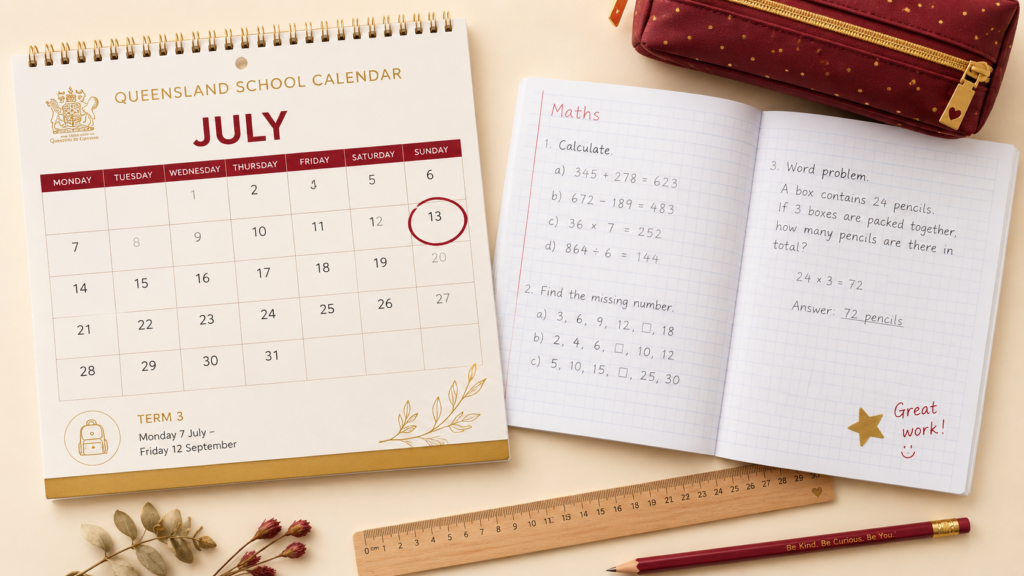
Term 3 starts Monday 13 July. It is typically the most demanding term in the Queensland school calendar, because the curriculum in Term 3 builds directly and cumulatively on what students covered in Terms 1 and 2.
For children who have gaps from earlier in the year, this matters. The pace does not slow down to wait for them. New content arrives while the older content is still unresolved, and that is when homework becomes harder, avoidance starts, and confidence begins to slip.
The good news is that early identification makes a significant difference. If you can spot a gap in Week 1, you can address it before it compounds. This article gives you a straightforward breakdown of what Queensland students in Prep to Year 6 are expected to be working on in Term 3, the signs to watch for, and what to do if you are concerned.
Queensland follows the Australian Curriculum, which is delivered across four terms. Term 3 builds on the foundational concepts introduced in Terms 1 and 2 and introduces more complex applications of those skills. The breakdown below reflects typical Term 3 content by year band.
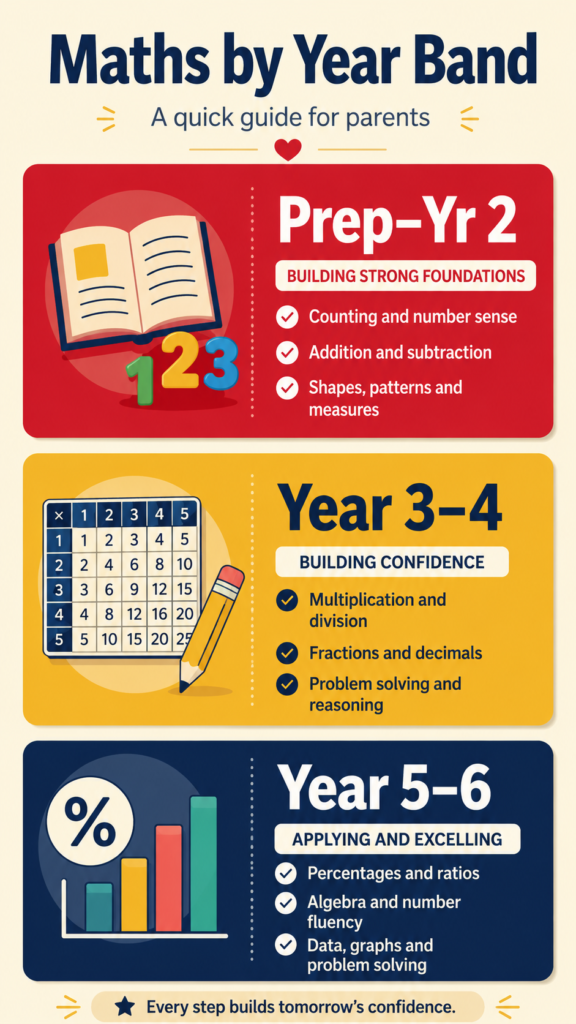
Mathematics: Children in Prep are extending their number sense to cover numbers up to 20 and beginning simple addition and subtraction. By Year 1, students are working with numbers to 100 and practising addition and subtraction strategies. Year 2 students are extending to numbers to 1000, introducing the concept of multiplication, and exploring basic fractions such as halves and quarters.
English: Phonics remains central across the Early Years band. Prep students are consolidating CVC words, blending and segmenting sounds, and building their sight word bank. Year 1 students are extending to digraphs and blends and beginning to read short texts. Year 2 students are reading longer and more complex texts, developing spelling patterns and writing in complete sentences with correct punctuation.
Signs of a gap in this band: Difficulty blending sounds they have already been taught, hesitation on multiplication or counting by 2s, 5s and 10s, or an inability to write a simple sentence independently.
Mathematics: Year 3 is when multiplication fluency becomes a major focus. Students are expected to know their times tables up to at least 5x, and Year 4 students extend to all facts up to 10×10. Fractions are introduced in Year 3 (unit fractions, halves, thirds, quarters) and extended in Year 4 to include equivalent fractions and simple addition of fractions. Measurement, time, area and data interpretation are also core components of this term.
English: Students in Years 3 and 4 are writing persuasive and informative texts. Grammar becomes explicit: students are expected to understand and use nouns, verbs, adjectives and adverbs correctly. Reading comprehension tasks become more complex, requiring students to identify main ideas, infer meaning and explain their reasoning. Vocabulary development is a key focus throughout.
Signs of a gap in this band: Inability to recall multiplication facts quickly, confusion about fractions, difficulty organising a written argument with a clear structure, or trouble identifying the main idea in a text they have read.
Mathematics: Upper primary students are working with decimals, percentages and fractions in the same term, which requires students to understand how these three representations are related. Multi-step word problems are a regular feature, requiring students to apply maths skills across more than one operation. Year 6 students are introduced to early algebraic thinking and more complex geometry.
English: Students at this level are writing extended arguments, explaining complex ideas in structured paragraphs, and using figurative language deliberately. Reading comprehension tasks involve longer and more complex texts. Research and note-taking skills are expected as students begin working independently on projects.
Signs of a gap in this band: Inability to convert between fractions, decimals and percentages, difficulty structuring a written argument across multiple paragraphs, or struggling to complete multi-step maths problems without step-by-step prompting.
Term 3 is when the cumulative nature of the curriculum becomes most visible. In mathematics particularly, each new concept assumes fluency in what came before it. A Year 4 student who did not consolidate their addition and subtraction strategies in Term 1 will find it significantly harder to learn multiplication in Term 3, because the strategies are connected.
The same is true in English. Persuasive writing in Year 3 requires a student to be able to write complete sentences fluently, which is built in Year 1 and 2. Complex comprehension tasks in Year 5 require vocabulary and reading fluency that has been built over years.
This is not a criticism of the curriculum. Cumulative learning is how deep knowledge is built. But it does mean that gaps which were manageable earlier in the year can become more difficult to work around in Term 3, and that catching a gap early in the term is considerably easier than catching it at the end.
These signs tend to appear in the first week or two of Term 3. If you see them, they are worth taking seriously.
1. They hesitate on things they knew last term. If a child could recall multiplication facts fluently in June but now pauses, counts on fingers or needs the table written out again, the holiday break has caused some regression. This is normal and reversible, but it needs to be addressed quickly before new content builds on top of it.
2. They struggle with multi-step tasks. Long division, multi-paragraph essays and word problems that involve more than one operation all require students to hold multiple pieces of information in working memory at once. This is harder when foundational steps are not automatic. A child who slows significantly on multi-step work may be missing a component skill earlier in the sequence.
3. They say school is boring or too hard. Both of these are avoidance signals, and they often mean the same thing: the content has moved ahead of where the child currently is. “Boring” often means “I do not understand what is happening and it is easier to disengage than to say I am lost.” Paying attention to the language a child uses about school is one of the fastest ways to detect a gap before it compounds.
Do not wait for a school report. School reports in Queensland typically arrive at the end of each term. By the time a Term 3 report identifies a gap, Term 4 is already underway. If you notice signs of difficulty in Week 1 or 2 of Term 3, it is worth acting then rather than waiting for confirmation that the gap is there.
Ask specific questions, not general ones. “How was school?” usually produces “fine.” Instead, ask: “What did you do in maths today?” or “Can you show me how to do that times table?” Specific questions reveal whether understanding is there or whether a child has learned to navigate around it.
Get an assessment that identifies the exact gap. Generic revision programmes that cover everything broadly are useful for maintenance. They are less useful for closing a specific gap, because they do not tell you what to focus on. A targeted assessment that identifies which specific concept or skill is missing is a far more efficient starting point.
If you are concerned about where your child is entering Term 3, our article on the holiday learning slump explains how gaps develop over school holidays and what to look for when school resumes.
At Spark Logic Academy in Rochedale, every new student begins with a free 30-minute trial assessment. That session is not a sales pitch. It is a structured assessment that identifies where your child is relative to the Queensland curriculum for their year level, which specific concepts have gaps, and what the right starting point for support looks like.
From there, students join a small group of up to eight students with a qualified teacher. Our programmes cover:
Term 3 places are available now. The earlier a gap is identified and addressed, the more time there is to close it before the Term 3 curriculum moves on to the next unit.
We find the exact gap. We build a plan. We start fixing it. A free 30-minute trial assessment for every new student. Small groups. Qualified teachers. Ages 3 to 12. Rochedale, Brisbane. Term 3 starts Monday 13 July.
WhatsApp: 0494 719 869
Tel: 0417 226 366 | info@sparklogicacademy.com.au
11 Lorisch Way, Rochedale QLD 4123

What does the Queensland curriculum cover in Term 3?
Term 3 in Queensland builds on Terms 1 and 2. Early Years students (Prep to Year 2) work on phonics, reading and foundational maths. Middle Primary students (Years 3 to 4) focus on multiplication, fractions and writing. Upper Primary students (Years 5 to 6) work with decimals, percentages and complex writing tasks.How do I know if my child is behind for their year level?
Watch for hesitation on content they knew last term, difficulty with multi-step tasks, and avoidance of subjects they previously managed. A short assessment is the most reliable way to identify the specific gap rather than guessing from behaviour alone.Is it too late to catch up if Term 3 has already started?
No. The earlier you identify and address a gap, the better, but Term 3 Week 1 to 3 is still early enough to close most gaps before the term’s major assessments. The key is identifying the specific skill or concept that is missing and targeting that directly.What year levels does Spark Logic Academy support?
Spark Logic Academy supports children from age 3 (Pre-Prep) through to Year 6 (age 12) across Maths, English, Phonics, Logic, STEM and Coding. Every new student starts with a free 30-minute trial assessment.Where is Spark Logic Academy?
We are located at 11 Lorisch Way, Rochedale QLD 4123, serving families across Rochedale, Rochedale South, Underwood, Springwood, Daisy Hill and surrounding areas. Contact us to arrange a trial or to ask about available session times.








Your information will never be shared with any third party